Tan Jianglin, Wu Jun
Institute of Burn Research, State Key Laboratory of Trauma, Burns and Combined Injuries, Chongqing Key Laboratory for Disease Proteomics, Southwest Hospital, Third Military Medical University, Chongqing, 400038 China.
Department of Burns, First Affiliated Hospital of Sun Yat-sen University, Guangzhou, 510080 China.
Burns Trauma. 2017 May 22;5:14. doi: 10.1186/s41038-017-0080-1. eCollection 2017.
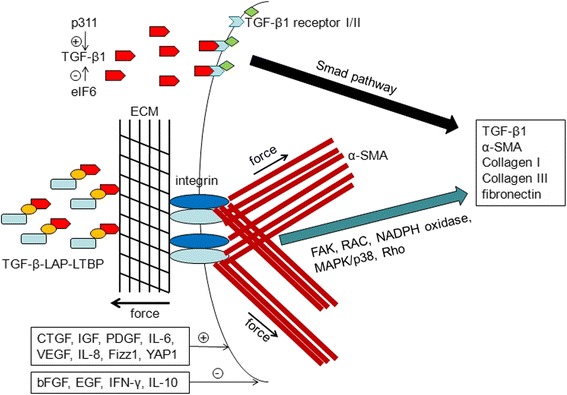
Abnormal wound healing is likely to induce scar formation, leading to dysfunction, deformity, and psychological trauma in burn patients. Despite the advancement of medical care treatment, scar contracture in burn patients remains a challenge. Myofibroblasts play a key role in scar contracture. It has been demonstrated that myofibroblasts, as well as inflammatory cells, fibroblasts, endothelial cells, and epithelial cells, secrete transforming growth factor-β1 (TGF-β1) and other cytokines, which can promote persistent myofibroblast activation via a positive regulation loop. In addition to the cellular contribution, the microenvironments, including the mechanical tension and integrin family, are also involved in scar contracture. Most recently, eukaryotic initiation factor 6 (eIF6), an upstream regulator of TGF-β1, has been demonstrated to be involved in myofibroblast differentiation and contraction in both in vitro fibroblast-populated collagen lattice (FPCL) and in vivo external mechanical stretch models. Moreover, the data showed that P311 could induce the transdifferentiation of epidermal stem cells to myofibroblasts by upregulating TGF-β1 expression, which mediated myofibroblast contraction. In this review, we briefly described the most current progress on the biological function of myofibroblasts in scar contracture and subsequently summarized the molecular events that initiated contracture. This would help us better understand the molecular basis of scar contracture as well as to find a comprehensive strategy for preventing/managing scar contracture.
伤口愈合异常可能会导致瘢痕形成,进而引起烧伤患者功能障碍、畸形和心理创伤。尽管医疗护理有所进步,但烧伤患者的瘢痕挛缩仍然是一个挑战。肌成纤维细胞在瘢痕挛缩中起关键作用。已经证明,肌成纤维细胞以及炎症细胞、成纤维细胞、内皮细胞和上皮细胞会分泌转化生长因子-β1(TGF-β1)和其他细胞因子,这些因子可通过正调节环促进肌成纤维细胞的持续活化。除了细胞方面的作用外,包括机械张力和整合素家族在内的微环境也参与瘢痕挛缩过程。最近,真核起始因子6(eIF6)作为TGF-β1的上游调节因子,已被证明在体外成纤维细胞填充胶原晶格(FPCL)和体内外部机械拉伸模型中均参与肌成纤维细胞的分化和收缩。此外,数据表明P311可通过上调TGF-β1表达诱导表皮干细胞向肌成纤维细胞转分化,从而介导肌成纤维细胞收缩。在本综述中,我们简要描述了肌成纤维细胞在瘢痕挛缩生物学功能方面的最新进展,随后总结了引发挛缩的分子事件。这将有助于我们更好地理解瘢痕挛缩的分子基础,并找到预防/处理瘢痕挛缩的综合策略。