Institute of Anatomy II, Medical Faculty, Heinrich-Heine-University, Moorenstrasse 5, 40225, Düsseldorf, Germany.
Institute of Pathology, University of Duisburg-Essen, University Hospital Essen, Hufelandstrasse 55, 45147, Essen, Germany.
Cell Tissue Res. 2017 Sep;369(3):579-590. doi: 10.1007/s00441-017-2634-8. Epub 2017 May 26.
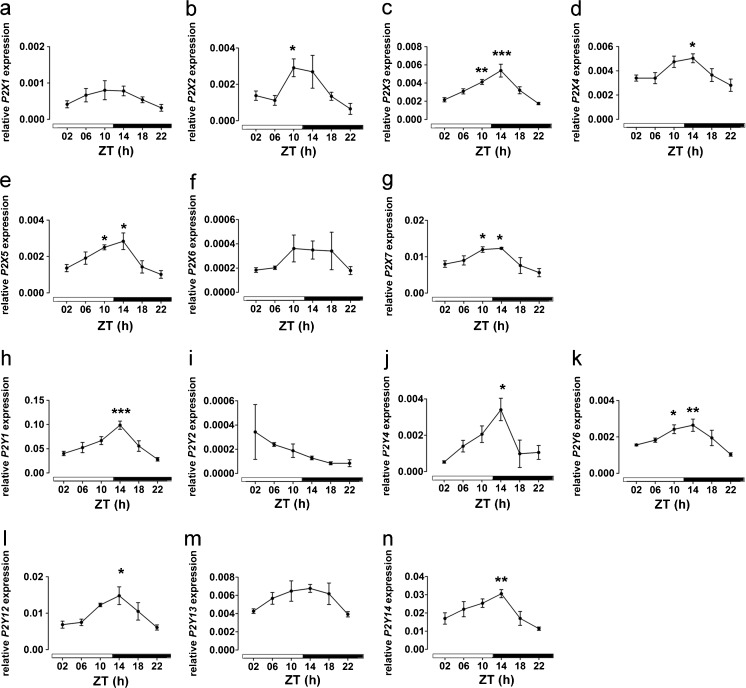
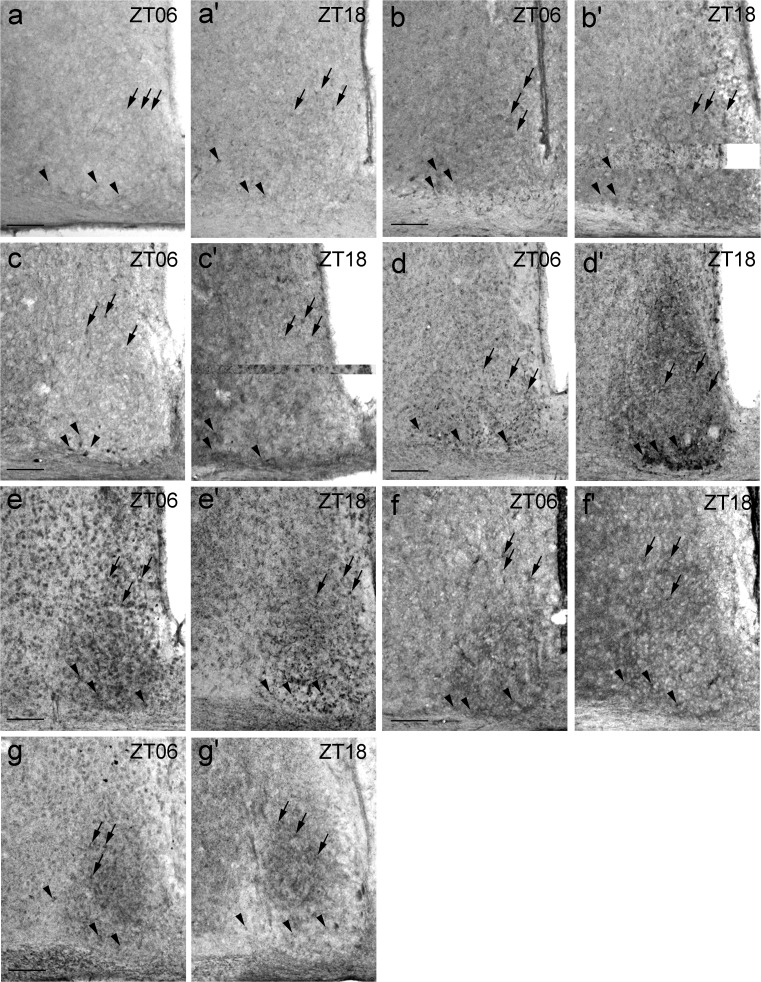
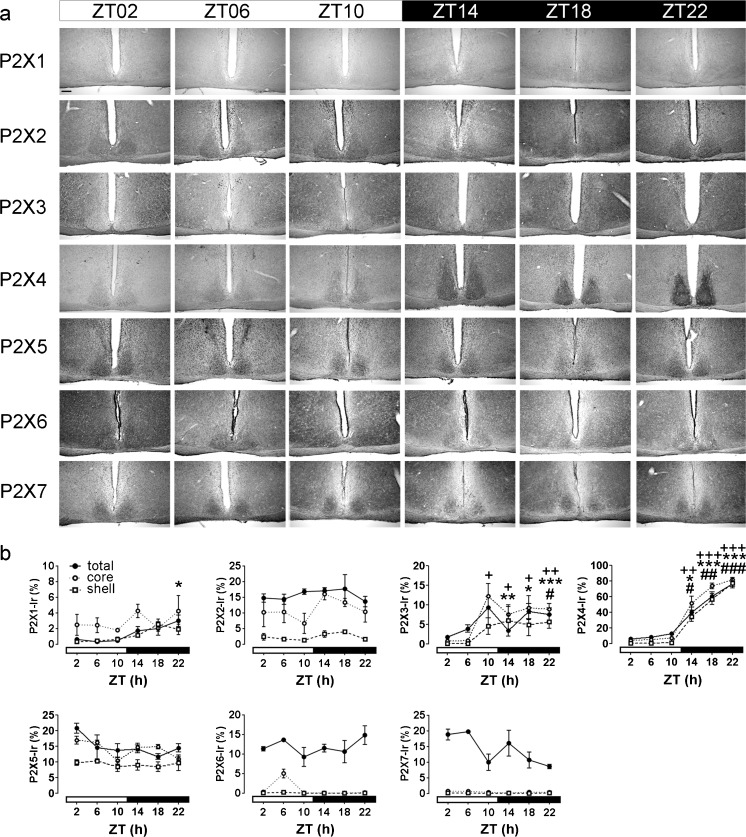
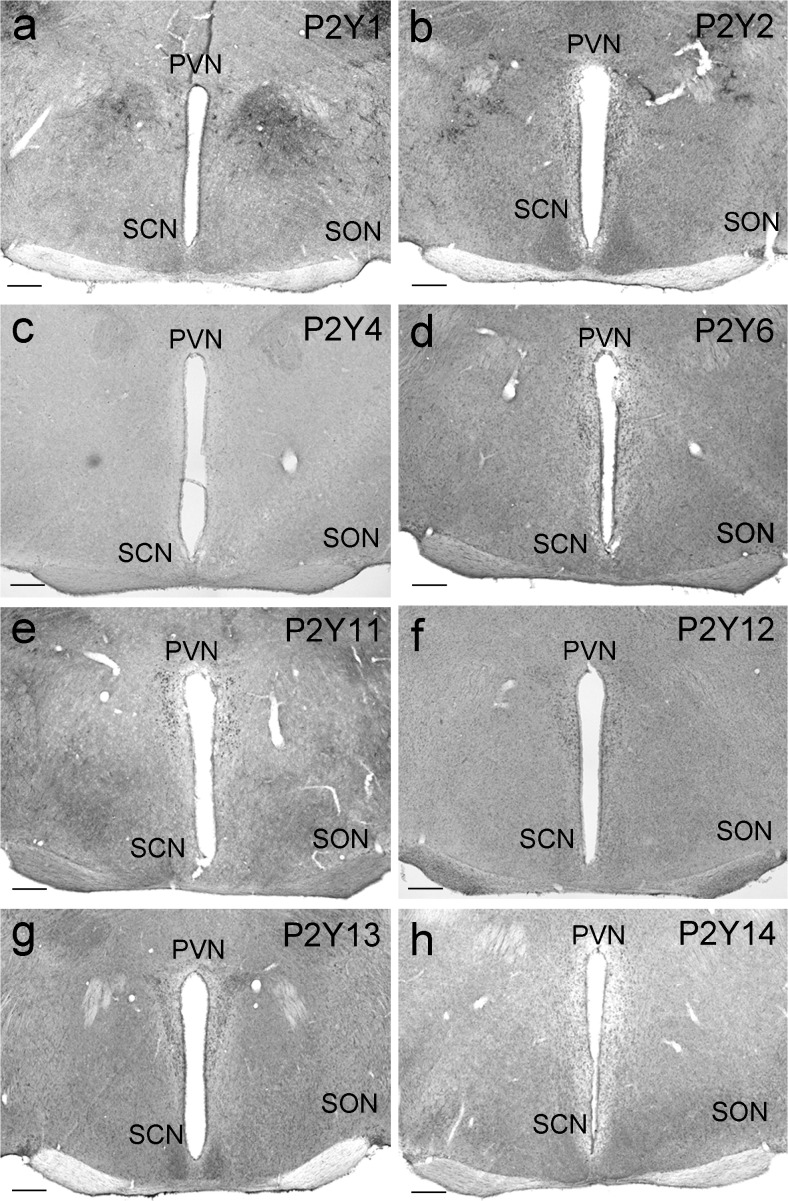
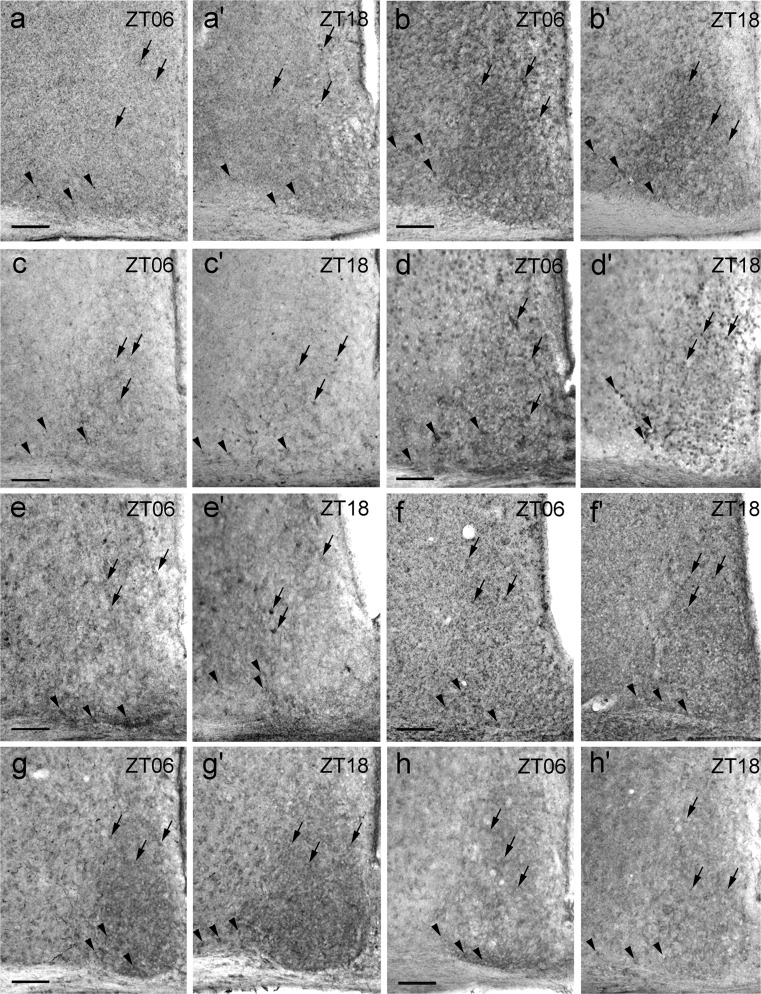
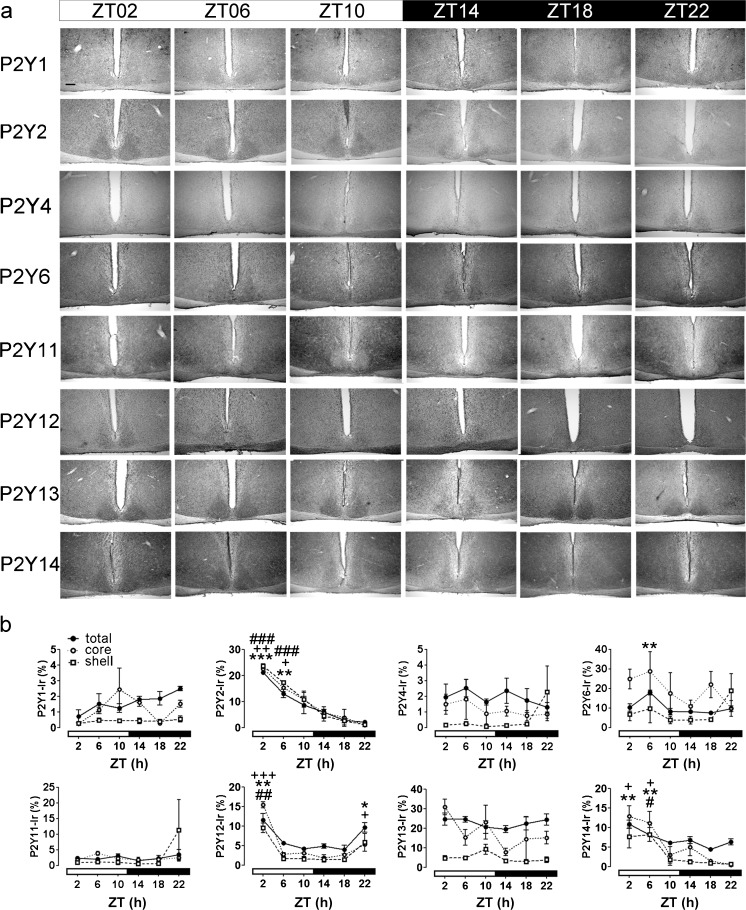
Purinergic P2X and P2Y receptors are involved in mediating intercellular signalling via purines such as adenosine triphosphate (ATP). P2X and P2Y receptors have been implicated in numerous body functions including learning, memory and sleep. All of these body functions show time-of-day-dependent variations controlled by the master circadian oscillator located in the suprachiasmatic nucleus (SCN). Evidence exists for a role of purinergic signalling in intercellular coupling within SCN. However, few studies have been performed on the expression of purinergic receptors in SCN. Therefore, we analyse the expression of seven P2X (P2X1-7) and eight P2Y (P2Y1-2, 4, 6, 11-14) receptors in mouse SCN and address their time-of-day-dependent variation by using immunohistochemistry and real-time polymerase chain reaction. At the early light phase, P2X and P2Y receptors show a low to moderate, homogenously distributed immunoreaction throughout SCN. P2Y13 reveals strong immunoreaction in fibres within the core region of SCN. From the fifteen analysed P2 receptors, seven exhibit a time-of-day-dependent variation in SCN. P2X1 immunoreaction is very low in the early light phase with a minor increase at the end of the dark phase. P2X4 immunoreaction strongly increases during the dark phase in soma cells in the core region and in a dense network of fibres in the shell region of SCN. P2X3 immunoreaction is moderately elevated during the dark phase. Conversely, immunoreaction for P2Y2, P2Y12 and P2Y14 moderately increases at the early light phase and P2Y6 immunoreaction displays a moderate increase at the mid-light phase. Thus, this study demonstrates a time-of-day-dependent variation of P2 receptors in mouse SCN.
嘌呤能 P2X 和 P2Y 受体通过嘌呤(如三磷酸腺苷 (ATP))参与细胞间信号转导。P2X 和 P2Y 受体参与许多身体功能,包括学习、记忆和睡眠。所有这些身体功能都表现出由位于视交叉上核 (SCN) 的主生物钟振荡器控制的昼夜变化。有证据表明嘌呤能信号在 SCN 细胞间偶联中起作用。然而,关于 SCN 中嘌呤能受体的表达的研究很少。因此,我们通过免疫组织化学和实时聚合酶链反应分析了七种 P2X(P2X1-7)和八种 P2Y(P2Y1-2、4、6、11-14)受体在小鼠 SCN 中的表达,并研究了它们的昼夜变化。在早期光照阶段,P2X 和 P2Y 受体在整个 SCN 中表现出低到中等强度的均匀分布免疫反应。P2Y13 在 SCN 核心区域的纤维中显示出强烈的免疫反应。在十五种分析的 P2 受体中,有七种在 SCN 中表现出昼夜变化。P2X1 免疫反应在早期光照阶段非常低,在暗期结束时略有增加。P2X4 免疫反应在核心区域的体细胞和 SCN 壳区的密集纤维网络中在暗期强烈增加。P2X3 免疫反应在暗期适度升高。相反,P2Y2、P2Y12 和 P2Y14 的免疫反应在早期光照阶段适度增加,P2Y6 的免疫反应在中光照阶段适度增加。因此,本研究表明小鼠 SCN 中 P2 受体存在昼夜变化。