Pavlopoulou Ioanna D, Tanaka Marsela, Dikalioti Stavroula, Samoli Evangelia, Nisianakis Pavlos, Boleti Olga D, Tsoumakas Konstantinos
Faculty of Nursing, Paediatric Clinic, P. & A. Kyriakou" Children's Hospital, National and Kapodistrian University of Athens, 123 Papadiamantopoulou str, 11527, Athens, Greece.
Faculty of Nursing, Postgraduate Program, National and Kapodistrian University of Athens, 123 Papadiamantopoulou str, 11527, Athens, Greece.
BMC Pediatr. 2017 May 26;17(1):132. doi: 10.1186/s12887-017-0888-7.
Migrant children are a population at risk for various health problems. Despite the increased inflow of migrants in Greece, data regarding their health assessment are lacking. This study aims to describe the clinical and certain laboratory characteristics and identify possible associations in a group of new immigrant (I) and refugee (R) children, arriving in Athens, Greece.
A prospective, cross- sectional study was performed in a migrant outpatient clinic of a tertiary Children's hospital. All immigrant and refugee children, examined to obtain a health certificate, within 3 months of their arrival in the country, were enrolled. Clinical and laboratory information was collected in a pre- designed form. We applied multiple logistic regression models to investigate the association between the child's status (immigrant vs refugee) and health indicators controlling for possible confounding effects, mainly of age and area of origin.
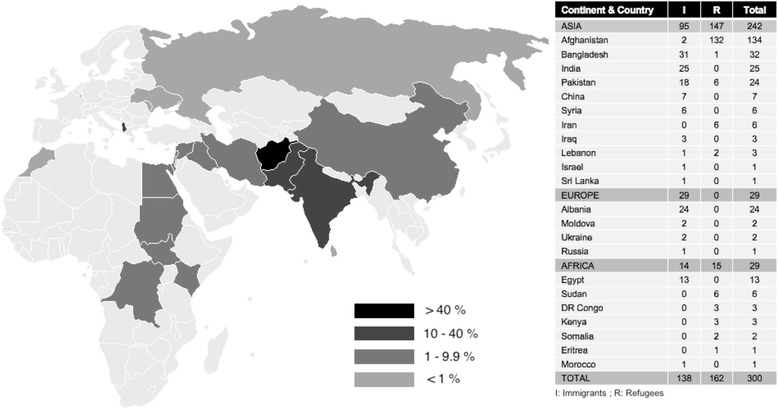
From 2010 to 2013, a total of 300 children (I/R:138/162) with a mean age of 7.08 (range 1-14) years were included. Overall, 79.3% presented unknown vaccination status, 21.3% dental and 7.3% additional clinical problems. Latent tuberculosis was identified in 2.7%, while anemia, low serum ferritin and eosinophilia were found in 13.7%, 17.3%, and 22.7% of subjects, respectively. 57.7% had protective antibodies to hepatitis B surface antigen (anti-HBs ≥ 10 IU/L) and 30.6% elevated blood lead levels (EBLLs). Immigrants had less likely unknown immunization (OR = 0.25, p < 0.001), but had increased odds of low ferritin (OR = 1.97, p = 0.043), EBLLs (OR = 2.97, p = 0.001) and protective anti-HBs (OR = 1.79, p = 0.03). Age was inversely associated with anemia (OR = 0.0.89, p = 0.017), low ferritin (OR = 0.91, p = 0.027), EBLLs (OR = 0.86, p = 0.001) or positive anti-HBs (OR = 0.92, p = 0.025). Children from Europe or Africa presented decreased probability of EBLLs (OR = 0.31, p = 0.001, and OR = 0.15, p = 0.005, respectively) compared to those from Asia.
New immigrant and refugee children presented distinct clinical problems and certain laboratory abnormalities. Some of these health issues differed according to their migration status, age and geographic area of origin. These findings provide evidence that may assist the optimal approach of this vulnerable population.
流动儿童是面临各种健康问题风险的人群。尽管希腊的移民流入有所增加,但缺乏有关他们健康评估的数据。本研究旨在描述一组抵达希腊雅典的新移民(I)和难民(R)儿童的临床和某些实验室特征,并确定可能的关联。
在一家三级儿童医院的移民门诊进行了一项前瞻性横断面研究。纳入所有在抵达该国3个月内前来检查以获取健康证明的移民和难民儿童。以预先设计的表格收集临床和实验室信息。我们应用多元逻辑回归模型来研究儿童身份(移民与难民)与健康指标之间的关联,并控制可能的混杂效应,主要是年龄和原籍地区。
2010年至2013年,共纳入300名儿童(I/R:138/162),平均年龄7.08岁(范围1 - 14岁)。总体而言,79.3%的儿童疫苗接种状况不明,21.3%有牙科问题,7.3%有其他临床问题。2.7%的儿童被诊断为潜伏性结核病,而分别有13.7%、17.3%和22.7%的儿童存在贫血症、血清铁蛋白水平低和嗜酸性粒细胞增多。57.7%的儿童对乙型肝炎表面抗原具有保护性抗体(抗 - HBs≥10 IU/L),30.6%的儿童血铅水平升高(EBLLs)。移民儿童疫苗接种状况不明的可能性较小(OR = 0.25,p < 0.001),但血清铁蛋白水平低(OR = 1.97,p = 0.043)、血铅水平升高(OR = 2.97,p = 0.001)和具有保护性抗 - HBs(OR = 1.79,p = 0.03)的几率增加。年龄与贫血症(OR = 0.89,p = 0.017)、血清铁蛋白水平低(OR = 0.91,p = 0.027)、血铅水平升高(OR = 0.86,p = 0.001)或抗 - HBs阳性(OR = 0.92,p = 0.025)呈负相关。与来自亚洲的儿童相比,来自欧洲或非洲的儿童血铅水平升高的可能性降低(分别为OR = 0.31,p = 0.001和OR = 0.15,p = 0.005)。
新移民和难民儿童存在不同的临床问题和某些实验室异常。其中一些健康问题因移民身份、年龄和原籍地理区域而异。这些发现提供了可能有助于对这一弱势群体采取最佳应对措施的证据。