Parola Nathalie, Zendjidjian Xavier Yves, Alessandrini Marine, Baumstarck Karine, Loundou Anderson, Fond Guillaume, Berna Fabrice, Lançon Christophe, Auquier Pascal, Boyer Laurent
Public Health, Chronic Diseases and Quality of Life - Research Unit EA 3279, Aix-Marseille University, Marseille.
Department of Psychiatry, Sainte-Marguerite University Hospital, Marseille.
Patient Prefer Adherence. 2017 May 12;11:929-937. doi: 10.2147/PPA.S125730. eCollection 2017.
The Ruminative Response Scale (RRS)-short form is one of the most widely used measures of rumination, comprising ten items and two components: reflection and brooding. The aim of this study was to investigate RRS validity and reliability in a clinical sample of French patients with major depressive disorder (MDD).
Outpatients with a DSM-IV-TR diagnosis of MDD were recruited from a public academic hospital in France. Depressive symptoms were evaluated by the Beck Depression Inventory, anxiety by the State-Trait Anxiety Inventory - state scale, and quality of life by the 36-Item Short Form Health Survey (SF-36) questionnaire. Confirmatory factor analyses, item-dimension correlations, Cronbach's -coefficients, Rasch statistics, and external validity were tested. Differential item functioning analyses were performed for sex.
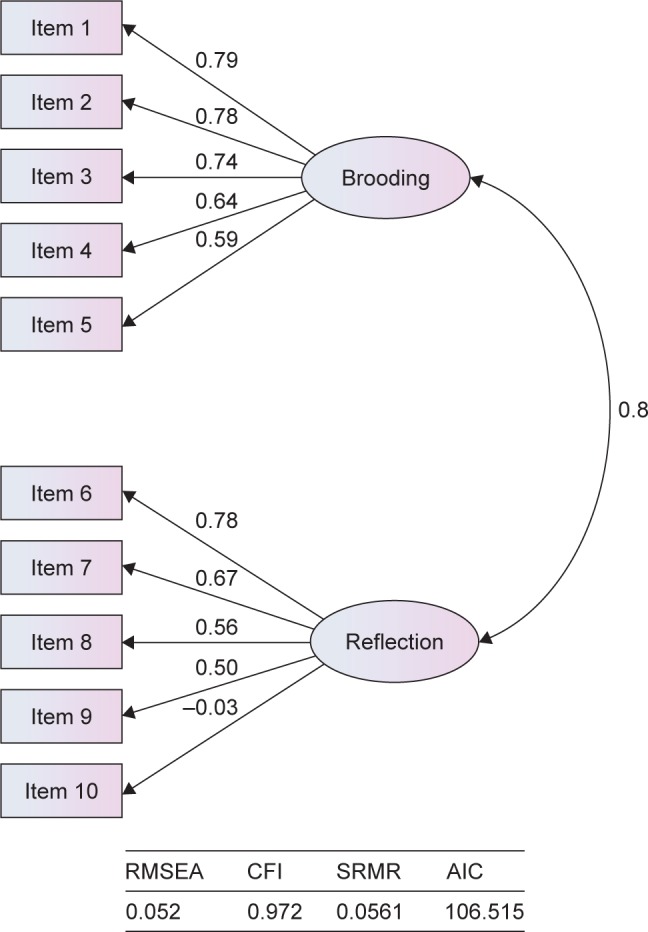
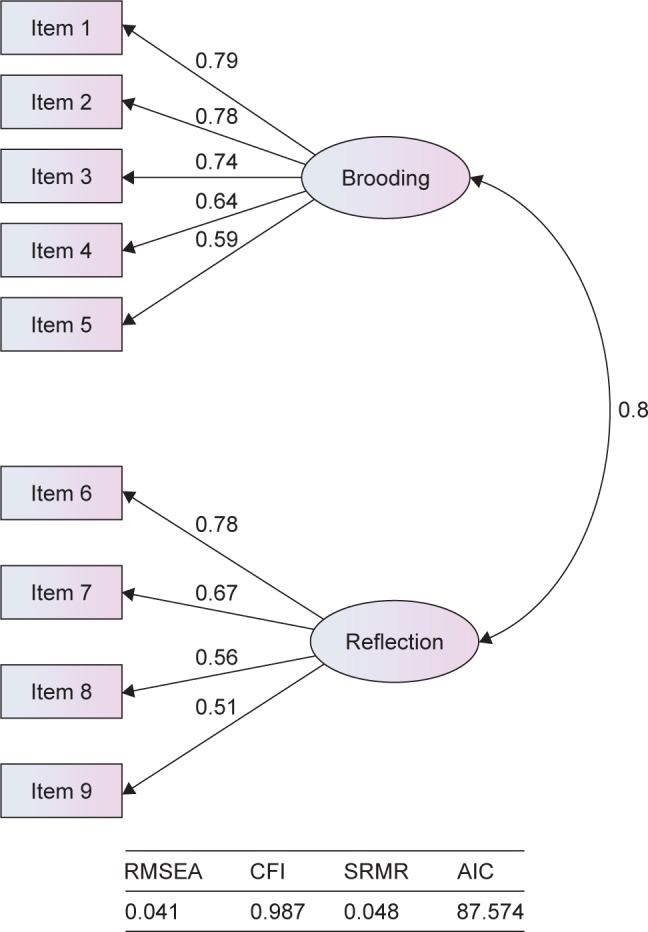
A total of 109 patients participated. The final reflection-brooding two-factor model of the RRS showed a good fit (root-mean-square error of approximation 0.041, comparative fit index 0.987, standardized root-mean-square residual 0.048) after removing one item (daily diary writing). Internal item consistency and reliability were satisfactory for the two dimensions. External validity testing confirmed that RRS scores were correlated with Beck Depression Inventory, State-Trait Anxiety Inventory, and SF-36 scores. There was no differential item functioning across sexes.
These results demonstrated good scale reliability and validity for assessing rumination in patients with MDD.
沉思反应量表(RRS)简版是使用最广泛的沉思测量工具之一,包含10个条目和两个分量表:反思和沉思。本研究旨在调查RRS在法国重度抑郁症(MDD)患者临床样本中的有效性和可靠性。
从法国一家公立学术医院招募符合DSM-IV-TR诊断标准的MDD门诊患者。采用贝克抑郁量表评估抑郁症状,采用状态-特质焦虑量表-状态分量表评估焦虑,采用36项简短健康调查(SF-36)问卷评估生活质量。进行验证性因素分析、条目-维度相关性分析、克朗巴赫α系数分析、拉施统计分析和外部效度检验。对性别进行差异项目功能分析。
共有109名患者参与。去除一个条目(每日写日记)后,RRS最终的反思-沉思两因素模型显示拟合良好(近似均方根误差0.041,比较拟合指数0.987,标准化均方根残差0.048)。两个维度的内部条目一致性和可靠性均令人满意。外部效度检验证实,RRS得分与贝克抑郁量表、状态-特质焦虑量表及SF-36得分相关。不同性别间不存在差异项目功能。
这些结果表明,RRS在评估MDD患者的沉思方面具有良好的量表可靠性和有效性。