Yale Jean-François, Dulude Hélène, Egeth Marc, Piché Claude A, Lafontaine Martin, Carballo Dolorès, Margolies Rebecca, Dissinger Emily, Shames Adam R, Kaplowitz Nicole, Zhang Michelle Xiaotian, Zhang Shuyu, Guzman Cristina B
1 McGill Department of Medicine, McGill University Health Center, McGill University , Montréal, Québec, Canada .
2 Locemia Solutions , Montréal, Canada .
Diabetes Technol Ther. 2017 Jul;19(7):423-432. doi: 10.1089/dia.2016.0460. Epub 2017 May 30.
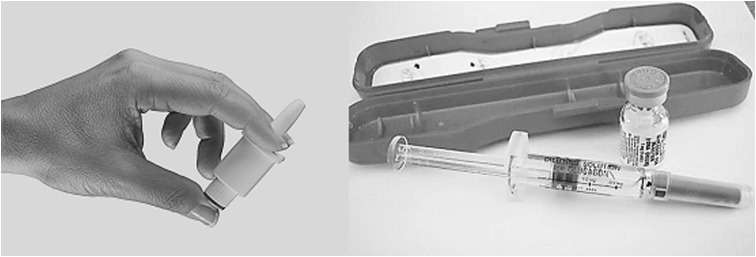
During severe hypoglycemic episodes, people with diabetes depend on others to help with treatment. We compared needle-free nasal glucagon and commercially available injectable glucagon for ease of use by caregivers of people with diabetes and by others in treating simulated episodes of severe hypoglycemia.
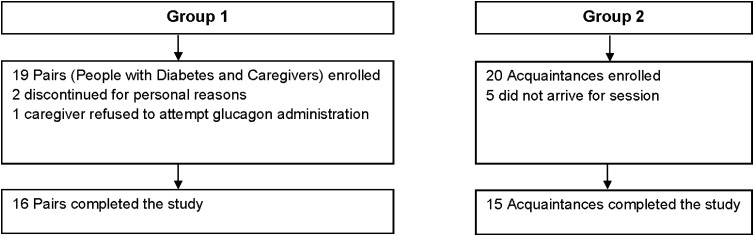
Sixteen instructed caregivers and 15 noninstructed acquaintances administered nasal and injectable glucagon to manikins, simulating unconscious people with diabetes during severe hypoglycemia episodes.
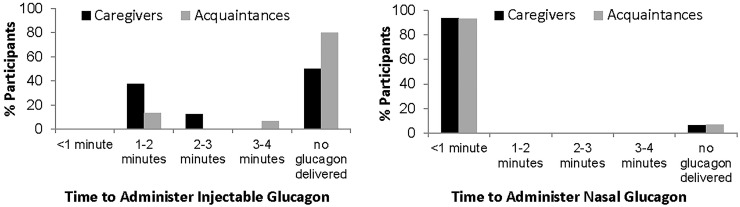
With nasal glucagon, 15 caregivers (94%) and 14 acquaintances (93%) administered a full dose (mean time 0.27 and 0.44 min, respectively). One caregiver and one acquaintance did not administer nasal glucagon because they did not fully depress the plunger on the device. Two caregivers deliberately administered both insulin and nasal glucagon, believing that insulin would also help the patient. With injectable glucagon, eight caregivers (50%) injected glucagon (mean time 1.89 min), but only two (13%) administered the full dose. Three acquaintances (20%) injected a partial dose of injectable glucagon (mean time 2.40 min); none gave a full dose. Errors included injecting diluent only, bending the needle, and injecting with an empty syringe. Two caregivers and one acquaintance injected insulin because they confused insulin with injectable glucagon.
More than 90% of participants delivered full doses of nasal glucagon, while 13% and 0% of caregivers and acquaintances delivered full doses of injectable glucagon, indicating that nasal glucagon is easier for nonmedically trained people to administer. Thus, nasal glucagon has the potential to substantially improve treatment for patients experiencing a life-threatening episode of severe hypoglycemia.
在严重低血糖发作期间,糖尿病患者依赖他人协助治疗。我们比较了无针鼻用胰高血糖素和市售注射用胰高血糖素在糖尿病患者护理人员及其他人治疗模拟严重低血糖发作时的易用性。
16名接受指导的护理人员和15名未接受指导的熟人向人体模型给予鼻用和注射用胰高血糖素,模拟严重低血糖发作时失去意识的糖尿病患者。
使用鼻用胰高血糖素时,15名护理人员(94%)和14名熟人(93%)给予了全剂量(平均时间分别为0.27和0.44分钟)。一名护理人员和一名熟人未给予鼻用胰高血糖素,因为他们未完全按下装置上的柱塞。两名护理人员故意同时给予胰岛素和鼻用胰高血糖素,认为胰岛素也会对患者有帮助。使用注射用胰高血糖素时,8名护理人员(50%)注射了胰高血糖素(平均时间1.89分钟),但只有两名(13%)给予了全剂量。三名熟人(20%)注射了部分剂量的注射用胰高血糖素(平均时间2.40分钟);无人给予全剂量。错误包括仅注射稀释剂、弄弯针头以及用空注射器注射。两名护理人员和一名熟人注射了胰岛素,因为他们将胰岛素与注射用胰高血糖素混淆。
超过90%的参与者给予了全剂量的鼻用胰高血糖素,而护理人员和熟人中分别只有13%和0%给予了全剂量的注射用胰高血糖素,这表明鼻用胰高血糖素对未接受医学培训的人来说更易于给药。因此,鼻用胰高血糖素有可能显著改善对经历危及生命的严重低血糖发作患者的治疗。