• 文献检索
  • 文档翻译
  • 深度研究
  • 学术资讯
  • Suppr Zotero 插件Zotero 插件
  • 邀请有礼
  • 套餐&价格
  • 历史记录
应用&插件
Suppr Zotero 插件Zotero 插件浏览器插件Mac 客户端Windows 客户端微信小程序
定价
高级版会员购买积分包购买API积分包
服务
文献检索文档翻译深度研究API 文档MCP 服务
关于我们
关于 Suppr公司介绍联系我们用户协议隐私条款
关注我们

Suppr 超能文献

核心技术专利:CN118964589B侵权必究
粤ICP备2023148730 号-1Suppr @ 2026

文献检索

告别复杂PubMed语法,用中文像聊天一样搜索,搜遍4000万医学文献。AI智能推荐,让科研检索更轻松。

立即免费搜索

文件翻译

保留排版,准确专业,支持PDF/Word/PPT等文件格式,支持 12+语言互译。

免费翻译文档

深度研究

AI帮你快速写综述,25分钟生成高质量综述,智能提取关键信息,辅助科研写作。

立即免费体验

了解癌症患者接受或拒绝心理肿瘤学支持的原因:一项前瞻性观察性研究,涵盖患者和临床医生对痛苦沟通的看法。

Understanding why cancer patients accept or turn down psycho-oncological support: a prospective observational study including patients' and clinicians' perspectives on communication about distress.

作者信息

Zwahlen Diana, Tondorf Theresa, Rothschild Sacha, Koller Michael T, Rochlitz Christoph, Kiss Alexander

机构信息

Department of Psychosomatic Medicine, University Hospital Basel, Hebelstrasse 2, 4031, Basel, Switzerland.

Medical Oncology Department, University Hospital Basel, Petersgraben 4, 4031, Basel, Switzerland.

出版信息

BMC Cancer. 2017 May 30;17(1):385. doi: 10.1186/s12885-017-3362-x.

DOI:10.1186/s12885-017-3362-x
PMID:28558713
原文链接:https://pmc.ncbi.nlm.nih.gov/articles/PMC5450069/
Abstract

BACKGROUND

International standards prioritize introducing routine emotional distress screening in cancer care to accurately identify patients who most need psycho-oncological treatment, and ensure that patients can access appropriate supportive care. However, only a moderate proportion of distressed patients accepts referrals to or uses psycho-oncological support services. Predictors and barriers to psycho-oncological support service utilization are under-studied. We know little about how patients and oncologists perceive the discussions when oncologists assess psychosocial distress with a screening instrument. We aim to 1) assess the barriers and predictors of uptake of in-house psycho-oncological support along the distress screening pathway in cancer patients treated at a University Oncology Outpatient Clinic and, 2) determine how patients and clinicians perceive communication about psychosocial distress after screening with the Distress Thermometer.

METHODS

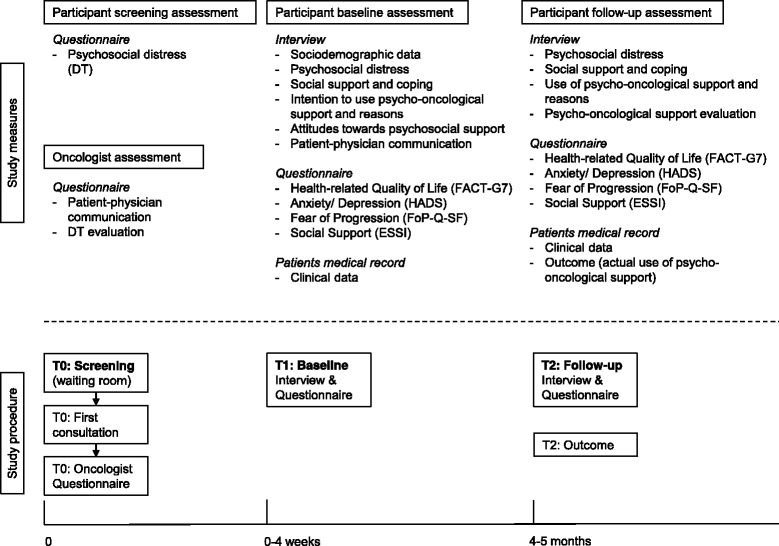
This is a quantitative prospective observational study with qualitative aspects. We will examine medical and demographic variables, cancer patient self-reports of various psychological measures, and aspects of the patient-clinician communication as variables that potentially predict uptake of psycho-oncological support service. We will also assess the patients' reasons for accepting or refusing psycho-oncological support services. We assess at three points in time, based on paper-and-pencil questionnaires and two patient interviews during the study period. We will monitor outcomes (psycho-oncology service uptake) four months after study entry.

DISCUSSION

The study will improve our understanding of characteristics of patients who accept or refuse psycho-oncological support, and help us understand how patients' and oncologists perceive communication about psychosocial distress, and referral to a psycho-oncologist. We believe this is the first study to focus on factors that affect uptake or rejection of psycho-oncological support services along the screening and referral pathway. The study 1) combines standard assessment with qualitative data collection, 2) embraces patient and oncologist perspectives, and, 3) focuses on patient-clinician communication about psychosocial issues raised by a standard screening instrument. Our results may improve routine practices and eliminate barriers to adequate health care, and make it easier to recognize patients with high distress levels who underuse the service.

摘要

背景

国际标准将在癌症护理中引入常规情绪困扰筛查作为优先事项,以准确识别最需要心理肿瘤治疗的患者,并确保患者能够获得适当的支持性护理。然而,只有一部分感到困扰的患者接受转介或使用心理肿瘤支持服务。心理肿瘤支持服务利用的预测因素和障碍研究不足。我们对患者和肿瘤学家在肿瘤学家使用筛查工具评估心理社会困扰时对讨论的看法知之甚少。我们旨在:1)评估在大学肿瘤门诊接受治疗的癌症患者在困扰筛查过程中接受内部心理肿瘤支持的障碍和预测因素;2)确定患者和临床医生在用苦恼温度计筛查后对心理社会困扰沟通的看法。

方法

这是一项兼具定量和定性方面的前瞻性观察性研究。我们将检查医学和人口统计学变量、癌症患者对各种心理测量的自我报告以及患者与临床医生沟通的方面,将其作为可能预测心理肿瘤支持服务利用情况的变量。我们还将评估患者接受或拒绝心理肿瘤支持服务的原因。在研究期间,我们基于纸笔问卷和两次患者访谈在三个时间点进行评估。我们将在研究开始四个月后监测结果(心理肿瘤服务利用情况)。

讨论

该研究将增进我们对接受或拒绝心理肿瘤支持的患者特征的理解,并帮助我们了解患者和肿瘤学家对心理社会困扰沟通以及转介给心理肿瘤学家的看法。我们认为这是第一项关注筛查和转介过程中影响心理肿瘤支持服务接受或拒绝因素的研究。该研究:1)将标准评估与定性数据收集相结合;2)涵盖患者和肿瘤学家的观点;3)关注患者与临床医生就标准筛查工具提出的心理社会问题进行的沟通。我们的结果可能会改善常规做法,消除获得充分医疗保健的障碍,并使更容易识别那些未充分利用该服务的高度困扰患者。
https://cdn.ncbi.nlm.nih.gov/pmc/blobs/9ca0/5450069/52993f163a84/12885_2017_3362_Fig1_HTML.jpg

相似文献

1
Understanding why cancer patients accept or turn down psycho-oncological support: a prospective observational study including patients' and clinicians' perspectives on communication about distress.了解癌症患者接受或拒绝心理肿瘤学支持的原因:一项前瞻性观察性研究,涵盖患者和临床医生对痛苦沟通的看法。
BMC Cancer. 2017 May 30;17(1):385. doi: 10.1186/s12885-017-3362-x.
2
Oncologist recommendation matters!-Predictors of psycho-oncological service uptake in oncology outpatients.肿瘤医生的推荐很重要!-肿瘤门诊患者接受心理肿瘤服务的预测因素。
Psychooncology. 2019 Feb;28(2):351-357. doi: 10.1002/pon.4948. Epub 2018 Dec 12.
3
[Standardized distress screening programs do not replace discussing distress and psychosocial care needs with patients].标准化的痛苦筛查程序并不能取代与患者讨论痛苦及心理社会护理需求。
Ther Umsch. 2019 Sep;76(4):219-224. doi: 10.1024/0040-5930/a001087.
4
Use of Follow-Up Psycho-Oncology Consultations in Urological Cancer after Transition from Inpatient to Outpatient Care.从住院治疗过渡到门诊治疗后,随访心理肿瘤学咨询在泌尿生殖系统癌症中的应用。
Oncol Res Treat. 2025;48(1-2):4-13. doi: 10.1159/000542458. Epub 2024 Nov 7.
5
Psychosocial distress, perceived need and utilization of psycho- social support services in patients in the early phase after the first cancer diagnosis.首次癌症诊断后早期患者的心理社会困扰、心理社会支持服务的感知需求及利用情况
J Cancer Res Clin Oncol. 2025 Feb 6;151(2):65. doi: 10.1007/s00432-025-06107-y.
6
Doctor's recommendations for psychosocial care: Frequency and predictors of recommendations and referrals.医生对心理社会关怀的建议:建议和转介的频率及预测因素。
PLoS One. 2018 Oct 4;13(10):e0205160. doi: 10.1371/journal.pone.0205160. eCollection 2018.
7
Effect of a structured psycho-oncological screening and treatment model on mental health in cancer patients (STEPPED CARE): study protocol for a cluster randomized controlled trial.结构化心理肿瘤筛查与治疗模式对癌症患者心理健康的影响(逐步护理):一项整群随机对照试验的研究方案
Trials. 2014 Dec 10;15:482. doi: 10.1186/1745-6215-15-482.
8
The impact of clinical conditions and social factors on the psychological distress of cancer patients: an explorative study at a consultation and liaison service in a rural general hospital.临床状况和社会因素对癌症患者心理困扰的影响:农村综合医院会诊联络服务处的探索性研究。
BMC Psychiatry. 2013 Sep 20;13:226. doi: 10.1186/1471-244X-13-226.
9
[Patient's Autonomy and Information in Psycho-Oncology: Computer Based Distress Screening for an Interactive Treatment Planning (ePOS-react)].[心理肿瘤学中的患者自主性与信息:基于计算机的交互式治疗计划痛苦筛查(ePOS-react)]
Psychother Psychosom Med Psychol. 2017 Jul;67(7):296-303. doi: 10.1055/s-0043-113438. Epub 2017 Jul 18.
10
Physicians' attitudes towards psycho-oncology, perceived barriers, and psychosocial competencies: Indicators of successful implementation of adjunctive psycho-oncological care?医生对心理肿瘤学的态度、感知障碍和心理社会能力:辅助心理肿瘤学护理成功实施的指标?
Psychooncology. 2019 Feb;28(2):415-422. doi: 10.1002/pon.4962. Epub 2018 Dec 21.

引用本文的文献

1
A Single-Site Qualitative Study Exploring What Cancer Patients and Health Care Professionals Consider to be the Core Priorities in Relation to Psychosocial Cancer Care.一项单中心定性研究,探讨癌症患者和医护人员认为心理社会癌症护理的核心优先事项是什么。
Cancer Control. 2025 Jan-Dec;32:10732748251356320. doi: 10.1177/10732748251356320. Epub 2025 Aug 13.
2
Concerns Oncology Clinicians Bring up During Psychodynamic Supervisions Conducted by Psycho-Oncologists: A Qualitative Exploration.肿瘤心理医生进行心理动力学督导期间肿瘤临床医生提出的担忧:一项质性探索
Psychooncology. 2025 Aug;34(8):e70238. doi: 10.1002/pon.70238.
3

本文引用的文献

1
Why do oncology outpatients who report emotional distress decline help?报告有情绪困扰的肿瘤门诊患者为何拒绝帮助?
Psychooncology. 2015 Jul;24(7):812-8. doi: 10.1002/pon.3729. Epub 2014 Dec 11.
2
Fear of progression in patients 6 months after cancer rehabilitation-a- validation study of the fear of progression questionnaire FoP-Q-12.癌症康复6个月后患者对病情进展的恐惧——对病情进展恐惧问卷FoP-Q-12的验证研究
Support Care Cancer. 2015 Jun;23(6):1579-87. doi: 10.1007/s00520-014-2516-5. Epub 2014 Nov 21.
3
Validation of the distress thermometer worldwide: state of the science.
A feasibility study of distress screening with psychometric evaluation and referral of cancer patients.
一项针对癌症患者进行心理困扰筛查、心理测量评估及转诊的可行性研究。
Sci Rep. 2025 Mar 26;15(1):10397. doi: 10.1038/s41598-025-94538-5.
4
Disparities and barriers in the assessment of psychological distress, access to and use of psycho-oncological support in Europe: current perspectives.欧洲心理困扰评估、心理肿瘤学支持的获取与使用方面的差异和障碍:当前观点
Front Psychol. 2023 Sep 19;14:1252843. doi: 10.3389/fpsyg.2023.1252843. eCollection 2023.
5
Perceived importance of emotional support provided by health care professionals and social networks: Should we broaden our focus for the delivery of supportive care?医护人员和社交网络提供的情感支持的感知重要性:我们是否应该扩大支持性护理的关注焦点?
Asia Pac J Clin Oncol. 2023 Dec;19(6):681-689. doi: 10.1111/ajco.13922. Epub 2023 Jan 25.
6
Reading Wishes from the Lips: Cancer Patients' Need for Psycho-Oncological Support during Inpatient and Outpatient Treatment.解读唇间的愿望:癌症患者在住院和门诊治疗期间对心理肿瘤学支持的需求。
Diagnostics (Basel). 2022 Oct 9;12(10):2440. doi: 10.3390/diagnostics12102440.
7
'Patients with Cancer are Distressed!' Indian Healthcare Provider Perspectives on Distress Screening and Referrals to Psycho-oncology Services - A Mixed Methods Study.“癌症患者备受困扰!” 印度医疗服务提供者对困扰筛查及转介至心理肿瘤学服务的看法——一项混合方法研究
Indian J Palliat Care. 2021 Oct-Dec;27(4):561-570. doi: 10.25259/IJPC_142_21. Epub 2021 Oct 21.
8
Reported Concerns and Acceptance of Information or Referrals Among Breast Cancer Survivors Seen for Care Planning Visits: Results from the University of Wisconsin Carbone Cancer Center Survivorship Program.接受过癌症诊疗服务的乳腺癌幸存者在就诊期间的顾虑和信息接受/转介情况:来自威斯康星大学卡洛琳癌症中心生存项目的研究结果。
J Cancer Educ. 2022 Dec;37(6):1702-1710. doi: 10.1007/s13187-021-02015-0. Epub 2021 Apr 26.
9
Screening for Predictive Parameters Requiring Psycho-Oncological Intervention via the National Comprehensive Cancer Network Distress Thermometer in the Follow-Up of Uveal Melanoma Patients.通过国家综合癌症网络苦恼温度计对葡萄膜黑色素瘤患者进行随访,筛查需要心理肿瘤学干预的预测参数。
Clin Ophthalmol. 2020 Nov 9;14:3813-3819. doi: 10.2147/OPTH.S276848. eCollection 2020.
10
Recruitment problems in psychosocial oncology research.心理肿瘤学研究中的招募问题。
Psychooncology. 2018 Sep;27(9):2296-2298. doi: 10.1002/pon.4792. Epub 2018 Jun 29.
全球痛苦温度计的验证:科学现状。
Psychooncology. 2014 Mar;23(3):241-50. doi: 10.1002/pon.3430. Epub 2013 Nov 11.
4
2013 President's Plenary International Psycho-oncology Society: embracing the IPOS standards as a means of enhancing comprehensive cancer care.2013年国际心理肿瘤学会主席全会:采用国际心理肿瘤学会标准作为加强癌症综合治疗的一种手段。
Psychooncology. 2014 Sep;23(9):1073-8. doi: 10.1002/pon.3618. Epub 2014 Jun 21.
5
Recommendations for the implementation of distress screening programs in cancer centers: report from the American Psychosocial Oncology Society (APOS), Association of Oncology Social Work (AOSW), and Oncology Nursing Society (ONS) joint task force.癌症中心实施痛苦筛查计划的建议:美国心理肿瘤学会(APOS)、肿瘤社会工作协会(AOSW)和肿瘤护理学会(ONS)联合工作组的报告。
Cancer. 2014 Oct 1;120(19):2946-54. doi: 10.1002/cncr.28750. Epub 2014 May 2.
6
Patient and health professional's perceived barriers to the delivery of psychosocial care to adults with cancer: a systematic review.患者和卫生专业人员对提供癌症成人心理社会关怀的感知障碍:系统评价。
Psychooncology. 2014 Jun;23(6):601-12. doi: 10.1002/pon.3474. Epub 2014 Feb 11.
7
Barriers to mental health service use and preferences for addressing emotional concerns among lung cancer patients.肺癌患者使用心理健康服务的障碍及解决情感问题的偏好
Psychooncology. 2014 Jul;23(7):812-9. doi: 10.1002/pon.3488. Epub 2014 Feb 3.
8
Screening alone is not enough: the importance of appropriate triage, referral, and evidence-based treatment of distress and common problems.仅靠筛查是不够的:对困扰和常见问题进行适当分诊、转诊及循证治疗的重要性。
J Clin Oncol. 2013 Oct 10;31(29):3616-7. doi: 10.1200/JCO.2013.51.4315. Epub 2013 Sep 3.
9
Benefits of screening cancer patients for distress still not demonstrated.对癌症患者进行痛苦筛查的益处仍未得到证实。
Br J Cancer. 2013 Feb 19;108(3):736-7. doi: 10.1038/bjc.2013.16. Epub 2013 Jan 31.
10
The FACT-G7: a rapid version of the functional assessment of cancer therapy-general (FACT-G) for monitoring symptoms and concerns in oncology practice and research.FACT-G7:一种功能评估癌症治疗-一般(FACT-G)的快速版本,用于在肿瘤学实践和研究中监测症状和关注点。
Ann Oncol. 2013 Apr;24(4):1073-8. doi: 10.1093/annonc/mds539. Epub 2012 Nov 7.