Abu-Halima Masood, Poryo Martin, Ludwig Nicole, Mark Janine, Marsollek Ina, Giebels Christian, Petersen Johannes, Schäfers Hans-Joachim, Grundmann Ulrich, Pickardt Thomas, Keller Andreas, Meese Eckart, Abdul-Khaliq Hashim
Department of Human Genetics, Saarland University, 66421, Homburg/Saar, Germany.
Department of Human Genetics, Saarland University Medical Center, 66421, Homburg/Saar, Germany.
J Transl Med. 2017 May 30;15(1):117. doi: 10.1186/s12967-017-1213-9.
Children with congenital heart defects (CHDs) are at high risk for myocardial failure after operative procedures with cardiopulmonary bypass (CPB). Recent studies suggest that microRNAs (miRNA) are involved in the development of CHDs and myocardial failure. Therefore, the aim of this study was to determine alterations in the miRNA profile in heart tissue after cardiac surgery using CPB.
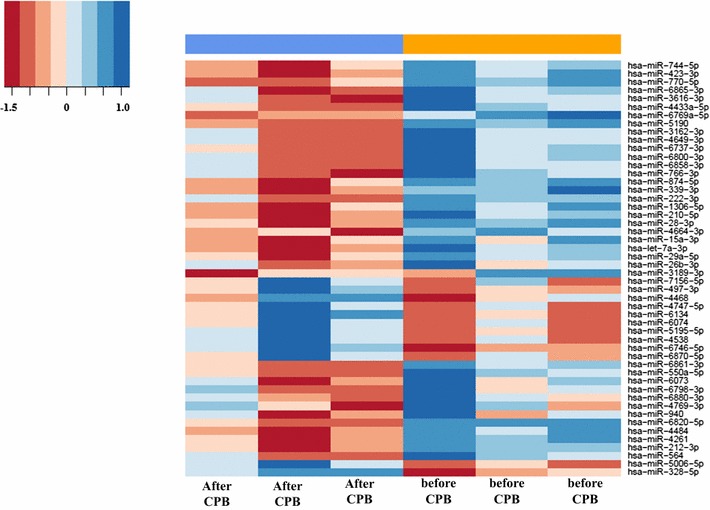
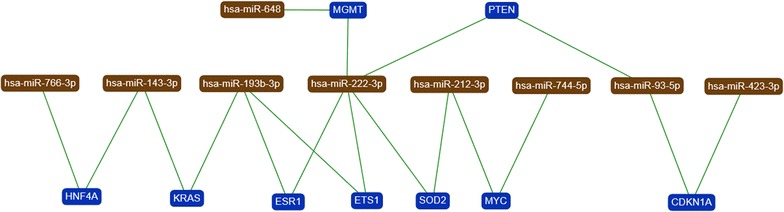
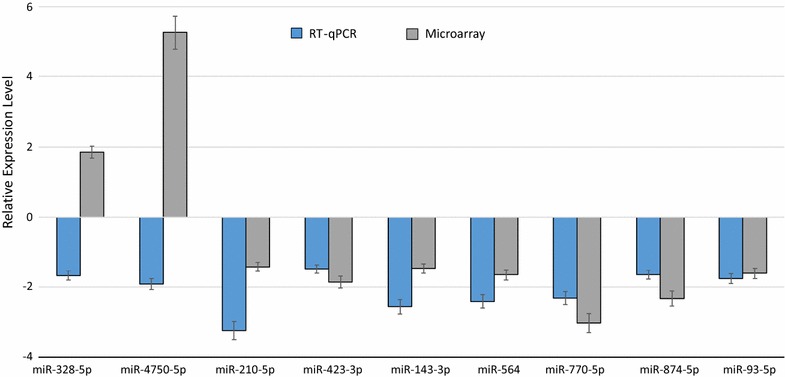
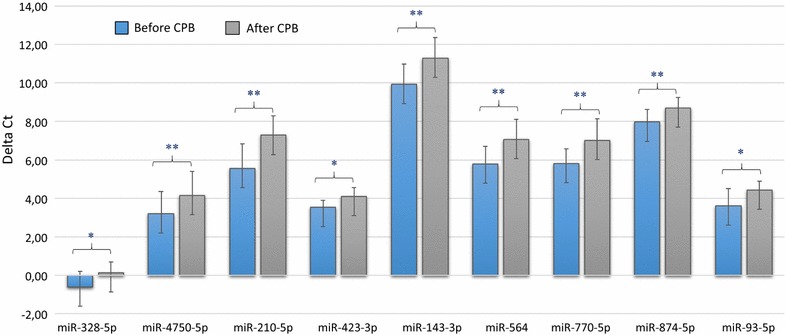
In total, 14 tissue samples from right atrium were collected from patients before and after connection of the CPB. SurePrint™ 8 × 60K Human v21 miRNA array and quantitative reverse transcription-polymerase chain reaction (RT-qPCR) were employed to determine the miRNA expression profile from three patients before and after connection of the CPB. Enrichment analyses of altered miRNA expression were predicted using bioinformatic tools.
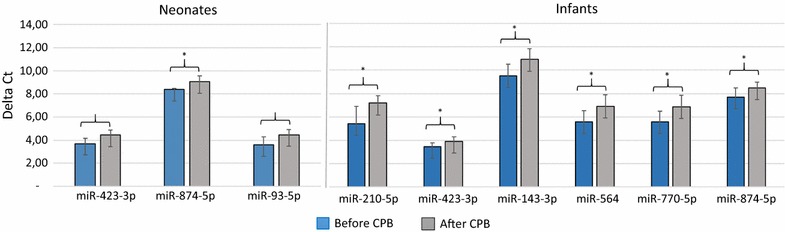
According to miRNA array, a total of 90 miRNAs were significantly altered including 29 miRNAs with increased and 61 miRNAs with decreased expression after de-connection of CPB (n = 3) compared to before CPB (n = 3). Seven miRNAs had been validated using RT-qPCR in an independent cohort of 11 patients. Enrichment analyses applying the KEGG database displayed the highest correlation for signaling pathways, cellular community, cardiovascular disease and circulatory system.
Our result identified the overall changes of the miRNome in right atrium tissue of patients with CHDs after CPB. The differentially altered miRNAs lay a good foundation for further understanding of the molecular function of changed miRNAs in regulating CHDs and after CPB in particular.
先天性心脏病(CHD)患儿在接受体外循环(CPB)手术操作后发生心肌衰竭的风险很高。最近的研究表明,微小RNA(miRNA)参与了CHD和心肌衰竭的发生发展。因此,本研究的目的是确定使用CPB进行心脏手术后心脏组织中miRNA谱的变化。
总共从CPB连接前后的患者中收集了14份右心房组织样本。使用SurePrint™ 8×60K人类v21 miRNA芯片和定量逆转录-聚合酶链反应(RT-qPCR)来确定3例CPB连接前后患者的miRNA表达谱。使用生物信息学工具预测miRNA表达改变的富集分析。
根据miRNA芯片,与CPB前(n = 3)相比,CPB断开后(n = 3)共有90种miRNA发生了显著变化,其中29种miRNA表达增加,61种miRNA表达减少。在一个由11名患者组成的独立队列中,使用RT-qPCR验证了7种miRNA。应用KEGG数据库的富集分析显示,信号通路、细胞群落、心血管疾病和循环系统的相关性最高。
我们的结果确定了CPB后CHD患者右心房组织中miRNome的总体变化。差异改变的miRNA为进一步了解变化的miRNA在调节CHD尤其是CPB后的分子功能奠定了良好基础。