Ramírez-Vélez Robinson, Cruz-Salazar Sandra Milena, Martínez Myriam, Cadore Eduardo L, Alonso-Martinez Alicia M, Correa-Bautista Jorge E, Izquierdo Mikel, Ortega Francisco B, García-Hermoso Antonio
Centro de Estudios en Medición de la Actividad Física (CEMA), Universidad del Rosario, Bogota, Cundinamarca, Colombia.
Exercise Research Laboratory, Physical Education School, Federal University of Rio Grande do Sul, Porto Alegre, Recife, Brazil.
PeerJ. 2017 May 23;5:e3351. doi: 10.7717/peerj.3351. eCollection 2017.
There is a lack of instruments and studies written in Spanish evaluating physical fitness, impeding the determination of the current status of this important health indicator in the Latin population, especially in Colombia. The aim of the study was two-fold: to examine the validity of the International Fitness Scale (IFIS) with a population-based sample of schoolchildren from Bogota, Colombia and to examine the reliability of the IFIS with children and adolescents from Engativa, Colombia.
The sample comprised 1,873 Colombian youths (54.5% girls) aged 9-17.9 years. We measured their adiposity markers (waist-to-height ratio, skinfold thickness, percentage of body fat and body mass index), blood pressure, lipids profile, fasting glucose, and physical fitness level (self-reported and measured). A validated cardiometabolic risk index score was also used. An age- and sex-matched subsample of 229 schoolchildren who were not originally included in the sample completed the IFIS twice for reliability purposes.
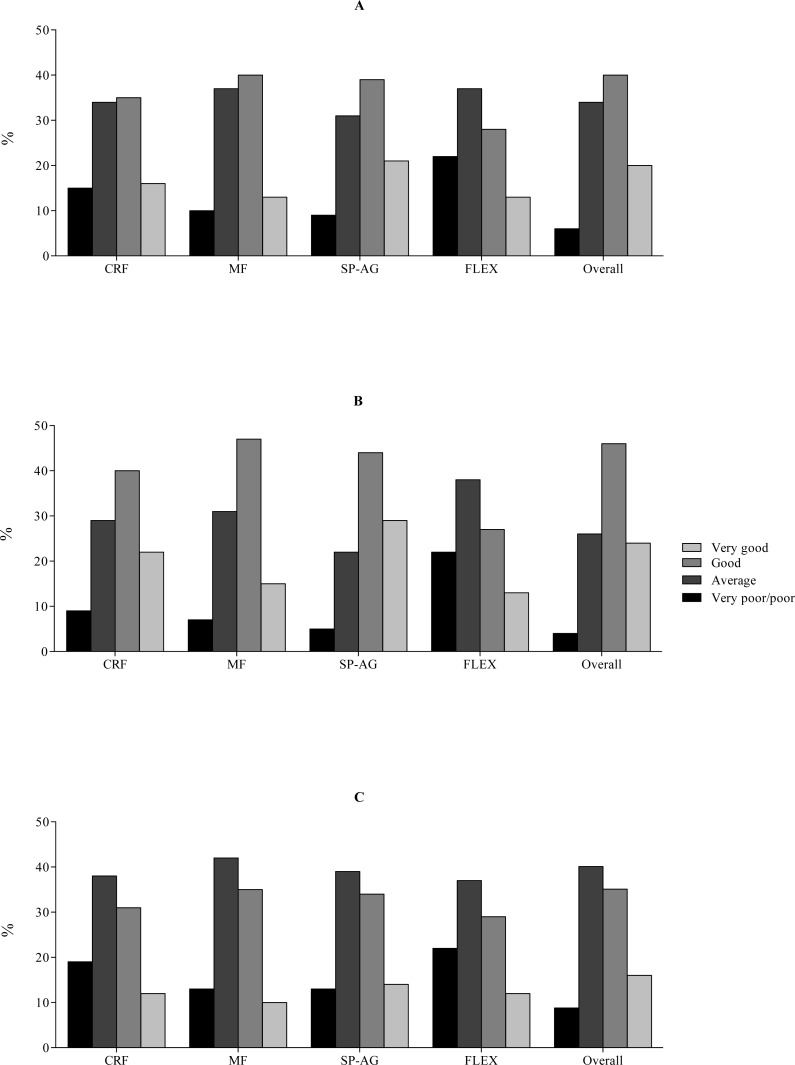
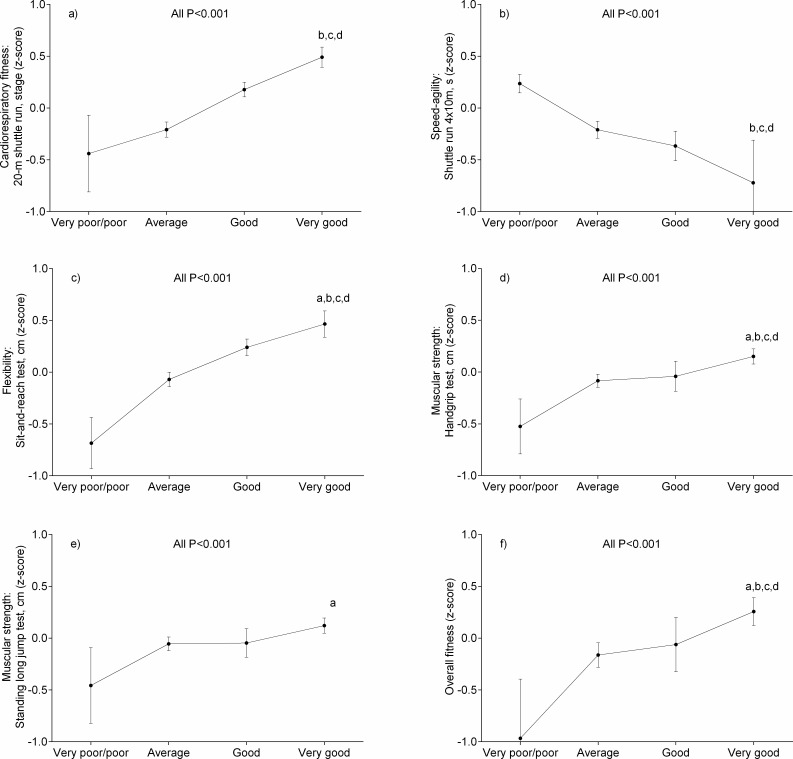
Our data suggest that both measured and self-reported overall physical fitness levels were inversely associated with percentage of body fat indicators and the cardiometabolic risk index score. Overall, schoolchildren who self-reported "good" or "very good" fitness had better measured fitness levels than those who reported "very poor/poor" fitness (all < 0.001). The test-retest reliability of the IFIS items was also good, with an average weighted kappa of 0.811.
Our findings suggest that self-reported fitness, as assessed by the IFIS, is a valid, reliable, and health-related measure. Furthermore, it can be a good alternative for future use in large studies with Latin schoolchildren from Colombia.
缺乏以西班牙语编写的评估体能的工具和研究,这阻碍了确定拉丁人群,尤其是哥伦比亚人群中这一重要健康指标的当前状况。本研究的目的有两个:一是在哥伦比亚波哥大的学龄儿童人群样本中检验国际体能量表(IFIS)的有效性;二是在哥伦比亚恩加蒂瓦的儿童和青少年中检验IFIS的可靠性。
样本包括1873名9至17.9岁的哥伦比亚青少年(54.5%为女孩)。我们测量了他们的肥胖指标(腰高比、皮褶厚度、体脂百分比和体重指数)、血压、血脂谱、空腹血糖和体能水平(自我报告和实测)。还使用了经过验证的心脏代谢风险指数评分。为了可靠性目的,一个年龄和性别匹配的229名最初未纳入样本的学龄儿童子样本完成了两次IFIS测试。
我们的数据表明,实测和自我报告的总体体能水平均与体脂指标百分比和心脏代谢风险指数评分呈负相关。总体而言,自我报告“良好”或“非常好”体能的学龄儿童,其实测体能水平优于报告“非常差/差”体能的儿童(所有P<0.001)。IFIS项目的重测信度也很好,平均加权kappa为0.811。
我们的研究结果表明,通过IFIS评估的自我报告体能是一种有效、可靠且与健康相关的测量方法。此外,它可能是未来用于对哥伦比亚拉丁裔学龄儿童进行大规模研究的一个很好的选择。