Kozlowska Kasia, Griffiths Kristi R, Foster Sheryl L, Linton James, Williams Leanne M, Korgaonkar Mayuresh S
The Children's Hospital at Westmead, Psychological Medicine, Locked Bag 4001, Westmead, NSW 2145, Australia; The Brain Dynamics Centre, Westmead Institute for Medical Research, 176 Hawkesbury Rd, Westmead, NSW 2145, Australia; The University of Sydney, Sydney, Australia.
The Brain Dynamics Centre, Westmead Institute for Medical Research, 176 Hawkesbury Rd, Westmead, NSW 2145, Australia; The University of Sydney, Sydney, Australia.
Neuroimage Clin. 2017 May 6;15:306-314. doi: 10.1016/j.nicl.2017.04.028. eCollection 2017.
Functional neurological symptom disorder refers to the presence of neurological symptoms not explained by neurological disease. Although this disorder is presumed to reflect abnormal of the brain, recent studies in adults show neuroanatomical abnormalities in brain . These structural brain abnormalities have been presumed to reflect long-term adaptations to the disorder, and it is unknown whether child and adolescent patients, with illness that is typically of shorter duration, show similar deficits or have normal brain structure.
High-resolution, three-dimensional T1-weighted magnetic resonance images (MRIs) were acquired in 25 patients (aged 10-18 years) and 24 healthy controls. Structure was quantified in terms of grey matter volume using voxel-based morphometry. Post hoc, we examined whether regions of structural difference related to a measure of motor readiness to emotional signals and to clinical measures of illness duration, illness severity, and anxiety/depression.
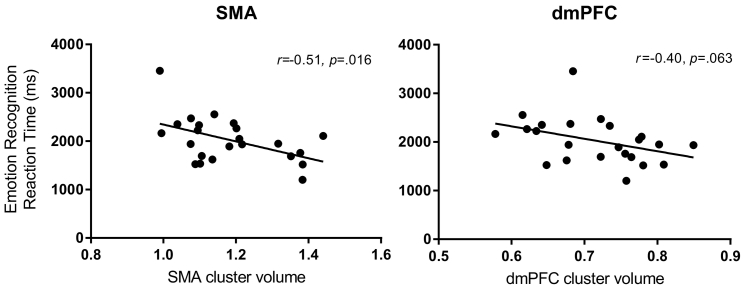
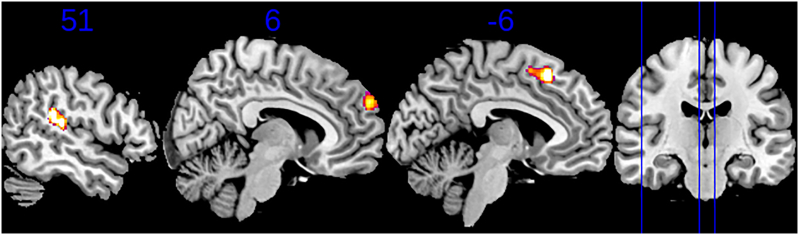
Patients showed greater volumes in the left supplementary motor area (SMA) and right superior temporal gyrus (STG) and dorsomedial prefrontal cortex (DMPFC) (corrected p < 0.05). Previous studies of adult patients have also reported alterations of the SMA. Greater SMA volumes correlated with faster reaction times in identifying emotions but not with clinical measures.
The SMA, STG, and DMPFC are known to be involved in the perception of emotion and the modulation of motor responses. These larger volumes may reflect the early expression of an experience-dependent plasticity process associated with increased vigilance to others' emotional states and enhanced motor readiness to organize self-protectively in the context of the long-standing relational stress that is characteristic of this disorder.
功能性神经症状障碍是指存在无法用神经疾病解释的神经症状。尽管该障碍被认为反映了大脑的异常,但近期对成人的研究显示大脑存在神经解剖学异常。这些大脑结构异常被认为反映了对该障碍的长期适应,而对于病程通常较短的儿童和青少年患者是否表现出类似的缺陷或大脑结构正常尚不清楚。
对25名患者(年龄10 - 18岁)和24名健康对照者进行了高分辨率三维T1加权磁共振成像(MRI)检查。使用基于体素的形态测量法对灰质体积进行结构量化。事后,我们检查了结构差异区域是否与对情绪信号的运动准备度测量以及疾病持续时间、疾病严重程度和焦虑/抑郁的临床测量相关。
患者左侧辅助运动区(SMA)、右侧颞上回(STG)和背内侧前额叶皮质(DMPFC)体积更大(校正p < 0.05)。先前对成年患者的研究也报告了SMA的改变。更大的SMA体积与识别情绪时更快的反应时间相关,但与临床测量无关。
已知SMA、STG和DMPFC参与情绪感知和运动反应的调节。这些更大的体积可能反映了一种与对他人情绪状态的更高警觉性以及在这种障碍所特有的长期关系压力背景下增强的自我保护组织运动准备相关的经验依赖性可塑性过程的早期表现。