Li Peng, Jing Ri-Xing, Zhao Rong-Jiang, Ding Zeng-Bo, Shi Le, Sun Hong-Qiang, Lin Xiao, Fan Teng-Teng, Dong Wen-Tian, Fan Yong, Lu Lin
Institute of Mental Health, National Clinical Research Center for Mental Disorders, Key Laboratory of Mental Health and Peking University Sixth Hospital, Peking University, Beijing, 100191 China.
National Laboratory of Pattern Recognition, Institute of Automation, Chinese Academy of Sciences, Beijing, 100190 China.
NPJ Schizophr. 2017 May 11;3:21. doi: 10.1038/s41537-017-0023-7. eCollection 2017.
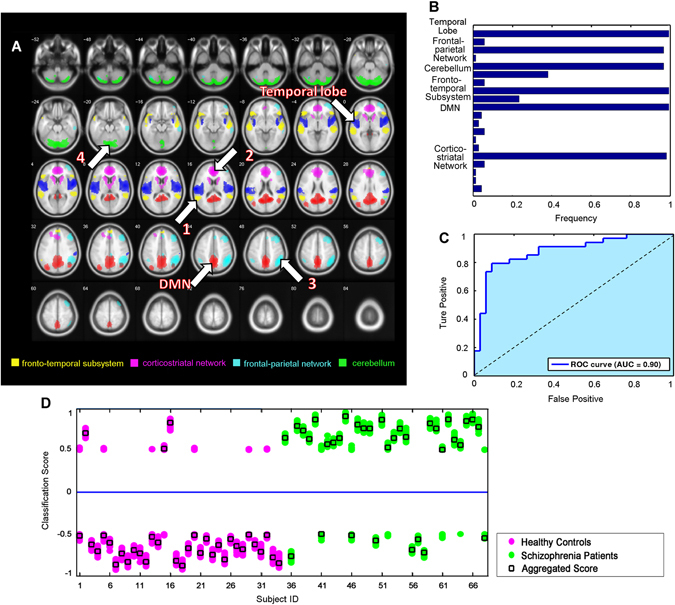
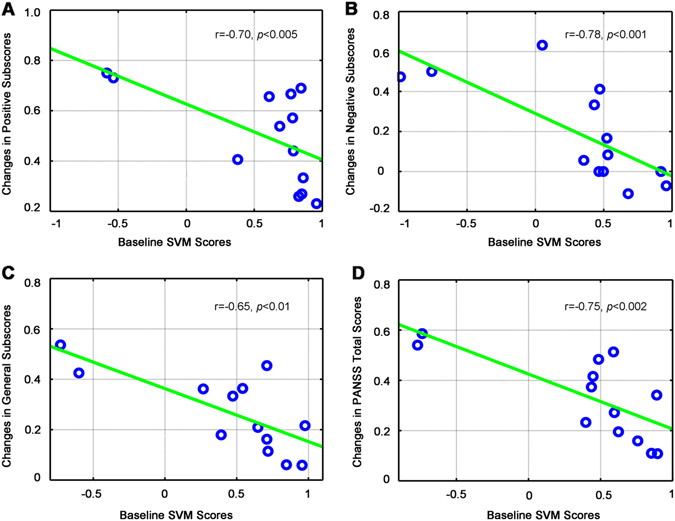
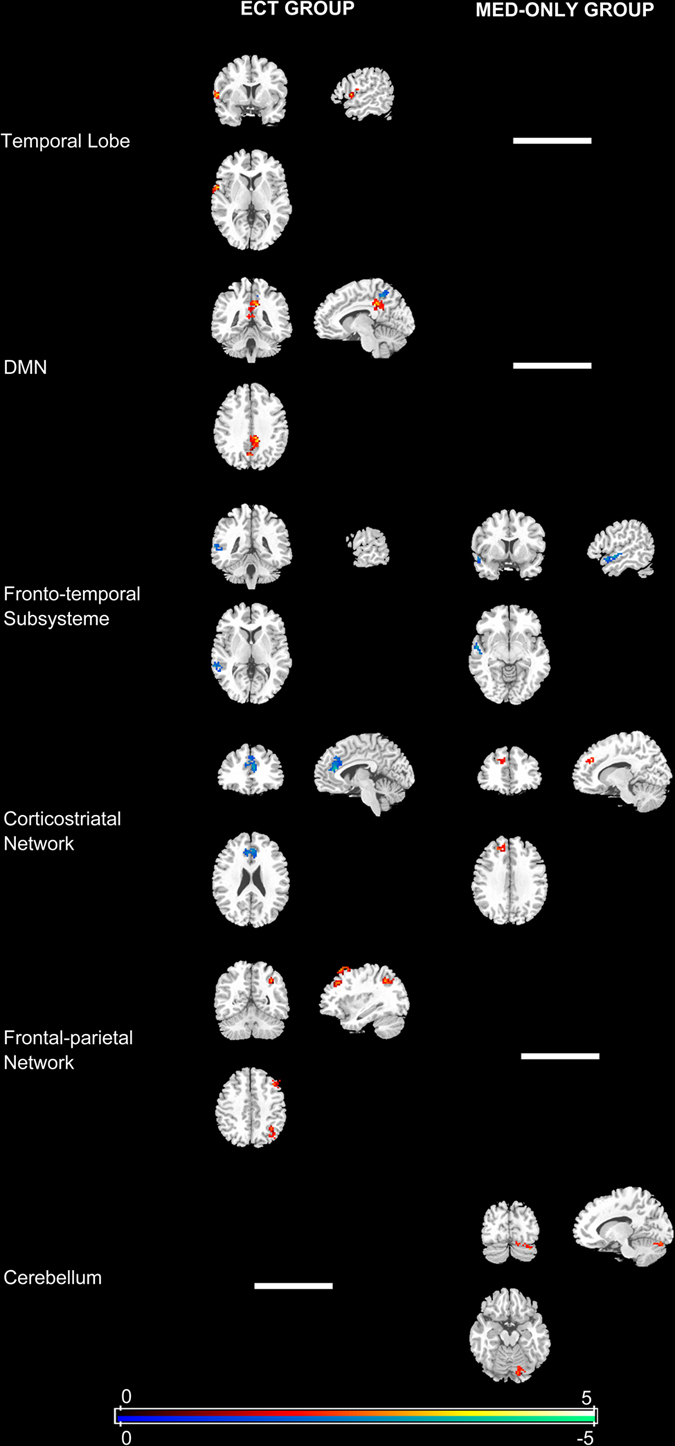
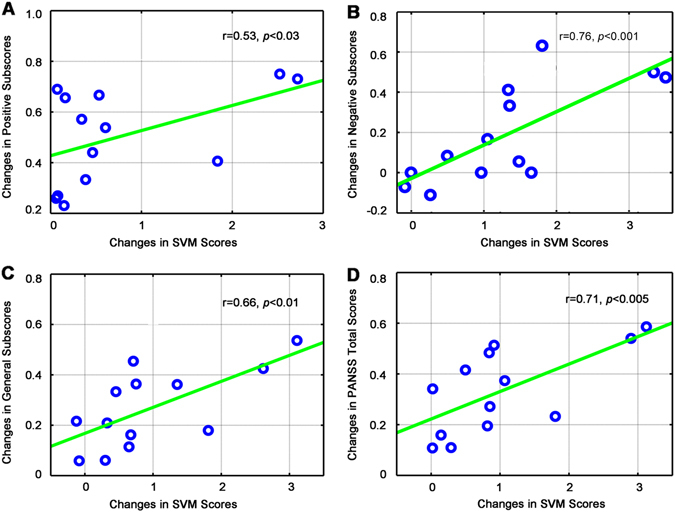
Previous studies suggested that electroconvulsive therapy can influence regional metabolism and dopamine signaling, thereby alleviating symptoms of schizophrenia. It remains unclear what patients may benefit more from the treatment. The present study sought to identify biomarkers that predict the electroconvulsive therapy response in individual patients. Thirty-four schizophrenia patients and 34 controls were included in this study. Patients were scanned prior to treatment and after 6 weeks of treatment with antipsychotics only ( = 16) or a combination of antipsychotics and electroconvulsive therapy ( = 13). Subject-specific intrinsic connectivity networks were computed for each subject using a group information-guided independent component analysis technique. Classifiers were built to distinguish patients from controls and quantify brain states based on intrinsic connectivity networks. A general linear model was built on the classification scores of first scan (referred to as baseline classification scores) to predict treatment response. Classifiers built on the default mode network, the temporal lobe network, the language network, the corticostriatal network, the frontal-parietal network, and the cerebellum achieved a cross-validated classification accuracy of 83.82%, with specificity of 91.18% and sensitivity of 76.47%. After the electroconvulsive therapy, psychosis symptoms of the patients were relieved and classification scores of the patients were decreased. Moreover, the baseline classification scores were predictive for the treatment outcome. Schizophrenia patients exhibited functional deviations in multiple intrinsic connectivity networks which were able to distinguish patients from healthy controls at an individual level. Patients with lower classification scores prior to treatment had better treatment outcome, indicating that the baseline classification scores before treatment is a good predictor for treatment outcome.
先前的研究表明,电休克疗法可影响局部代谢和多巴胺信号传导,从而缓解精神分裂症症状。目前尚不清楚哪些患者可能从该治疗中获益更多。本研究旨在识别可预测个体患者电休克疗法反应的生物标志物。本研究纳入了34例精神分裂症患者和34名对照。在治疗前以及仅使用抗精神病药物治疗6周后(n = 16)或使用抗精神病药物与电休克疗法联合治疗6周后(n = 13)对患者进行扫描。使用基于组信息引导的独立成分分析技术为每个受试者计算特定于个体的内在连接网络。构建分类器以区分患者与对照,并基于内在连接网络量化脑状态。基于首次扫描的分类分数(称为基线分类分数)建立一个通用线性模型来预测治疗反应。基于默认模式网络、颞叶网络、语言网络、皮质纹状体网络、额顶网络和小脑构建的分类器实现了83.82%的交叉验证分类准确率,特异性为91.18%,敏感性为76.47%。电休克治疗后,患者的精神病症状得到缓解,患者的分类分数降低。此外,基线分类分数可预测治疗结果。精神分裂症患者在多个内在连接网络中表现出功能偏差,这些偏差能够在个体水平上区分患者与健康对照。治疗前分类分数较低的患者治疗效果较好,这表明治疗前的基线分类分数是治疗结果的良好预测指标。