Zhou Qing, Deng Qing, Hu Bo, Wang Yi-Jia, Chen Jin-Ling, Cui Jing-Jing, Cao Sheng, Song Hong-Ning
Department of Ultrasound Imaging, Renmin Hospital, Wuhan University, Wuhan, Hubei 430060, P.R. China.
Exp Ther Med. 2017 May;13(5):2293-2303. doi: 10.3892/etm.2017.4270. Epub 2017 Mar 28.
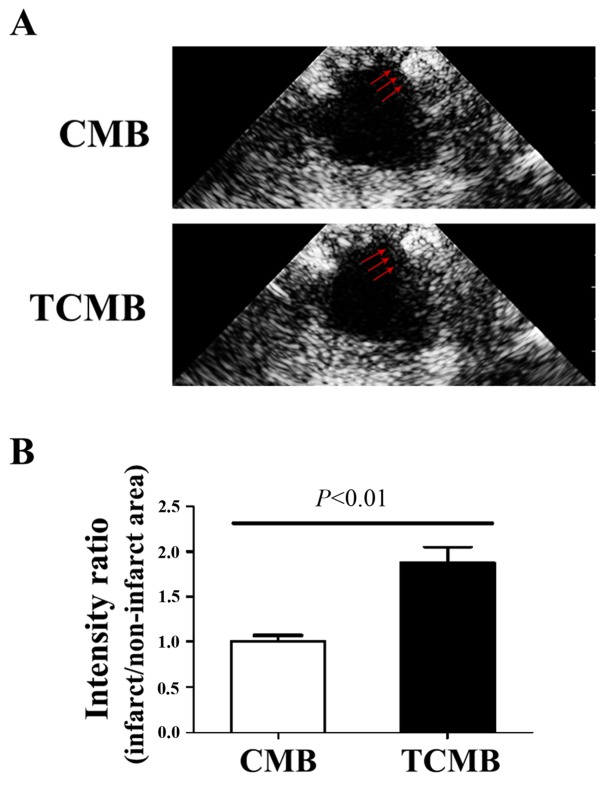
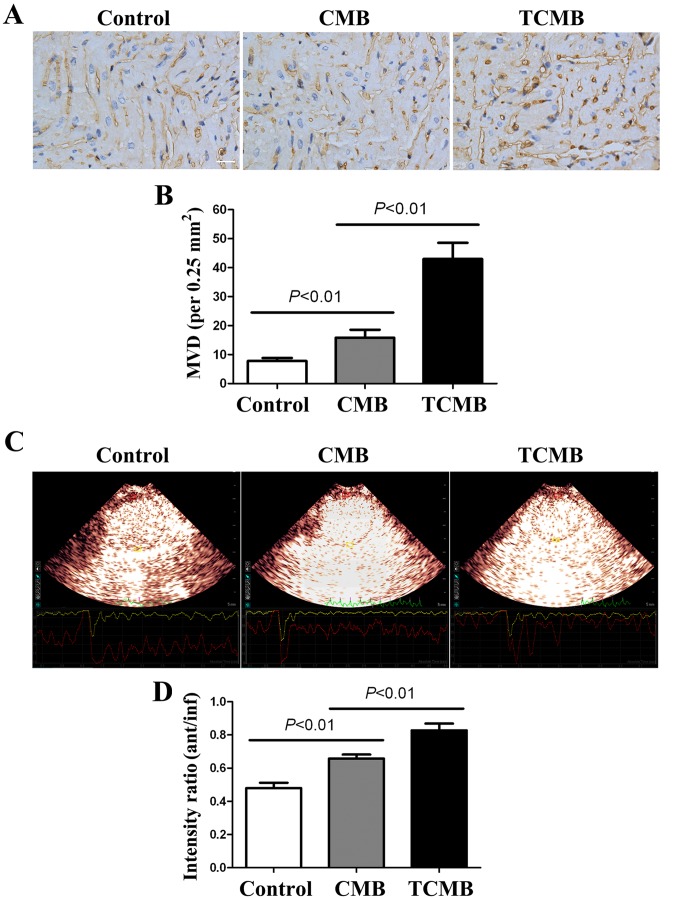
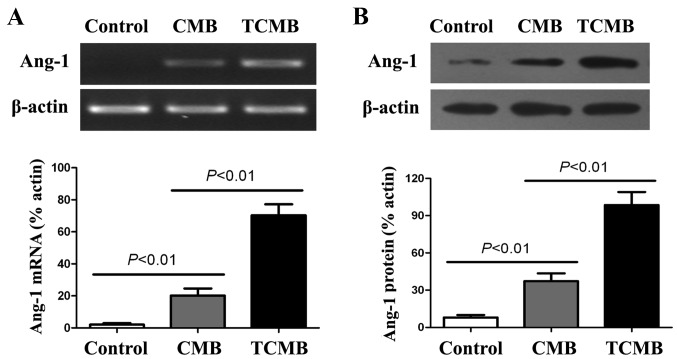
The present study aimed to construct targeted cationic microbubbles (TCMBs) by synthesizing cationic microbubbles conjugated to an intercellular adhesion molecule-1 (ICAM-1) antibody, and then to use the TCMBs to deliver the angiopoietin-1 (Ang-1) gene into infarcted heart tissue using ultrasound-mediated microbubble destruction. It was hypothesized that the TCMBs would accumulate in higher numbers than non-targeted cationic microbubbles (CMBs) in the infarcted heart, and would therefore increase the efficiency of targeted Ang-1 gene transfection and promote angiogenesis. The results of the study demonstrated that the ability of TCMBs to target inflammatory endothelial cells was 18.4-fold higher than that of the CMBs . The accumulation of TCMBs was greater than that of CMBs in TNF-α-stimulated human umbilical cord veins, indicated by a 212% higher acoustic intensity. , the TCMBs specifically accumulated in the myocardial infarct area in a rabbit model. Three days after ultrasound microbubble-mediated gene transfection, Ang-1 protein expression in the TCMB group was 2.7-fold higher than that of the CMB group. Angiogenesis, the thickness of the infarct region and the heart function of the TCMB group were all significantly improved compared with those in the CMB and control groups at 4 weeks following gene transfection (all P<0.01). Therefore, the results of the current study demonstrate that ultrasound-mediated TCMB destruction effectively delivered the Ang-1 gene to the infarcted myocardium, resulting in improved cardiac morphology and function in the animal model. Ultrasound-mediated TCMB destruction is a promising strategy for improving gene therapy in the future.
本研究旨在通过合成与细胞间黏附分子-1(ICAM-1)抗体偶联的阳离子微泡来构建靶向阳离子微泡(TCMBs),然后利用超声介导的微泡破坏技术将血管生成素-1(Ang-1)基因输送到梗死的心脏组织中。研究假设,在梗死心脏中,TCMBs的聚集数量会高于非靶向阳离子微泡(CMBs),因此会提高靶向Ang-1基因转染的效率并促进血管生成。研究结果表明,TCMBs靶向炎症内皮细胞的能力比CMBs高18.4倍。在肿瘤坏死因子-α刺激的人脐静脉中,TCMBs的聚集量大于CMBs,声强高212%表明了这一点。此外,在兔模型中,TCMBs特异性聚集在心肌梗死区域。超声微泡介导的基因转染三天后,TCMB组中Ang-1蛋白表达比CMB组高2.7倍。基因转染后4周,与CMB组和对照组相比,TCMB组的血管生成、梗死区域厚度和心脏功能均显著改善(均P<0.01)。因此,本研究结果表明,超声介导的TCMB破坏有效地将Ang-1基因输送到梗死心肌,在动物模型中改善了心脏形态和功能。超声介导的TCMB破坏是未来改善基因治疗的一种有前景的策略。