Department of Nuclear Medicine, Zhongshan Hospital, Fudan University, 180 Fenglin Road, Shanghai, 200032, China.
Molecular Imaging Program at Stanford (MIPS), Department of Radiology and Bio-X Program, Canary Center at Stanford for Cancer Early Detection, Stanford University, Stanford, CA, 94305, USA.
Sci Rep. 2017 May 31;7(1):2574. doi: 10.1038/s41598-017-02691-3.
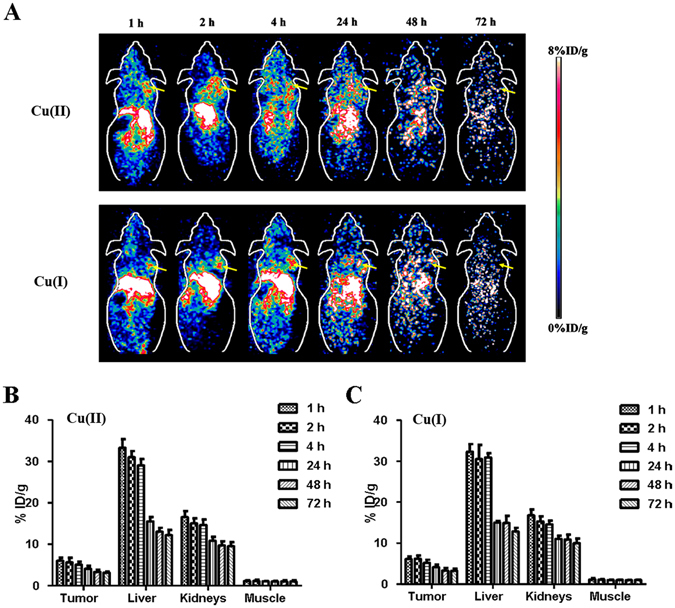
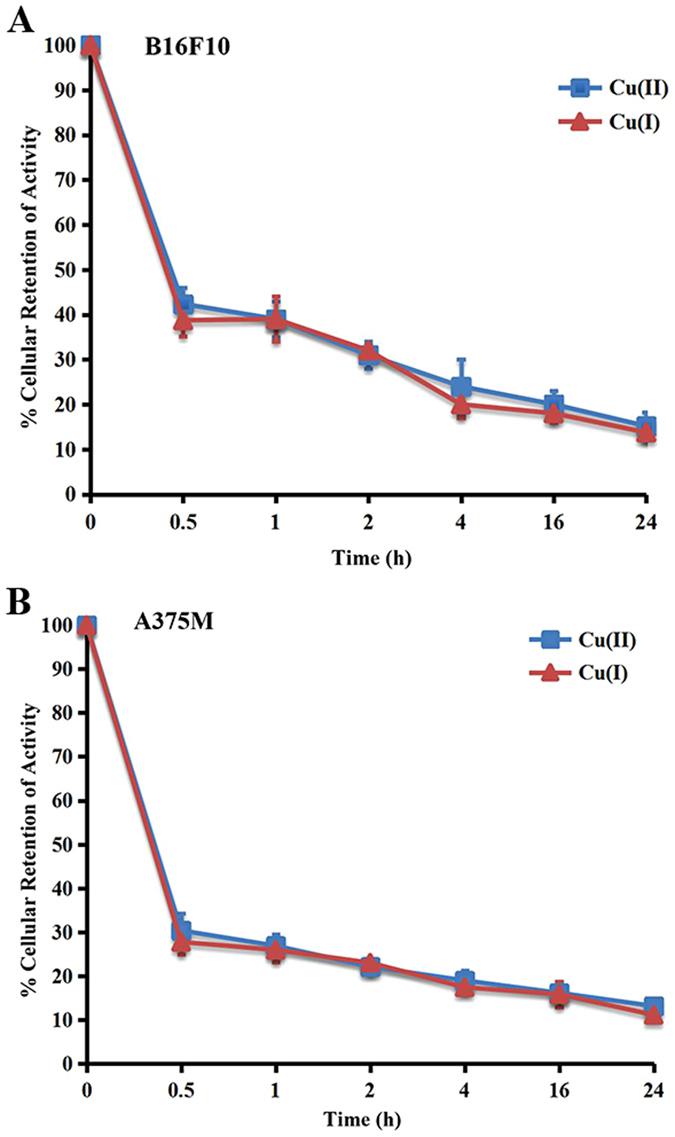
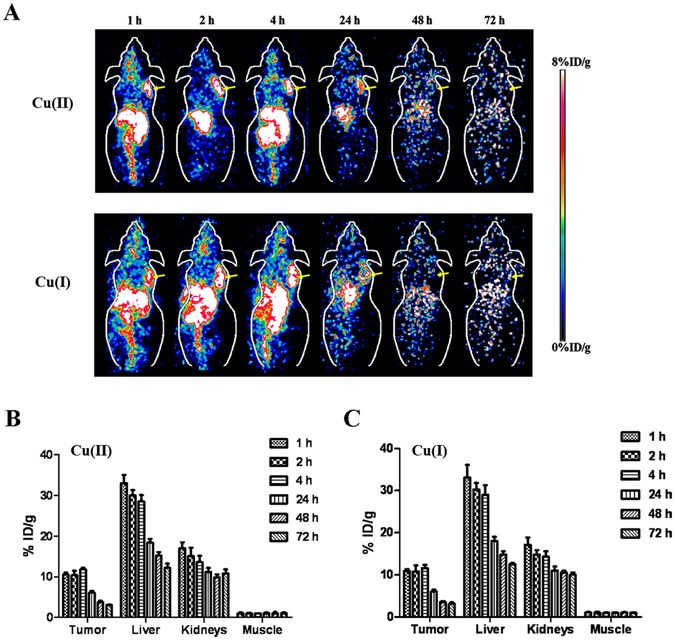
At present, Cu(II) labeled tracers including CuCl have been widely applied in the research of molecular imaging and therapy. Human copper transporter 1 (hCTR1) is the major high affinity copper influx transporter in mammalian cells, and specially responsible for the transportation of Cu(I) not Cu(II). Thus, we investigated the feasible application of Cu(I) for PET imaging. Cu(II) was reduced to Cu(I) with the existence of sodium L-ascorbate, DL-Dithiothreitol or cysteine. Cell uptake and efflux assay was investigated using B16F10 and A375 cell lines, respectively. Small animal PET and biodistribution studies were performed in both B16F10 and A375 tumor-bearing mice. Compared with Cu(II), Cu(I) exhibited higher cellular uptake by melanoma, which testified CTR1 specially influx of Cu(I). However, due to oxidation reaction in vivo, no significant difference between Cu(I) and Cu(II) was observed through PET images and biodistribution. Additionally, radiation absorbed doses for major tissues of human were calculated based on the mouse biodistribution. Radiodosimetry calculations for Cu(I) and Cu(II) were similar, which suggested that although melanoma were with high radiation absorbed doses, high radioactivity accumulation by liver and kidney should be noticed for the further application. Thus, Cu(I) should be further studied to evaluate it as a PET imaging radiotracer.
目前,Cu(II)标记示踪剂(如 CuCl)已广泛应用于分子成像和治疗的研究中。人铜转运蛋白 1(hCTR1)是哺乳动物细胞中主要的高亲和力铜内流转运蛋白,专门负责 Cu(I)而不是 Cu(II)的转运。因此,我们研究了 Cu(I)在 PET 成像中的可行应用。在存在抗坏血酸钠、DL-二硫苏糖醇或半胱氨酸的情况下,Cu(II)被还原为 Cu(I)。使用 B16F10 和 A375 细胞系分别进行细胞摄取和外排试验。在 B16F10 和 A375 荷瘤小鼠中进行小动物 PET 和生物分布研究。与 Cu(II)相比,Cu(I)在黑色素瘤中的细胞摄取率更高,这证明了 CTR1 专门摄取 Cu(I)。然而,由于体内的氧化反应,通过 PET 图像和生物分布没有观察到 Cu(I)和 Cu(II)之间的显著差异。此外,根据小鼠生物分布计算了 Cu(I)和 Cu(II)对人体主要组织的吸收剂量。Cu(I)和 Cu(II)的放射剂量计算结果相似,这表明尽管黑色素瘤具有较高的吸收剂量,但应注意肝脏和肾脏的高放射性积聚,以便进一步应用。因此,应进一步研究 Cu(I),以评估其作为 PET 成像放射性示踪剂的潜力。