Campos-Náñez Enrique, Fortwaengler Kurt, Breton Marc D
1 Center for Diabetes Technology, University of Virginia, Charlottesville, VA, USA.
2 Roche Diabetes Care, Mannheim, Germany.
J Diabetes Sci Technol. 2017 Nov;11(6):1187-1195. doi: 10.1177/1932296817710474. Epub 2017 Jun 1.
Patients with diabetes rely on blood glucose (BG) monitoring devices to manage their condition. As some self-monitoring devices are becoming more and more accurate, it becomes critical to understand the relationship between system accuracy and clinical outcomes, and the potential benefits of analytical accuracy.
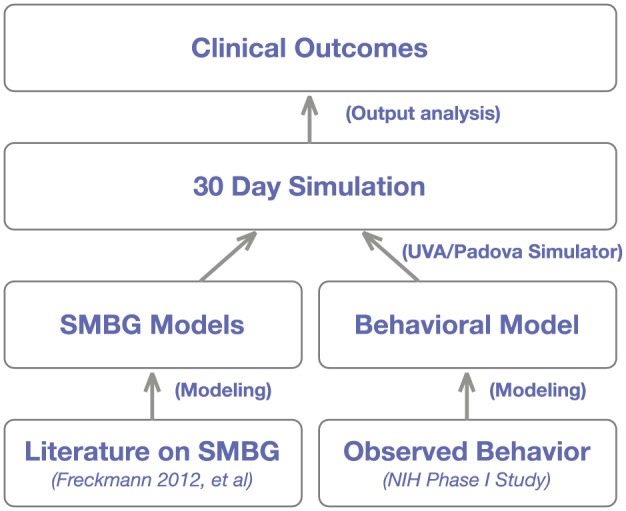
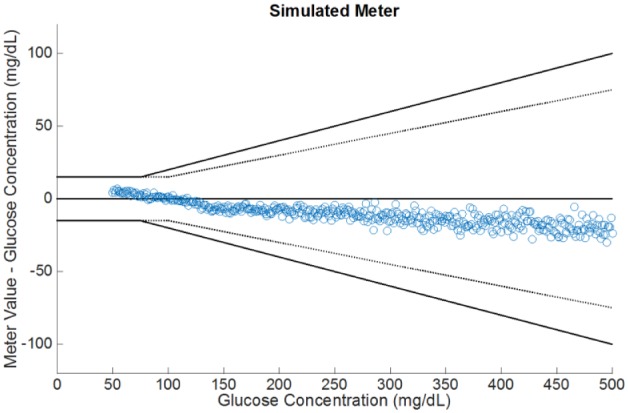
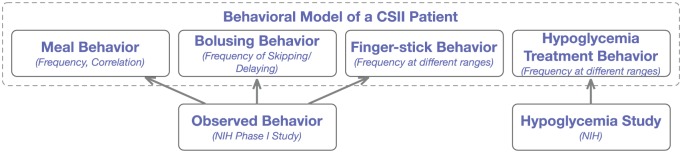
We conducted a 30-day in-silico study in type 1 diabetes mellitus (T1DM) patients using continuous subcutaneous insulin infusion (CSII) therapy and a variety of BG meters, using the FDA-approved University of Virginia (UVA)/Padova Type 1 Simulator. We used simulated meter models derived from the published characteristics of 43 commercial meters. By controlling random events in each parallel run, we isolated the differences in clinical performance that are directly associated with the meter characteristics.
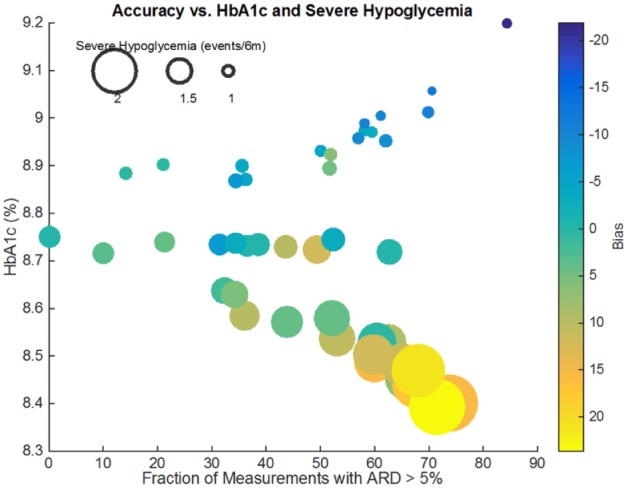
A meter's systematic bias has a significant and inverse effect on HbA1c ( P < .01), while also affecting the number of severe hypoglycemia events. On the other hand, error, defined as the fraction of measurements beyond 5% of the true value, is a predictor of severe hypoglycemia events ( P < .01), but in the absence of bias has a nonsignificant effect on average glycemia (HbA1c). Both bias and error have significant effects on total daily insulin (TDI) and the number of necessary glucose measurements per day ( P < .01). Furthermore, these relationships can be accurately modeled using linear regression on meter bias and error.
Two components of meter accuracy, bias and error, clearly affect clinical outcomes. While error has little effect on HbA1c, it tends to increase episodes of severe hypoglycemia. Meter bias has significant effects on all considered metrics: a positive systemic bias will reduce HbA1c, but increase the number of severe hypoglycemia attacks, TDI use, and number of fingersticks per day.
糖尿病患者依靠血糖(BG)监测设备来管理病情。随着一些自我监测设备越来越准确,了解系统准确性与临床结果之间的关系以及分析准确性的潜在益处变得至关重要。
我们使用美国食品药品监督管理局(FDA)批准的弗吉尼亚大学(UVA)/帕多瓦1型模拟器,对使用持续皮下胰岛素输注(CSII)疗法的1型糖尿病(T1DM)患者和多种血糖仪进行了为期30天的计算机模拟研究。我们使用从43种商用血糖仪的已发表特性中推导出来的模拟血糖仪模型。通过控制每个并行运行中的随机事件,我们分离出了与血糖仪特性直接相关的临床性能差异。
血糖仪的系统偏差对糖化血红蛋白(HbA1c)有显著的反向影响(P <.01),同时也影响严重低血糖事件的数量。另一方面,误差定义为超出真实值5%的测量值比例,是严重低血糖事件的一个预测指标(P <.01),但在没有偏差的情况下,对平均血糖水平(HbA1c)的影响不显著。偏差和误差对每日总胰岛素(TDI)和每天必要的血糖测量次数均有显著影响(P <.01)。此外,使用血糖仪偏差和误差的线性回归可以准确地模拟这些关系。
血糖仪准确性的两个组成部分,偏差和误差,明显影响临床结果。虽然误差对HbA1c影响不大,但它往往会增加严重低血糖发作的次数。血糖仪偏差对所有考虑的指标都有显著影响:正向系统偏差会降低HbA1c,但会增加严重低血糖发作次数、TDI使用量和每天的指尖采血次数。