State Key Joint Laboratory of Environmental Simulation and Pollution Control, School of Environment, Tsinghua University, Beijing, 10084, China.
Institute for Environmental Genomics, Department of Microbiology and Plant Biology and School of Civil Engineering and Environmental Sciences, University of Oklahoma, Norman, OK, 73019, USA.
Microbiome. 2017 May 31;5(1):57. doi: 10.1186/s40168-017-0272-8.
Bacteriophage-prokaryote dynamics and interaction are believed to be important in governing microbiome composition and ecosystem functions, yet our limited knowledge of the spatial and temporal variation in phage and prokaryotic community compositions precludes accurate assessment of their roles and impacts. Anaerobic digesters are ideal model systems to examine phage-host interaction, owing to easy access, stable operation, nutrient-rich environment, and consequently enormous numbers of phages and prokaryotic cells.
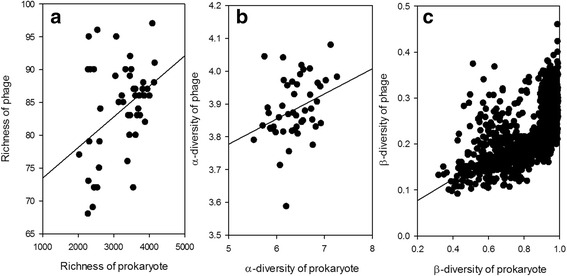
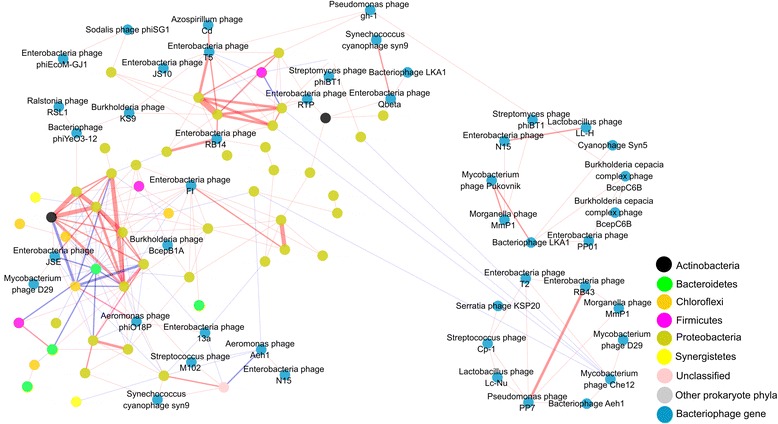
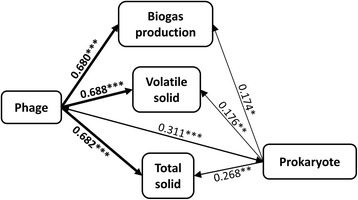
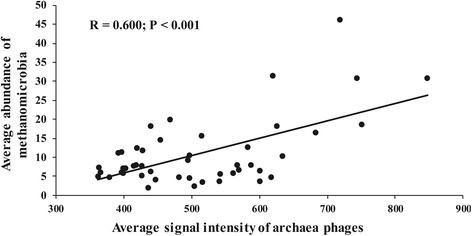
Equipped with high-throughput, cutting-edge environmental genomics techniques, we examined phage and prokaryotic community composition of four anaerobic digesters in full-scale wastewater treatment plants across China. Despite the relatively stable process performance in biogas production, phage and prokaryotic groups fluctuated monthly over a year of study period, showing significant correlations between those two groups at the α- and β-diversity levels. Strikingly, phages explained 40.6% of total variations of the prokaryotic community composition, much higher than the explanatory power by abiotic factors (14.5%). Consequently, phages were significantly (P < 0.010) linked to parameters related to process performance including biogas production and volatile solid concentrations. Association network analyses showed phage-prokaryote pairs were shallowly conserved since they were detected only within small viral clades.
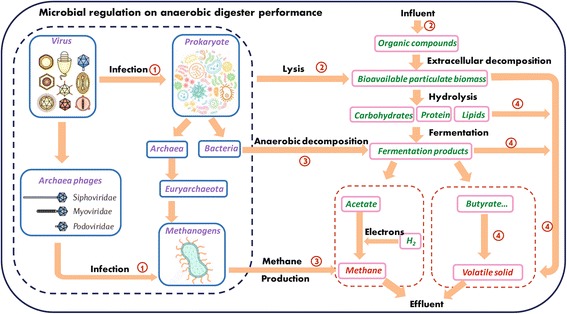
Those results collectively demonstrate phages as a major biotic factor in controlling prokaryotic composition and process performance. Therefore, phages may play a larger role in shaping prokaryotic community dynamics and process performance of anaerobic digesters than currently appreciated.
噬菌体-原核生物的动态和相互作用被认为对控制微生物组组成和生态系统功能很重要,但我们对噬菌体和原核生物群落组成的时空变化的了解有限,这妨碍了对其作用和影响的准确评估。由于易于接近、稳定的运行、富含营养的环境,以及因此大量的噬菌体和原核细胞,厌氧消化器是研究噬菌体-宿主相互作用的理想模型系统。
我们配备了高通量、最先进的环境基因组学技术,研究了中国四个全规模污水处理厂的四个厌氧消化器中的噬菌体和原核生物群落组成。尽管沼气生产过程性能相对稳定,但在一年的研究期间,噬菌体和原核生物群每月都有波动,在 α-和 β-多样性水平上两者之间存在显著相关性。引人注目的是,噬菌体解释了原核生物群落组成总变异的 40.6%,远高于非生物因素(14.5%)的解释能力。因此,噬菌体与与工艺性能相关的参数(包括沼气产量和挥发性固体浓度)显著相关(P < 0.010)。关联网络分析表明,噬菌体-原核生物对的保守性较浅,因为它们仅在小的病毒类群中检测到。
这些结果共同表明噬菌体是控制原核生物组成和工艺性能的主要生物因素。因此,噬菌体在塑造厌氧消化器中原核生物群落动态和工艺性能方面可能发挥的作用比目前认识的要大。