Yoo Jihyung, Lee Sang Kwang, Lim Mikyung, Sheen Donghyuk, Choi Eun-Hye, Kim Soon Ae
Department of Internal Medicine, School of Medicine, Eulji University, Daejeon, Korea.
Eulji Medi-Bio Research Institute, Eulji University, Daejeon, Korea.
Arthritis Res Ther. 2017 May 31;19(1):119. doi: 10.1186/s13075-017-1334-9.
Exosomes are thought to play an important role in exchanging information between cells. The proteins and lipids in exosomes play roles in mediating inflammatory and autoimmune diseases. The aim of this study was to identify exosomal candidate proteins that are related to other inflammatory parameters in rheumatoid arthritis (RA).
The study population consisted of 60 patients with RA: 30 in the clinical remission (CR) group with a Disease Activity Score in 28 joints based on erythrocyte sedimentation rate (DAS28-ESR) ≤2.6 and 30 in the non-clinical remission (non-CR) group with a DAS28-ESR >2.6. Preparation of exosomes from patient serum samples was performed with the ExoQuick kit, and protein identification/quantification was performed using tandem mass tag labeling/mass spectrometry and an enzyme-linked immunosorbent assay. Comparisons between groups were made using Student's t test or the Mann-Whitney U test, as appropriate. Spearman's correlation coefficients (ρ) were calculated.
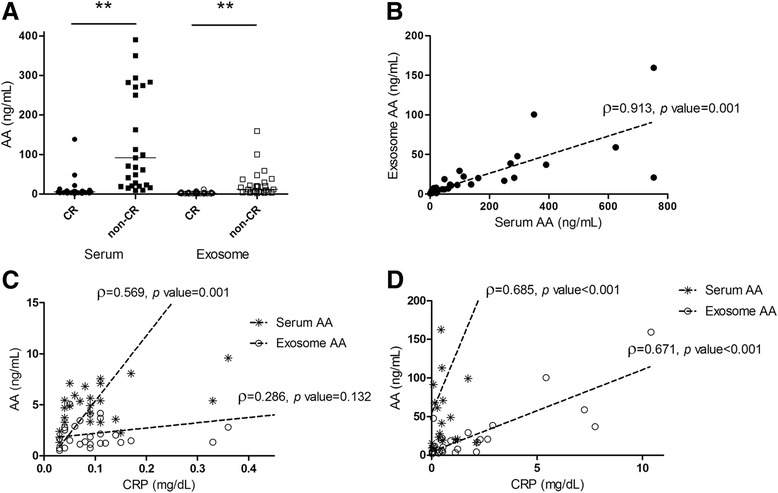
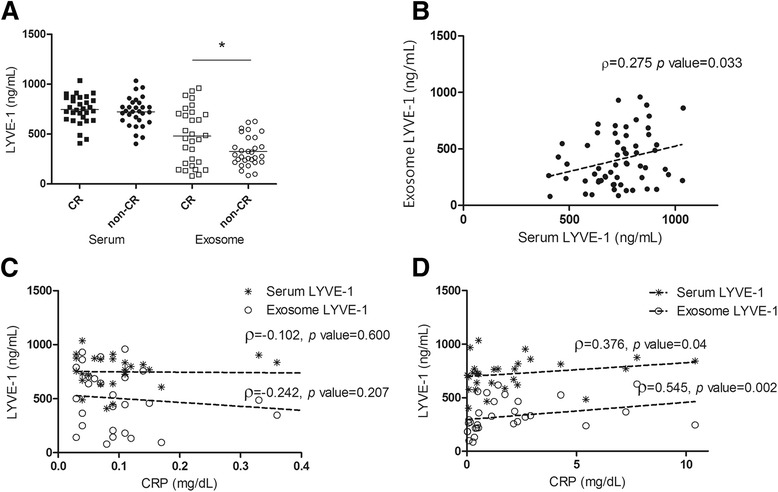
We identified six candidate proteins. Exosomal levels of amyloid A (AA) and lymphatic vessel endothelial hyaluronic acid receptor-1 (LYVE-1) differed between the CR and non-CR groups. Both serum and exosomal AA levels were higher in the non-CR group than in the CR group (p = 0.001). Significant positive correlations were found between exosomal AA and C-reactive protein (CRP) as well as between serum AA and CRP (ρ = 0.614, p = 0.001, and ρ = 0.624, p = 0.001, respectively). Although serum levels of LYVE-1 did not differ between the non-CR and CR groups, exosomal levels of LYVE-1 were lower in the non-CR group than in the CR group (p = 0.01). We identified positive correlations between serum/exosomal LYVE-1 and CRP only in the non-CR group (serum ρ = 0.376, p = 0.04; exosome ρ = 0.545, p = 0.002).
Exosomal LYVE-1 shows potential for use as an additional marker of disease activity in patients with RA, and exosomes may carry other useful markers for RA.
外泌体被认为在细胞间信息交换中起重要作用。外泌体中的蛋白质和脂质在介导炎症和自身免疫性疾病中发挥作用。本研究的目的是鉴定类风湿关节炎(RA)中与其他炎症参数相关的外泌体候选蛋白。
研究人群包括60例RA患者:30例处于临床缓解(CR)组,基于红细胞沉降率的28个关节疾病活动评分(DAS28-ESR)≤2.6;30例处于非临床缓解(非CR)组,DAS28-ESR>2.6。使用ExoQuick试剂盒从患者血清样本中制备外泌体,并使用串联质谱标签标记/质谱和酶联免疫吸附测定进行蛋白质鉴定/定量。根据情况,使用学生t检验或曼-惠特尼U检验进行组间比较。计算斯皮尔曼相关系数(ρ)。
我们鉴定出六种候选蛋白。CR组和非CR组之间,外泌体淀粉样蛋白A(AA)和淋巴管内皮透明质酸受体-1(LYVE-1)水平存在差异。非CR组的血清和外泌体AA水平均高于CR组(p = 0.001)。在外泌体AA与C反应蛋白(CRP)之间以及血清AA与CRP之间发现显著正相关(ρ分别为0.614,p = 0.001和ρ = 0.624,p = 0.001)。尽管非CR组和CR组之间LYVE-1的血清水平没有差异,但非CR组的外泌体LYVE-1水平低于CR组(p = 0.01)。仅在非CR组中,我们发现血清/外泌体LYVE-1与CRP之间存在正相关(血清ρ = 0.376,p = 0.04;外泌体ρ = 0.545,p = 0.002)。
外泌体LYVE-1显示出作为RA患者疾病活动额外标志物的潜力,并且外泌体可能携带其他对RA有用的标志物。