From the Ingestive Behavior and Obesity Program (Sanmiguel, Gupta, Ju, Stains, Coveleskie, Mayer, Labus), Oppenheimer Center for Neurobiology of Stress & Resilience; Department of Surgery (Balioukova, Chen, Dutson), Center for Obesity and Metabolic Health; UCLA Microbiome Center (Sanmiguel, Jacobs, Lagishetty, Mayer, Labus); and David Geffen School of Medicine at UCLA (Sanmiguel, Jacobs, Gupta, Ju, Stains, Lagishetty, Balioukova, Chen, Dutson, Mayer, Labus), Los Angeles, California.
Psychosom Med. 2017 Oct;79(8):880-887. doi: 10.1097/PSY.0000000000000494.
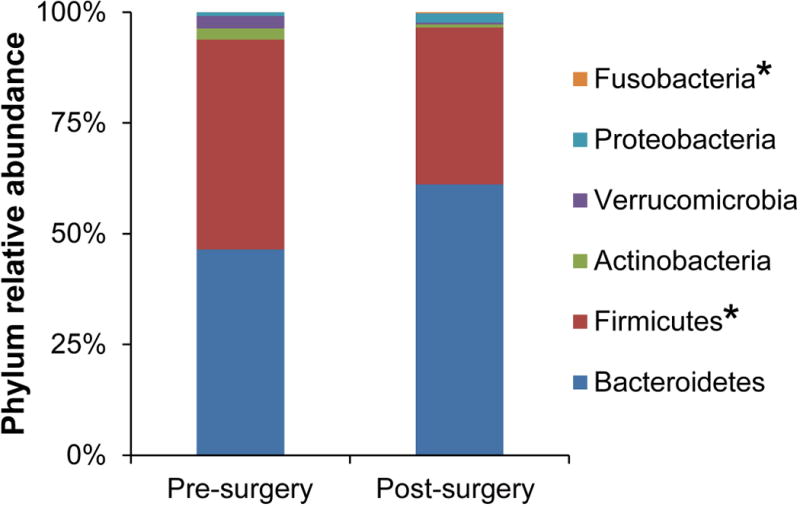
Weight loss surgery results in significant changes in the anatomy, function, and intraluminal environment of the gastrointestinal tract affecting the gut microbiome. Although bariatric surgery results in sustained weight loss, decreased appetite, and hedonic eating, it is unknown whether the surgery-induced alterations in gut microbiota play a role in the observed changes in hedonic eating. We explored the following hypotheses: (1) laparoscopic sleeve gastrectomy (LSG) results in changes in gut microbial composition; (2) alterations in gut microbiota are related to weight loss; (3) alterations in gut microbiome are associated with changes in appetite and hedonic eating.
Eight obese women underwent LSG. Their body mass index, body fat mass, food intake, hunger, hedonic eating scores, and stool samples were obtained at baseline and 1-month postsurgery. 16S ribosomal RNA gene sequencing was performed on stool samples. DESeq2 changes in microbial abundance. Multilevel-sparse partial least squares discriminant analysis was applied to genus-level abundance for discriminative microbial signatures.
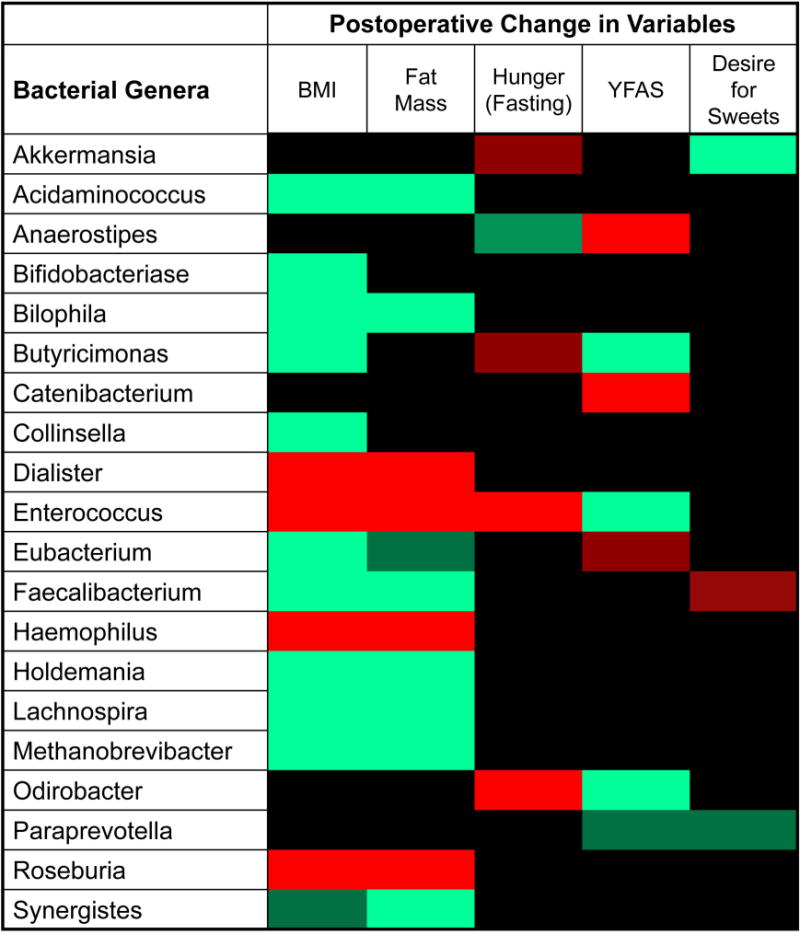
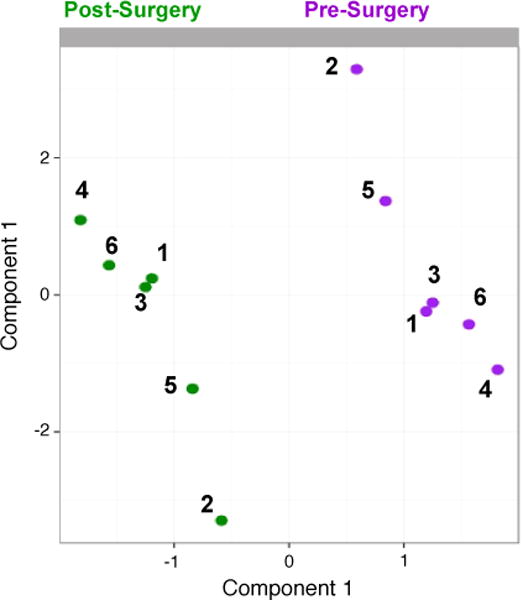
LSG resulted in significant reductions in body mass index, food intake, and hedonic eating. A microbial signature composed of five bacterial genera discriminated between pre- and postsurgery status. Several bacterial genera were significantly associated with weight loss (Bilophila, q = 3E-05; Faecalibacterium q = 4E-05), lower appetite (Enterococcus, q = 3E-05), and reduced hedonic eating (Akkermansia, q = .037) after surgery.
In this preliminary analysis, changes in gut microbial abundance discriminated between pre- and postoperative status. Alterations in gut microbiome were significantly associated with weight loss and with reduced hedonic eating after surgery; however, a larger sample is needed to confirm these findings.
减肥手术会导致胃肠道解剖结构、功能和腔内环境发生重大变化,从而影响肠道微生物组。虽然减重手术可带来持续的体重减轻、食欲下降和愉悦性进食,但尚不清楚手术引起的肠道微生物群改变是否在观察到的愉悦性进食变化中发挥作用。我们探索了以下假设:(1)腹腔镜袖状胃切除术(LSG)会导致肠道微生物组成发生变化;(2)肠道微生物群的改变与体重减轻有关;(3)肠道微生物组的改变与食欲和愉悦性进食的变化有关。
8 名肥胖女性接受了 LSG。她们的体重指数、体脂肪量、食物摄入量、饥饿感、愉悦性进食评分和粪便样本在基线和术后 1 个月时进行了采集。对粪便样本进行了 16S 核糖体 RNA 基因测序。使用 DESeq2 分析微生物丰度的变化。采用多层稀疏偏最小二乘判别分析(multilevel-sparse partial least squares discriminant analysis)对属水平丰度进行判别性微生物特征分析。
LSG 显著降低了体重指数、食物摄入量和愉悦性进食。由五个细菌属组成的微生物特征可区分手术前后的状态。几个细菌属与体重减轻显著相关(Bilophila,q = 3E-05;Faecalibacterium,q = 4E-05),与术后食欲降低(Enterococcus,q = 3E-05)和愉悦性进食减少(Akkermansia,q =.037)相关。
在这项初步分析中,肠道微生物丰度的变化可区分手术前后的状态。肠道微生物组的改变与体重减轻以及手术后愉悦性进食减少显著相关;然而,需要更大的样本量来证实这些发现。