Reiter Paul L, Katz Mira L, Bauermeister Jose A, Shoben Abigail B, Paskett Electra D, McRee Annie-Laurie
College of Medicine, Ohio State University, Columbus, OH, United States.
College of Public Health, Ohio State University, Columbus, OH, United States.
JMIR Public Health Surveill. 2017 Jun 2;3(2):e33. doi: 10.2196/publichealth.7545.
Web-based approaches, specifically social media sites, represent a promising approach for recruiting young gay and bisexual men for research studies. Little is known, however, about how the performance of social media advertisements (ads) used to recruit this population is affected by ad content (ie, image and text).
The aim of this study was to evaluate the effects of different images and text included in social media ads used to recruit young gay and bisexual men for the pilot test of a Web-based human papillomavirus (HPV) vaccination intervention.
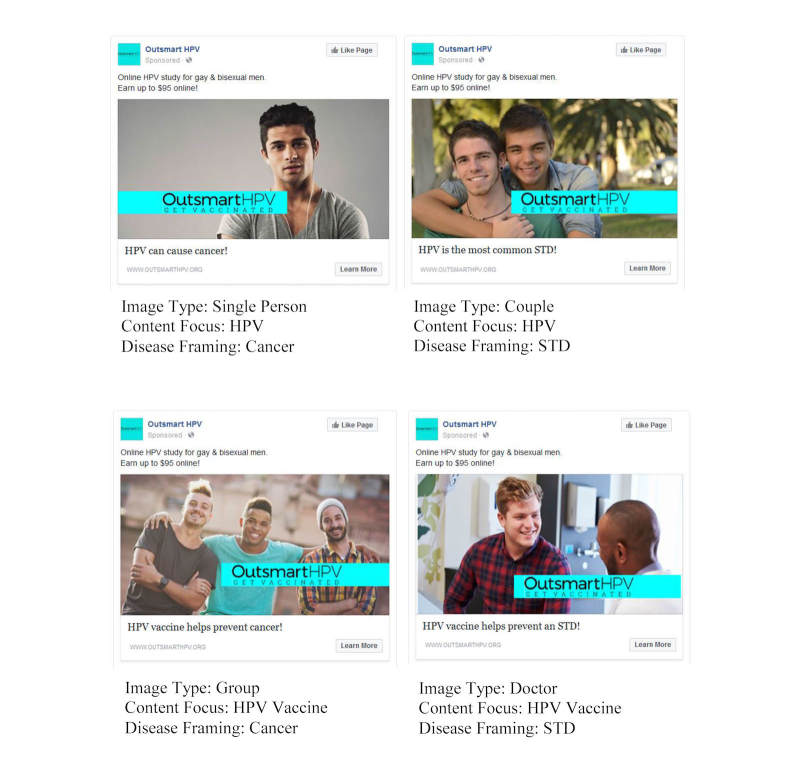
In July and September 2016, we used paid Facebook advertisements to recruit men who were aged 18-25 years, self-identified as gay or bisexual, US resident, and had not received HPV vaccine. A 4x2x2 factorial experiment varied ad image (a single young adult male, a young adult male couple, a group of young adult men, or a young adult male talking to a doctor), content focus (text mentioning HPV or HPV vaccine), and disease framing (text mentioning cancer or a sexually transmitted disease [STD]). Poisson regression determined whether these experimental factors affected ad performance.
The recruitment campaign reached a total of 35,646 users who viewed ads for 36,395 times. This resulted in an overall unique click-through rate of 2.01% (717/35,646) and an overall conversion rate of 0.66% (241/36,395). Reach was higher for ads that included an image of a couple (incidence rate ratio, IRR=4.91, 95% CI 2.68-8.97, P<.001) or a group (IRR=2.65, 95% CI 1.08-6.50, P=.03) compared with those that included an image of a single person. Ads that included an image of a couple also had a higher conversion rate (IRR=2.56, 95% CI 1.13-5.77, P=.02) than ads that included an image of a single person. Ads with text mentioning an STD had a higher unique click-through rate compared with ads with text mentioning cancer (IRR=1.34, 95% CI 1.06-1.69, P=.01). The campaign cost a total of US $413.72 and resulted in 150 eligible and enrolled individuals (US $2.76 per enrolled participant).
Facebook ads are a convenient and cost-efficient strategy for reaching and recruiting young gay and bisexual men for a Web-based HPV vaccination intervention. To help optimize ad performance among this population, researchers should consider the importance of the text and image included in the social media recruitment ads.
基于网络的方法,特别是社交媒体网站,是招募年轻男同性恋者和双性恋者参与研究的一种很有前景的途径。然而,对于用于招募该人群的社交媒体广告(广告)的效果如何受到广告内容(即图像和文字)的影响,我们知之甚少。
本研究旨在评估用于招募年轻男同性恋者和双性恋者以进行基于网络的人乳头瘤病毒(HPV)疫苗接种干预试点测试的社交媒体广告中不同图像和文字的效果。
在2016年7月和9月,我们使用付费脸书广告招募年龄在18 - 25岁、自我认定为男同性恋或双性恋、美国居民且未接种HPV疫苗的男性。一项4×2×2析因实验改变了广告图像(一名年轻成年男性、一对年轻成年男性情侣、一群年轻成年男性或一名年轻成年男性与医生交谈)、内容重点(提及HPV或HPV疫苗的文字)以及疾病框架(提及癌症或性传播疾病[STD]的文字)。泊松回归确定这些实验因素是否影响广告效果。
招募活动共覆盖35646名用户,他们查看广告36395次。这导致总体唯一点击率为2.01%(717/35646),总体转化率为0.66%(241/36395)。与包含单人图像的广告相比,包含情侣图像(发病率比,IRR = 4.91,95%可信区间2.68 - 8.97,P <.001)或群体图像(IRR = 2.65,95%可信区间1.08 - 6.50,P =.03)的广告覆盖面更高。包含情侣图像的广告转化率(IRR = 2.56,95%可信区间1.13 - 5.77,P =.02)也高于包含单人图像的广告。与提及癌症的文字的广告相比,提及性传播疾病的文字的广告具有更高的唯一点击率(IRR = 1.34,95%可信区间1.06 - 1.69,P =.01)。该活动总成本为413.72美元,共招募到150名符合条件并登记的个体(每位登记参与者成本为2.76美元)。
脸书广告是一种便捷且经济高效的策略,可用于覆盖和招募年轻男同性恋者和双性恋者参与基于网络的HPV疫苗接种干预。为帮助优化该人群中的广告效果,研究人员应考虑社交媒体招募广告中文字和图像的重要性。