Wang Xia-Rong, Gao Si-Qian, Niu Xiao-Qian, Li Long-Jian, Ying Xiao-Ying, Hu Zhong-Jie, Gao Jian-Qing
Institute of Pharmaceutics, College of Pharmaceutical Sciences, Zhejiang University, Hangzhou.
Zhejiang Provincial Corps Hospital of Chinese People's Armed Police Forces, Jiaxing, Zhejiang.
Int J Nanomedicine. 2017 May 22;12:3881-3898. doi: 10.2147/IJN.S131901. eCollection 2017.
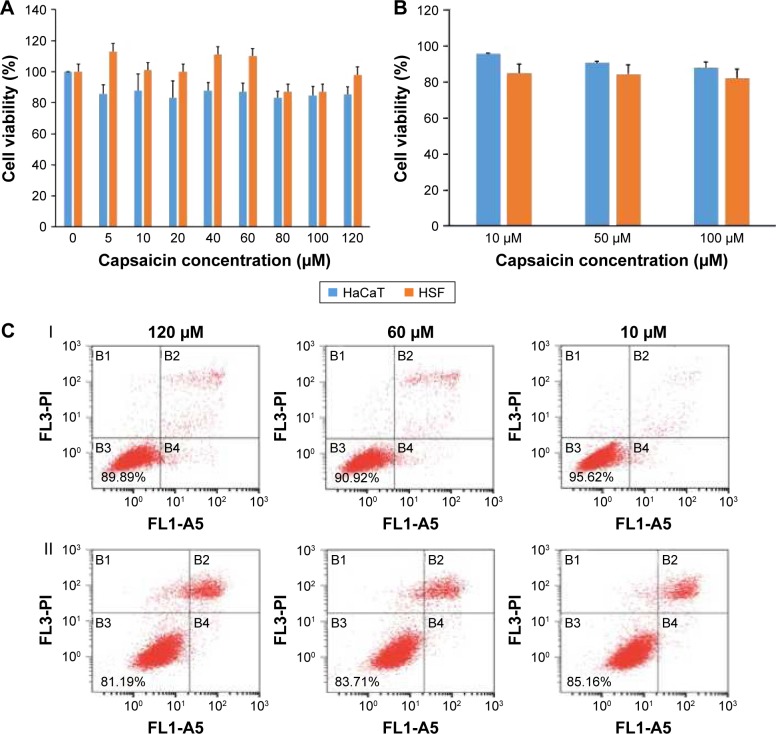
Capsaicin has been used in clinical applications for the treatment of pain disorders and inflammatory diseases. Given the strong pungency and high oil/water partition coefficient of capsaicin, capsaicin-loaded nanolipoidal carriers (NLCs) were designed to increase permeation and achieve the analgesic, anti-inflammatory effect with lower skin irritation. Capsaicin-loaded NLCs were prepared and later optimized by the Box-Behnken design. The physicochemical characterizations, morphology, and encapsulation of the capsaicin-loaded NLCs were subsequently confirmed. Capsaicin-loaded NLCs and capsaicin-loaded NLCs gel exhibited sustained release and no cytotoxicity properties. Also, they could significantly enhance the penetration amount, permeation flux, and skin retention amounts of capsaicin due to the application of NLCs. To study the topical permeation mechanism of capsaicin, 3,3'-dioctadecyloxacarbocyanine perchlorate (Dio) was used as a fluorescent dye. Dio-loaded NLCs and Dio-loaded NLCs gel could effectively deliver Dio up to a skin depth of 260 and 210 μm, respectively, primarily through the appendage route on the basis of version skin sections compared with Dio solution, which only delivered Dio up to 150 μm. In vivo therapeutic experiments demonstrated that capsaicin-loaded NLCs and capsaicin-loaded NLCs gel could improve the pain threshold in a dose-dependent manner and inhibit inflammation, primarily by reducing the prostaglandin E2 levels in the tissue compared with capsaicin cream and capsaicin solution. Meanwhile, skin irritation was reduced, indicating that application of NLCs could decrease the irritation caused by capsaicin. Overall, NLCs may be a potential carrier for topical delivery of capsaicin for useful pain and inflammation therapy.
辣椒素已被用于临床治疗疼痛性疾病和炎症性疾病。鉴于辣椒素具有强烈的辛辣味和高油/水分配系数,设计了载辣椒素纳米脂质载体(NLCs)以增加其渗透性,并在降低皮肤刺激性的同时实现镇痛、抗炎效果。制备了载辣椒素NLCs,随后通过Box-Behnken设计进行优化。随后对载辣椒素NLCs的物理化学特性、形态和包封情况进行了确认。载辣椒素NLCs和载辣椒素NLCs凝胶表现出缓释且无细胞毒性的特性。此外,由于NLCs的应用,它们能显著提高辣椒素的渗透量、渗透通量和皮肤保留量。为了研究辣椒素的局部渗透机制,使用3,3'-二辛基氧杂羰花青高氯酸盐(Dio)作为荧光染料。与仅能将Dio输送至150μm深度的Dio溶液相比,载Dio的NLCs和载Dio的NLCs凝胶分别能有效地将Dio输送至皮肤深度260μm和210μm,主要通过附属器途径。体内治疗实验表明,与辣椒素乳膏和辣椒素溶液相比,载辣椒素NLCs和载辣椒素NLCs凝胶能以剂量依赖的方式提高痛阈并抑制炎症,主要是通过降低组织中前列腺素E2的水平。同时,皮肤刺激性降低,表明NLCs的应用可减少辣椒素引起的刺激。总体而言,NLCs可能是用于局部递送辣椒素以有效治疗疼痛和炎症的潜在载体。