Fornell Anna, Ohlin Mathias, Garofalo Fabio, Nilsson Johan, Tenje Maria
Department Biomedical Engineering, Lund University, Lund, Sweden.
Department Engineering Sciences, Uppsala University, Uppsala, Sweden.
Biomicrofluidics. 2017 May 26;11(3):031101. doi: 10.1063/1.4984131. eCollection 2017 May.
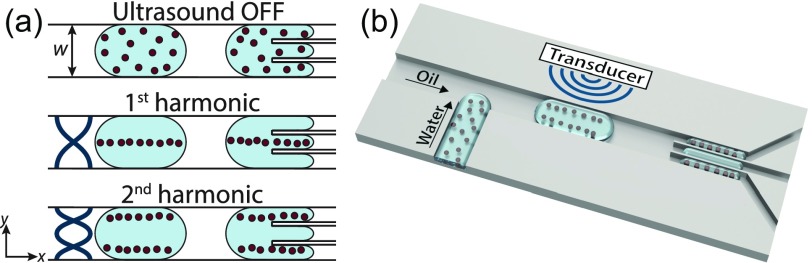
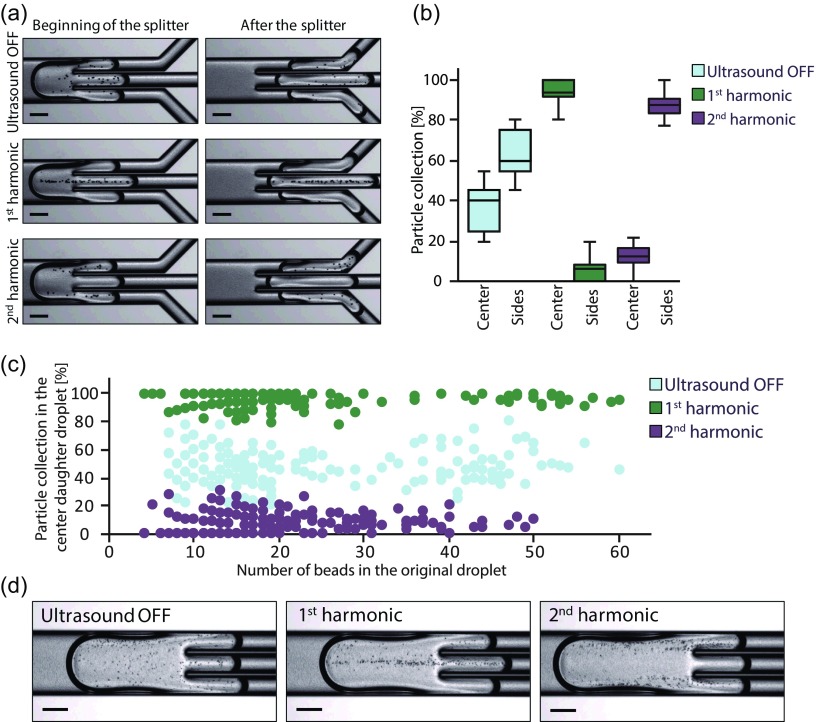
To transfer cell- and bead-assays into droplet-based platforms typically requires the use of complex microfluidic circuits, which calls for methods to switch the direction of the encapsulated particles. We present a microfluidic chip where the combination of acoustic manipulation at two different harmonics and a trident-shaped droplet-splitter enables direction-switching of microbeads and yeast cells in droplet microfluidic circuits. At the first harmonic, the encapsulated particles exit the splitter in the center daughter droplets, while at the second harmonic, the particles exit in the side daughter droplets. This method holds promises for droplet-based assays where particle-positioning needs to be selectively controlled.
要将基于细胞和珠子的检测方法转移到基于液滴的平台上,通常需要使用复杂的微流控电路,这就需要有方法来切换被包裹颗粒的方向。我们展示了一种微流控芯片,其中两种不同谐波的声学操控与三叉戟形状的液滴分离器相结合,能够在液滴微流控电路中实现微珠和酵母细胞的方向切换。在基波时,被包裹的颗粒从分离器进入中间的子液滴,而在二次谐波时,颗粒从侧面的子液滴中流出。这种方法对于需要选择性控制颗粒定位的基于液滴的检测具有应用前景。