Banerjee Anindita, Khemka Vineet Kumar, Roy Debashree, Dhar Aparajita, Sinha Roy Tapan Kumar, Biswas Atanu, Mukhopadhyay Barun, Chakrabarti Sasanka
1Department of Biochemistry, ICARE Institute of Medical Sciences and Research, Haldia, India.
2Department of Biochemistry, Institute of Post Graduate Medical Education and Research, Kolkata, India.
Aging Dis. 2017 May 2;8(3):267-276. doi: 10.14336/AD.2016.1017. eCollection 2017 May.
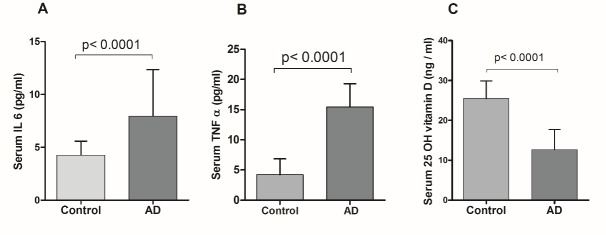
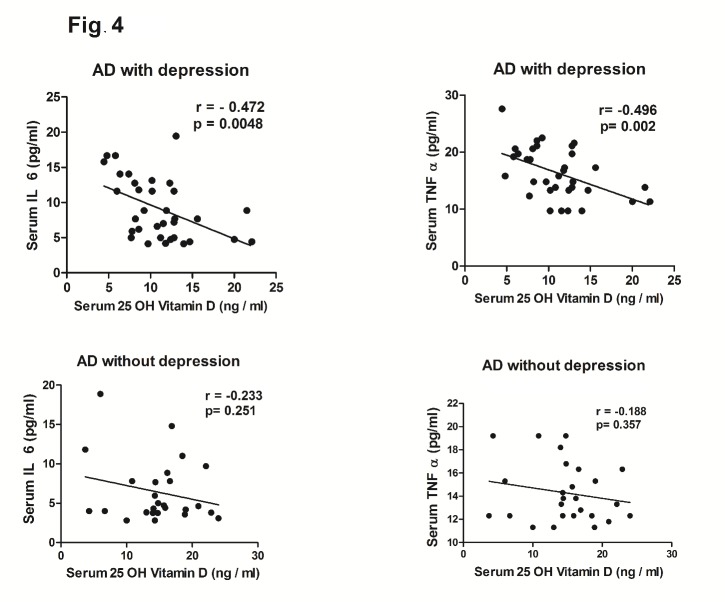
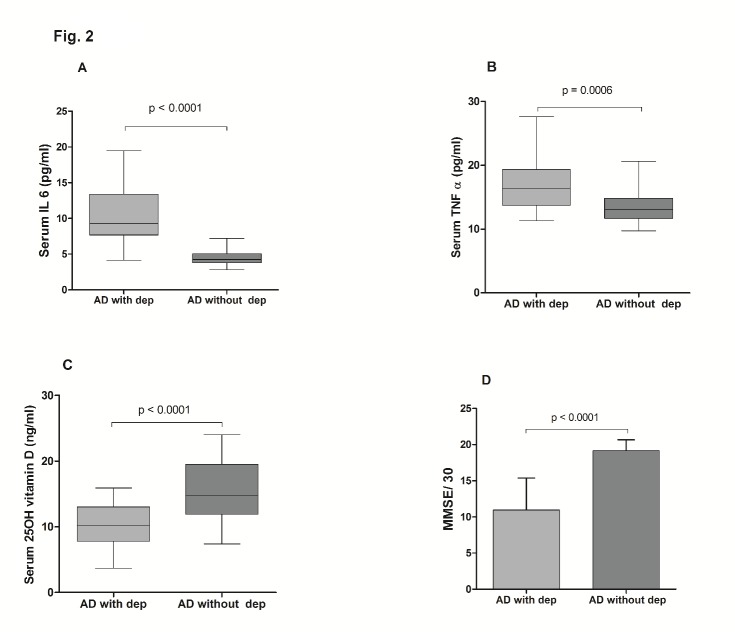
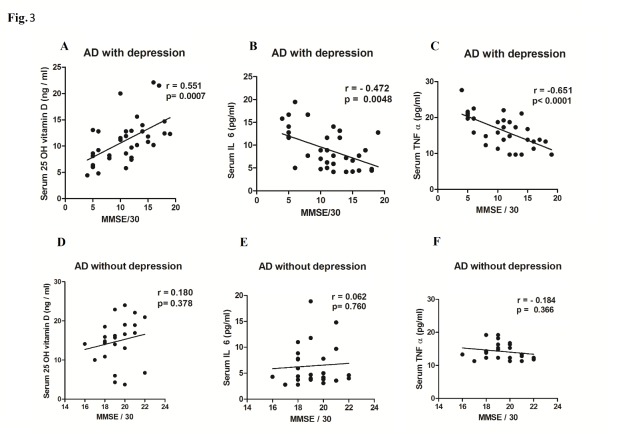
Symptoms of depression are present in a significant proportion of Alzheimer's disease (AD) patients. While epidemiological studies have shown a strong association between depression and AD, it has not been established whether depression is a risk factor or merely a co-morbidity of AD. It is also uncertain if depression affects the pathogenesis of AD. In this paper, we address these questions by measuring the serum levels of two common metabolic risk factors of AD and depression, inflammatory cytokines (IL 6 and TNF alpha) and serum 25-hydroxyvitamin D, in a case-control study. We measured the serum levels of IL 6, TNF α and 25-hydroxyvitamin D in age-matched healthy controls (n= 60) and in AD patients without depression (n=26) or AD patients with depression (n=34), and statistically analyzed the changes in these parameters among different groups under this study. Our results show that in AD there is a significant increase in IL 6 and TNF α and a marked decrease in 25-hydroxyvitamin D in the peripheral circulation compared to age-matched healthy controls. Furthermore, AD patients with depression have even significantly higher levels of IL 6 or TNF α and a lower level of 25-hydroxyvitamin D in circulation than in AD patients without depression. We also found a strong statistical correlation between the disease severity and the serum levels of IL 6, TNF α and 25-hydroxyvitamin D in AD patients with depression. These results suggest that altered circulating levels of common metabolic risk factors lead to the co-existence of depression with AD in many patients, and when they co-exist, the depression presumably affects the severity of AD presentations through more aggravated changes in these risk factors.
相当一部分阿尔茨海默病(AD)患者存在抑郁症状。虽然流行病学研究表明抑郁与AD之间存在密切关联,但抑郁是AD的危险因素还是仅仅是一种合并症尚未确定。抑郁是否影响AD的发病机制也不确定。在本文中,我们通过一项病例对照研究测量AD和抑郁的两种常见代谢危险因素——炎性细胞因子(IL-6和TNF-α)以及血清25-羟基维生素D的血清水平来解决这些问题。我们测量了年龄匹配的健康对照者(n = 60)、无抑郁的AD患者(n = 26)以及有抑郁的AD患者(n = 34)的IL-6、TNF-α和25-羟基维生素D的血清水平,并对本研究中不同组之间这些参数的变化进行了统计学分析。我们的结果表明,与年龄匹配的健康对照者相比,AD患者外周循环中IL-6和TNF-α显著升高,而25-羟基维生素D显著降低。此外,有抑郁的AD患者循环中的IL-6或TNF-α水平甚至比无抑郁的AD患者更高,而25-羟基维生素D水平更低。我们还发现,在有抑郁的AD患者中,疾病严重程度与IL-6、TNF-α和25-羟基维生素D的血清水平之间存在很强的统计学相关性。这些结果表明,常见代谢危险因素的循环水平改变导致许多患者的抑郁与AD共存,并且当它们共存时,抑郁可能通过这些危险因素更严重的变化影响AD症状的严重程度。