Richardson J D, Thompson A, King L, Corbett B, Shnaider P, St Cyr K, Nelson C, Sareen J, Elhai J, Zamorski M
Western University, 1151 Richmond St, London, ON, N6A 3K7, Canada.
McMaster University, 1280 Main St W, Hamilton, ON, L8S 4L8, Canada.
BMC Psychiatry. 2017 Jun 6;17(1):211. doi: 10.1186/s12888-017-1372-5.
Past research on the association between insomnia and suicidal ideation (SI) has produced mixed findings. The current study explored the relationship between insomnia, SI, and past-year mental health status among a large Canadian Forces (CF) sample.
Data was obtained from the 2013 Canadian Forces Mental Health Survey (CFMHS), and included a large representative sample of Canadian Regular Forces personnel (N = 6700). A series of univariate logistic regressions were conducted to test individual associations between past-year mental health status, insomnia, and potential confounds and SI. Mental health status included three groups: 0, 1, or two or more probable diagnoses of posttraumatic stress disorder (PTSD), major depressive disorder (MDD), generalized anxiety disorder (GAD), panic disorder (PD) and alcohol abuse/dependence. Stepwise multivariate logistic regression was used to assess the relationship between insomnia and SI with mental health status as a moderator.
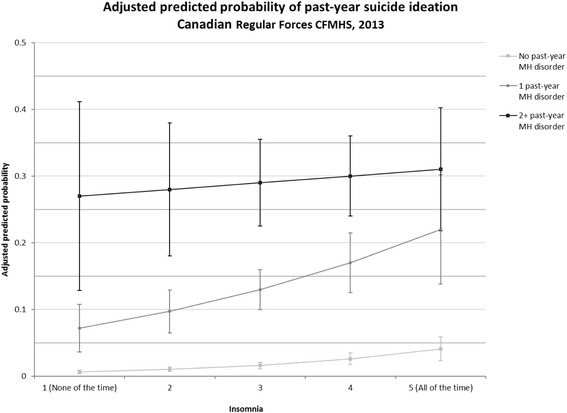
40.8% of respondents reported experiencing insomnia. Both insomnia and number of mental health conditions incrementally increased the risk of SI. However, past-year mental health status was a significant moderator of this relationship, such that for CF personnel with either no (AOR = 1.61, 1.37-1.89) or only one past-year mental health condition (AOR = 1.39, 1.12-1.73), an incremental increase in insomnia was associated with an increased likelihood of SI. However, in personnel with two or more past-year mental health disorders, insomnia was no longer significantly associated with SI (AOR = 1.04, 0.81-1.33).
Insomnia significantly increased the odds of SI, but only among individuals with no or one mental health condition. Findings highlight the importance of assessing insomnia among CF members in order to further suicide prevention efforts.
过去关于失眠与自杀意念(SI)之间关联的研究结果不一。本研究在一个庞大的加拿大军队(CF)样本中探讨了失眠、自杀意念和过去一年心理健康状况之间的关系。
数据来自2013年加拿大军队心理健康调查(CFMHS),包括加拿大正规部队人员的一个大型代表性样本(N = 6700)。进行了一系列单变量逻辑回归,以检验过去一年心理健康状况、失眠、潜在混杂因素与自杀意念之间的个体关联。心理健康状况包括三组:0、1或两种或更多可能的创伤后应激障碍(PTSD)、重度抑郁症(MDD)、广泛性焦虑症(GAD)、惊恐障碍(PD)和酒精滥用/依赖诊断。采用逐步多变量逻辑回归,以心理健康状况作为调节变量,评估失眠与自杀意念之间的关系。
40.8%的受访者报告有失眠经历。失眠和心理健康状况的数量都逐步增加了自杀意念的风险。然而,过去一年的心理健康状况是这种关系的一个重要调节变量,对于过去一年没有(优势比[AOR]=1.61,1.37 - 1.89)或只有一种心理健康状况的CF人员(AOR = 1.39,1.12 - 1.73),失眠的逐渐增加与自杀意念可能性的增加相关。然而,在过去一年有两种或更多心理健康障碍的人员中,失眠与自杀意念不再有显著关联(AOR = 1.04,0.81 - 1.33)。
失眠显著增加了自杀意念的几率,但仅在没有或有一种心理健康状况的个体中如此。研究结果凸显了评估CF成员失眠情况对于进一步开展自杀预防工作的重要性。