Ma Teng, Sun Jiacheng, Zhao Zhenao, Lei Wei, Chen Yueqiu, Wang Xu, Yang Junjie, Shen Zhenya
Department of Cardiovascular Surgery of the First Affiliated Hospital & Institute for Cardiovascular Science, Soochow University, No.899, Pinghai Road, Suzhou, 215006, China.
Stem Cell Res Ther. 2017 Jun 5;8(1):124. doi: 10.1186/s13287-017-0585-3.
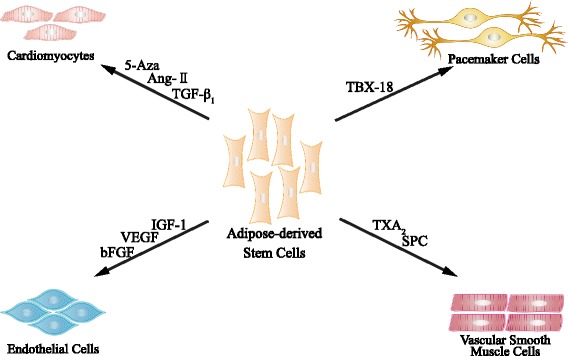
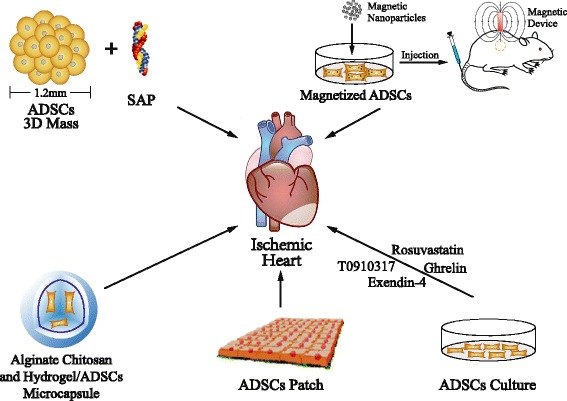
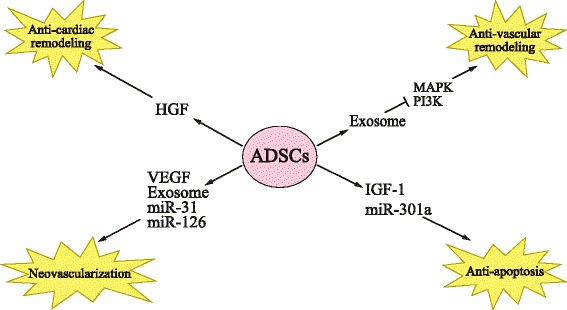
Adipose-derived stem cells (ADSCs) are easily obtained and expanded, and have emerged as a novel source of adult stem cells for the treatment of cardiovascular diseases. These cells have been shown to have the capability of differentiating into cardiomyocytes, vascular smooth muscle cells, and endothelial cells. Furthermore, ADSCs secrete a series of paracrine factors to promote neovascularization, reduce apoptosis, and inhibit fibrosis, which contributes to cardiac regeneration. As a novel therapy in the regenerative field, ADSCs still face various limitations, such as low survival and engraftment. Thus, engineering and pharmacological studies have been conducted to solve these problems. Investigations have moved into phase I and II clinical trials examining the safety and efficacy of ADSCs in the setting of myocardial infarction. In this review, we discuss the differentiation and paracrine functions of ADSCs, the strategies promoting their therapeutic efficacy, and their clinical usage.
脂肪来源干细胞(ADSCs)易于获取和扩增,已成为用于治疗心血管疾病的新型成体干细胞来源。这些细胞已被证明具有分化为心肌细胞、血管平滑肌细胞和内皮细胞的能力。此外,ADSCs分泌一系列旁分泌因子以促进新血管形成、减少细胞凋亡并抑制纤维化,这有助于心脏再生。作为再生领域的一种新型疗法,ADSCs仍面临各种限制,如低存活率和低植入率。因此,已经开展了工程学和药理学研究来解决这些问题。研究已进入I期和II期临床试验,以检验ADSCs在心肌梗死情况下的安全性和有效性。在本综述中,我们讨论了ADSCs的分化和旁分泌功能、提高其治疗效果的策略及其临床应用。