Satuvuori Eero, Mulansky Mario, Bozanic Nebojsa, Malvestio Irene, Zeldenrust Fleur, Lenk Kerstin, Kreuz Thomas
Institute for Complex Systems, CNR, Sesto Fiorentino, Italy; Department of Physics and Astronomy, University of Florence, Sesto Fiorentino, Italy; MOVE Research Institute, Department of Human Movement Sciences, Vrije Universiteit Amsterdam, The Netherlands.
Institute for Complex Systems, CNR, Sesto Fiorentino, Italy.
J Neurosci Methods. 2017 Aug 1;287:25-38. doi: 10.1016/j.jneumeth.2017.05.028. Epub 2017 Jun 3.
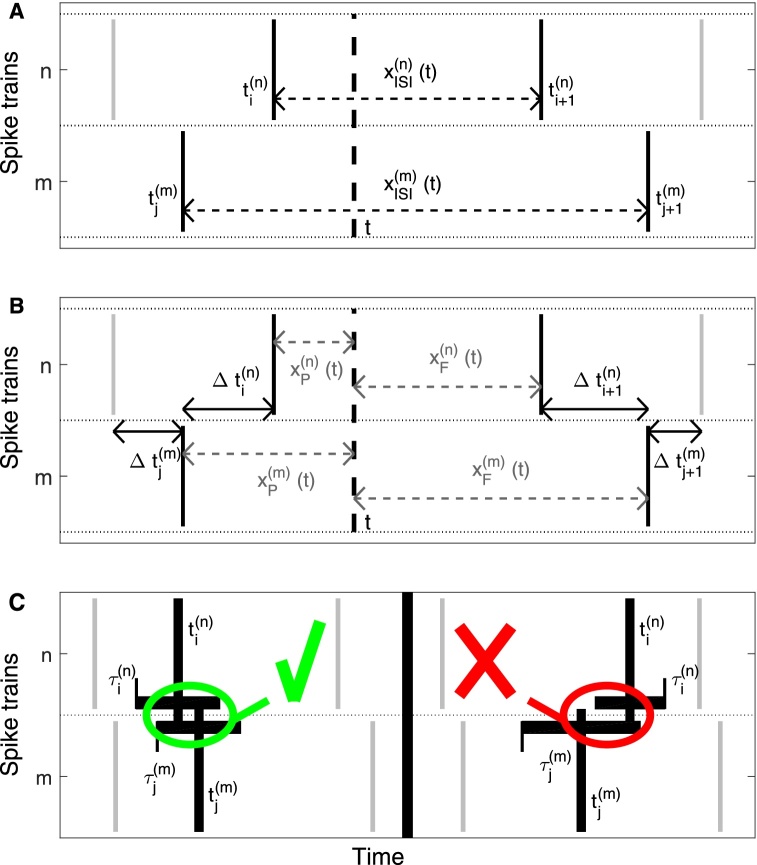
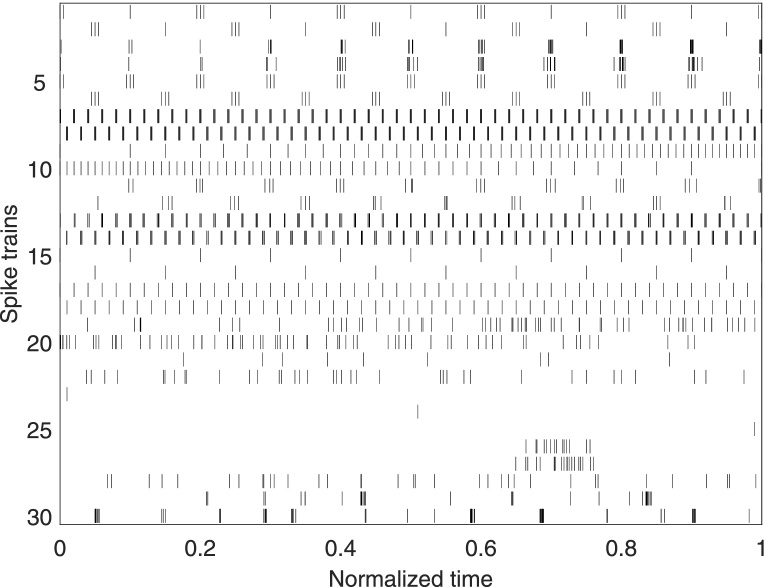
Measures of spike train synchrony are widely used in both experimental and computational neuroscience. Time-scale independent and parameter-free measures, such as the ISI-distance, the SPIKE-distance and SPIKE-synchronization, are preferable to time scale parametric measures, since by adapting to the local firing rate they take into account all the time scales of a given dataset.
In data containing multiple time scales (e.g. regular spiking and bursts) one is typically less interested in the smallest time scales and a more adaptive approach is needed. Here we propose the A-ISI-distance, the A-SPIKE-distance and A-SPIKE-synchronization, which generalize the original measures by considering the local relative to the global time scales. For the A-SPIKE-distance we also introduce a rate-independent extension called the RIA-SPIKE-distance, which focuses specifically on spike timing.
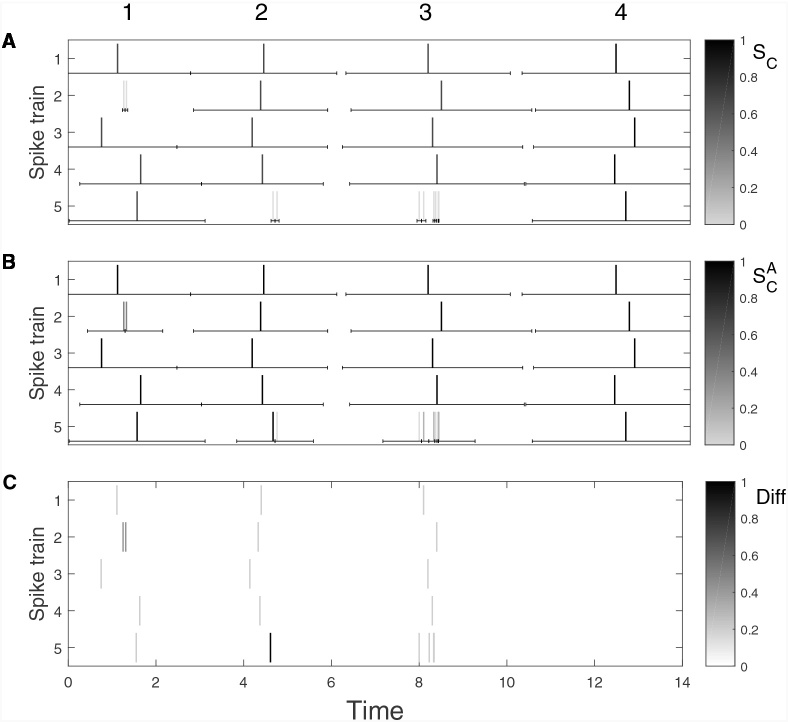
The adaptive generalizations A-ISI-distance and A-SPIKE-distance allow to disregard spike time differences that are not relevant on a more global scale. A-SPIKE-synchronization does not any longer demand an unreasonably high accuracy for spike doublets and coinciding bursts. Finally, the RIA-SPIKE-distance proves to be independent of rate ratios between spike trains.
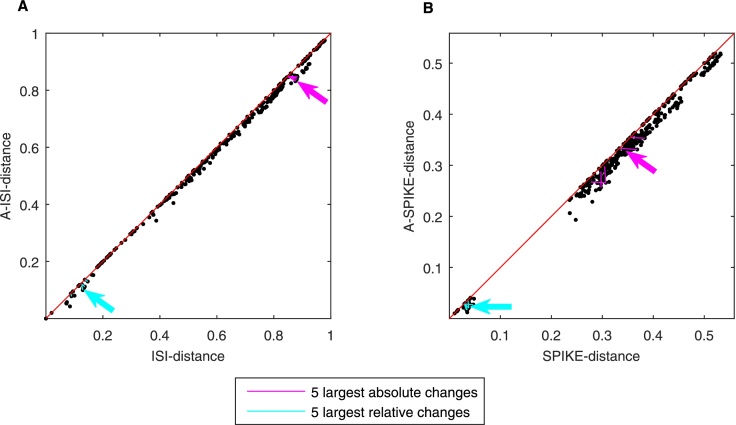
We find that compared to the original versions the A-ISI-distance and the A-SPIKE-distance yield improvements for spike trains containing different time scales without exhibiting any unwanted side effects in other examples. A-SPIKE-synchronization matches spikes more efficiently than SPIKE-synchronization.
With these proposals we have completed the picture, since we now provide adaptive generalized measures that are sensitive to firing rate only (A-ISI-distance), to timing only (ARI-SPIKE-distance), and to both at the same time (A-SPIKE-distance).
脉冲序列同步性的测量方法在实验神经科学和计算神经科学中都有广泛应用。与时间尺度参数化测量方法相比,诸如ISI距离、SPIKE距离和SPIKE同步性等与时间尺度无关且无参数的测量方法更具优势,因为它们通过适应局部发放率,考虑了给定数据集的所有时间尺度。
在包含多个时间尺度的数据(例如规则发放和爆发)中,人们通常对最小的时间尺度不太感兴趣,因此需要一种更具适应性的方法。在此,我们提出了A-ISI距离、A-SPIKE距离和A-SPIKE同步性,它们通过考虑局部相对于全局时间尺度来推广原始测量方法。对于A-SPIKE距离,我们还引入了一种与发放率无关的扩展,称为RIA-SPIKE距离,它特别关注脉冲时间。
适应性推广的A-ISI距离和A-SPIKE距离能够忽略在更全局尺度上不相关的脉冲时间差异。A-SPIKE同步性不再对脉冲对和重合爆发要求过高的精度。最后,RIA-SPIKE距离被证明与脉冲序列之间的发放率比率无关。
我们发现,与原始版本相比,A-ISI距离和A-SPIKE距离在包含不同时间尺度的脉冲序列中表现更优,且在其他示例中未表现出任何不良副作用。A-SPIKE同步性比SPIKE同步性更有效地匹配脉冲。
通过这些提议,我们完善了这一图景,因为我们现在提供了仅对发放率敏感(A-ISI距离)、仅对时间敏感(ARI-SPIKE距离)以及同时对两者敏感(A-SPIKE距离)的适应性广义测量方法。