College of Electrical and Information Engineering, Chongqing University of Science and Technology, Chongqing 401331, China.
Sensors (Basel). 2017 May 25;17(6):1212. doi: 10.3390/s17061212.
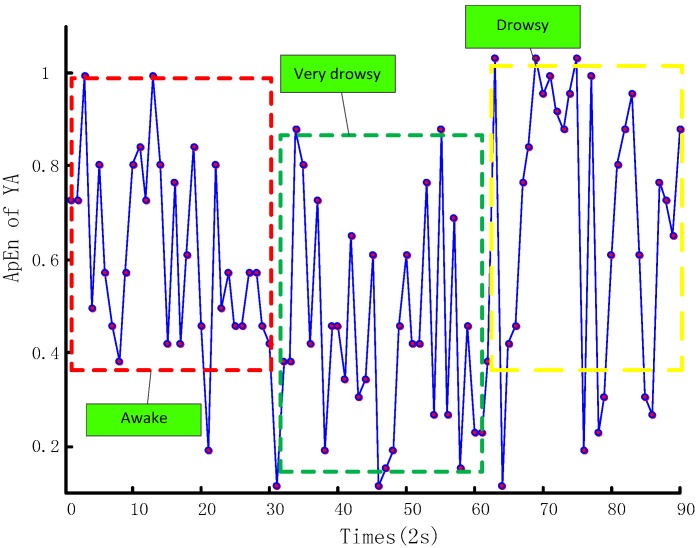
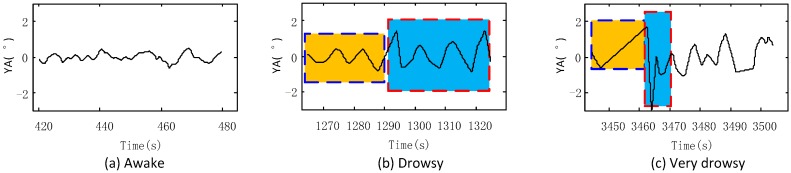
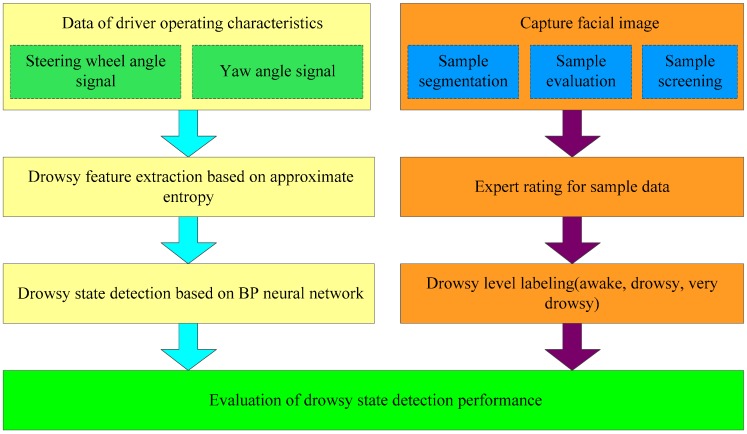
Fatigued driving is a major cause of road accidents. For this reason, the method in this paper is based on the steering wheel angles (SWA) and yaw angles (YA) information under real driving conditions to detect drivers' fatigue levels. It analyzes the operation features of SWA and YA under different fatigue statuses, then calculates the approximate entropy (ApEn) features of a short sliding window on time series. Using the nonlinear feature construction theory of dynamic time series, with the fatigue features as input, designs a "2-6-6-3" multi-level back propagation (BP) Neural Networks classifier to realize the fatigue detection. An approximately 15-h experiment is carried out on a real road, and the data retrieved are segmented and labeled with three fatigue levels after expert evaluation, namely "awake", "drowsy" and "very drowsy". The average accuracy of 88.02% in fatigue identification was achieved in the experiment, endorsing the value of the proposed method for engineering applications.
疲劳驾驶是道路交通事故的主要原因。基于此,本文的方法基于实际驾驶条件下的方向盘角度(SWA)和偏航角度(YA)信息来检测驾驶员的疲劳程度。它分析了不同疲劳状态下 SWA 和 YA 的操作特征,然后计算时间序列上短滑动窗口的近似熵(ApEn)特征。利用动态时间序列的非线性特征构造理论,以疲劳特征作为输入,设计了一个“2-6-6-3”多层反向传播(BP)神经网络分类器,以实现疲劳检测。在真实道路上进行了大约 15 小时的实验,经过专家评估,对检索到的数据进行了分段和标记,分为三个疲劳等级,即“清醒”、“困倦”和“非常困倦”。实验中疲劳识别的平均准确率达到 88.02%,证明了该方法在工程应用中的价值。