Puerto-Parejo Luis M, Aliaga Ignacio, Canal-Macias María L, Leal-Hernandez Olga, Roncero-Martín Raul, Rico-Martín Sergio, Moran Jose M
Metabolic Bone Diseases Research Group, Nursing Department, University of Extremadura, 10003 Caceres, Spain.
Int J Environ Res Public Health. 2017 May 26;14(6):564. doi: 10.3390/ijerph14060564.
Heavy metals, such as lead, cadmium, and mercury, are absorbed through contaminated food sources and water. Few studies have investigated the extent to which dietary heavy metals are associated with low bone mineral density.
We aimed to characterize the dietary intake of the heavy metals lead, cadmium and mercury among healthy, non-smoking postmenopausal women in Spain. Furthermore, we sought to establish a putative relationship between bone health and the intake of these heavy metals in this population.
The daily intake of the heavy metals considered for the different food groups was calculated by accounting for food content and consumption in 281 postmenopausal women. Bone measurements were performed using a Quantitative Bone Ultrasound (QUS), a Dual-Energy X-ray Absorptiometry (DXA) and a Peripheral Quantitative Computed Tomography (pQCT).
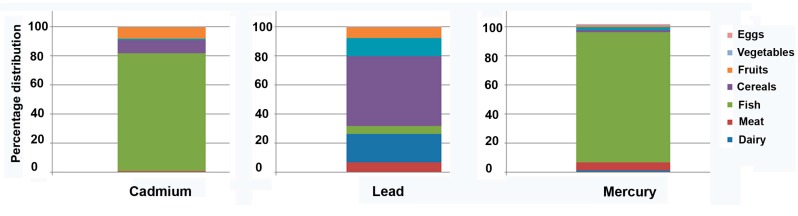
The average estimated dietary cadmium exposure among the 281 women studied was 29.87 μg/day (20.41-41.04) and 3.03 μg/kg body weight (b.w.; 2.17-4.40). Dietary lead exposure was 46.24 μg/day (38.11-54.77) and 4.87 μg/kg b.w. (4.00-6.14). The estimated dietary mercury exposure was 11.64 μg/day and 1.19 μg/kg b.w. (0.82-1.76). Participants were classified according to their heavy metal intake (above or below the respective medians). After further adjustment for potential confounding factors, no significant differences were found in all the measured parameters ( > 0.05).
We did not find associations between bone health and the dietary intake of three heavy metals in postmenopausal women. Dietary intake of the measured heavy metals were within the recommended values.
铅、镉和汞等重金属可通过受污染的食物和水被人体吸收。很少有研究调查膳食中的重金属与低骨密度之间的关联程度。
我们旨在描述西班牙健康、不吸烟的绝经后女性膳食中铅、镉和汞的摄入量特征。此外,我们试图在该人群中确定骨骼健康与这些重金属摄入量之间的假定关系。
通过计算281名绝经后女性的食物含量和消费量,得出不同食物组中所考虑的重金属的每日摄入量。使用定量骨超声(QUS)、双能X线吸收法(DXA)和外周定量计算机断层扫描(pQCT)进行骨测量。
在研究的281名女性中,估计膳食镉平均暴露量为29.87μg/天(20.41 - 41.04),3.03μg/千克体重(b.w.;2.17 - 4.40)。膳食铅暴露量为46.24μg/天(38.11 - 54.77),4.87μg/千克体重(4.00 - 6.14)。估计膳食汞暴露量为11.64μg/天,1.19μg/千克体重(0.82 - 1.76)。参与者根据其重金属摄入量(高于或低于各自中位数)进行分类。在对潜在混杂因素进行进一步调整后,所有测量参数均未发现显著差异(P>0.05)。
我们未发现绝经后女性的骨骼健康与三种重金属的膳食摄入量之间存在关联。所测量的重金属膳食摄入量在推荐值范围内。