Electroanalytical Laboratory, Department of Chemistry, Durban University of Technology, Durban 4000, South Africa.
Biosensors (Basel). 2017 Jun 5;7(2):21. doi: 10.3390/bios7020021.
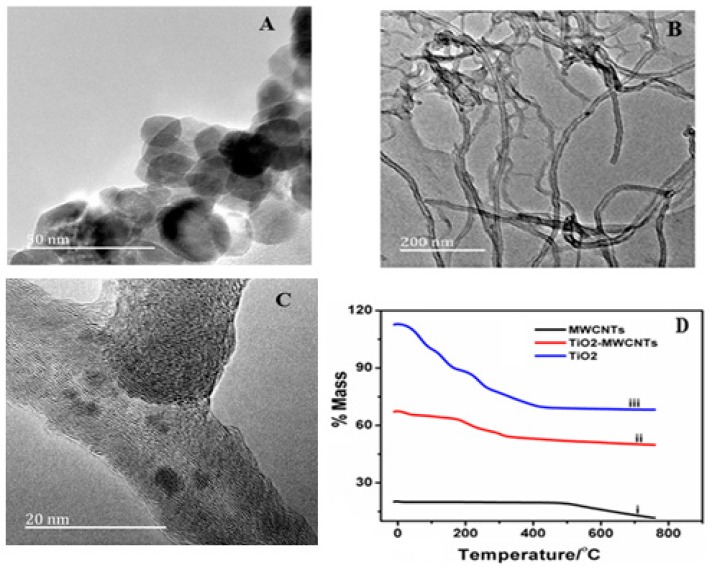
In this present work, a glassy carbon electrode (GCE) was modified primarily with multiwalled carbon nanotubes (MWCNTs) and a composite of MWCNTs and titanium oxide nanoparticles (TiO₂NPs). The enzyme horseradish peroxidase (HRP) was immobilized to enhance the sensing ability of GCE. The proposed biosensor was used for the sensitive determination of isoniazid (INZ) in various pharmaceutical samples. The electrochemical behaviour of the developed MWCNT-TiO₂NPs-HRP-GCE biosensor was studied by using cyclic voltammetry (CV) and differential pulse voltammetric (DPV) techniques. Fourier transform infrared spectroscopy (FT-IR), X-ray diffraction (XRD), thermogravimetry (TGA) and transmission electron microscopy (TEM) techniques were used to characterize the developed sensor. Phosphate buffer solution (PBS) with pH 7 was used as supporting electrolyte in the present investigation. The cyclic voltammetric results revealed that the increment of anodic peak currents for the enzyme-induced sensor was almost 8-fold greater than that of a bare GCE. The DPV technique exhibited good limit of detection and limit of quantification values, viz., 0.0335 μM and 0.1118 μM, respectively. Moreover, the developed sensor showed long-lasting stability and repeatability without any interferents. This strongly indicates that the fabricated sensor shows outstanding electrochemical performance towards INZ, with excellent selectivity and sensitivity. The developed sensor was successfully applied to pharmaceutical samples and gave good percentages of recoveries.
在本工作中,主要通过多壁碳纳米管 (MWCNTs) 和 MWCNTs 和氧化钛纳米粒子 (TiO₂NPs) 的复合物对玻碳电极 (GCE) 进行了修饰。固定化辣根过氧化物酶 (HRP) 以提高 GCE 的传感能力。所提出的生物传感器用于灵敏测定各种药物样品中的异烟肼 (INZ)。通过使用循环伏安法 (CV) 和差分脉冲伏安法 (DPV) 技术研究了开发的 MWCNT-TiO₂NPs-HRP-GCE 生物传感器的电化学行为。傅里叶变换红外光谱 (FT-IR)、X 射线衍射 (XRD)、热重分析 (TGA) 和透射电子显微镜 (TEM) 技术用于表征所开发的传感器。在本研究中,使用磷酸盐缓冲溶液 (PBS),pH 值为 7 作为支持电解质。循环伏安法结果表明,酶诱导传感器的阳极峰电流增加几乎是裸 GCE 的 8 倍。DPV 技术表现出良好的检测限和定量限值,分别为 0.0335 μM 和 0.1118 μM。此外,所开发的传感器具有持久的稳定性和重复性,没有任何干扰物。这强烈表明所制造的传感器对 INZ 表现出出色的电化学性能,具有出色的选择性和灵敏度。该开发的传感器已成功应用于药物样品,并给出了良好的回收率百分比。