Chokkareddy Rajasekhar, Redhi Gan G, Karthick T
Department of Chemistry, Durban University of Technology, Durban, 4000, South Africa.
Institute of Organic Chemistry and Biochemistry, Academy of Sciences, Flemingovo náměstí 2, 16610 Prague, Czech Republic.
Heliyon. 2019 Mar 30;5(3):e01457. doi: 10.1016/j.heliyon.2019.e01457. eCollection 2019 Mar.
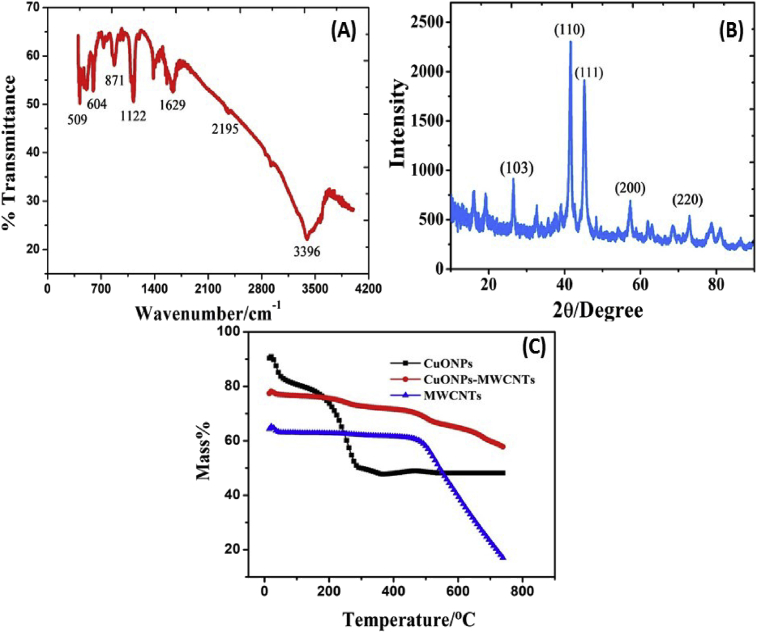
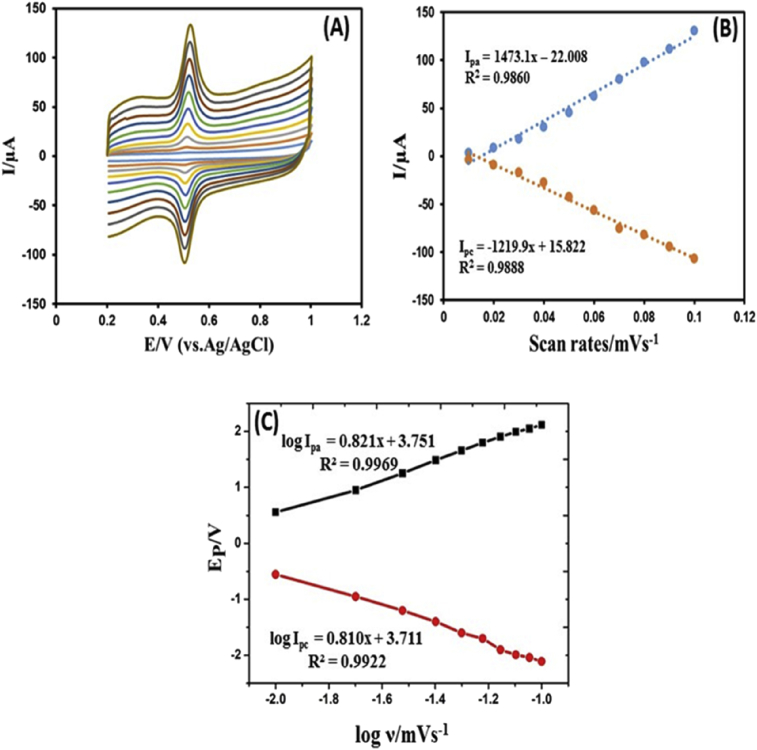
In this study, an innovative nanocomposite of multiwalled carbon nanotubes (MWCNTs), copper oxide nanoparticles (CuONPs) and lignin (LGN) polymer were successfully synthesized and used to modify the glassy carbon electrode for the determination of chlorogenic acid (CGA). Cyclic voltammetry (CV) emphasised a quasi-reversible, adsorption controlled and pH dependent electrode procedure. In cyclic voltammetry a pair of well distinct redox peaks of CGA were observed at the LGN-MWCNTs-CuONPs-GCE in 0.1 M phosphate buffer solution (PBS), at pH 2. The synthesized nanoparticles and nanocomposites were characterized by Fourier transformation infrared spectroscopy (FTIR), transmission electron microscopy (TEM) and x-ray diffraction (XRD) analyses. Differential pulse voltammetry (DPV) was applied to the anodic peak and used for the quantitative detection of CGA. Under optimal conditions, the proposed sensor showed linear responses from 5 μM to 50 μM, the linear regression equation I (μA) = 2.6074 C-5.1027 (R = 0.995), whilst the limit of detection (LOD) and limit of quantifications (LOQ) were found to be 0.0125 μM and 0.2631 μM respectively. The LGN-MWCNTs-CuONPs-GCE were applied to detect the CGA in real coffee samples with the recovery ranging from 97 to 106 %. The developed sensor was successfully applied for the analysis of CGA content in the coffee samples. In addition, electrophilic, nucleophilic reactions and chlorogenic acid docking studies were carried out to better understand the redox mechanisms and were supported by density functional theory calculations.
在本研究中,成功合成了一种由多壁碳纳米管(MWCNTs)、氧化铜纳米颗粒(CuONPs)和木质素(LGN)聚合物组成的创新型纳米复合材料,并将其用于修饰玻碳电极以测定绿原酸(CGA)。循环伏安法(CV)强调了一种准可逆、吸附控制且依赖于pH值的电极过程。在循环伏安法中,在pH为2的0.1 M磷酸盐缓冲溶液(PBS)中,在LGN-MWCNTs-CuONPs-GCE上观察到了一对清晰的CGA氧化还原峰。通过傅里叶变换红外光谱(FTIR)、透射电子显微镜(TEM)和X射线衍射(XRD)分析对合成的纳米颗粒和纳米复合材料进行了表征。将差分脉冲伏安法(DPV)应用于阳极峰,并用于CGA的定量检测。在最佳条件下,所提出的传感器在5 μM至50 μM范围内呈现线性响应,线性回归方程为I(μA)= 2.6074 C - 5.1027(R = 0.995),而检测限(LOD)和定量限(LOQ)分别为0.0125 μM和0.2631 μM。LGN-MWCNTs-CuONPs-GCE被用于检测实际咖啡样品中的CGA,回收率在97%至106%之间。所开发的传感器成功应用于咖啡样品中CGA含量的分析。此外,还进行了亲电、亲核反应以及绿原酸对接研究,以更好地理解氧化还原机制,并得到了密度泛函理论计算的支持。