Zhang Li-Chao, Wang Yue, Tong Ling-Chang, Sun Sheng, Liu Wei-Ye, Zhang Su, Wang Rong-Mei, Wang Zhi-Bin, Li Ling
Department of Pharmacy, Shanghai Municipal Hospital of Traditional Chinese Medicine, Shanghai 200071, P.R. China.
Department of Pharmacy, Ningxia Medical University, Yinchuan, Ningxia 750004, P.R. China.
Exp Ther Med. 2017 Jun;13(6):3374-3382. doi: 10.3892/etm.2017.4402. Epub 2017 Apr 28.
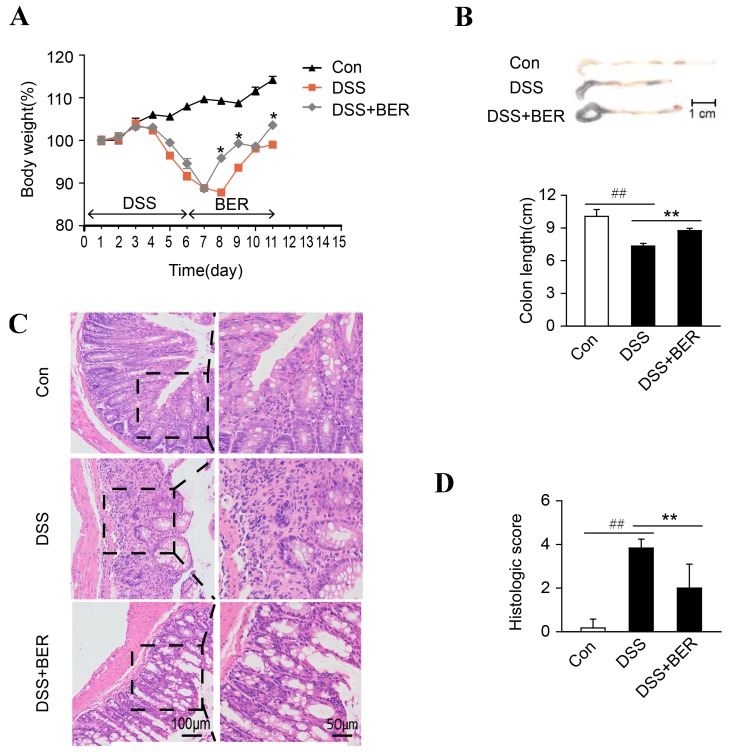
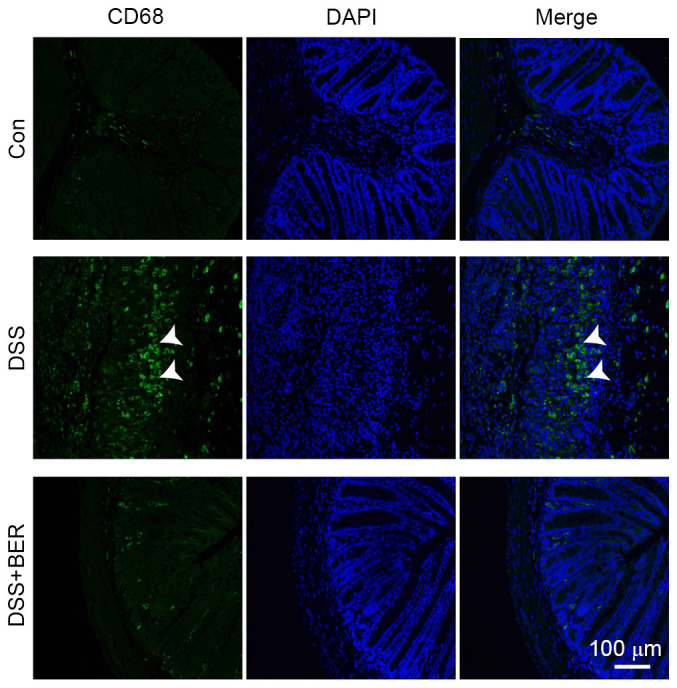
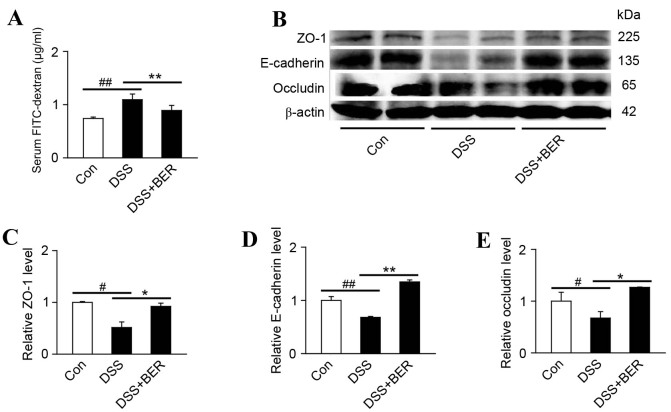
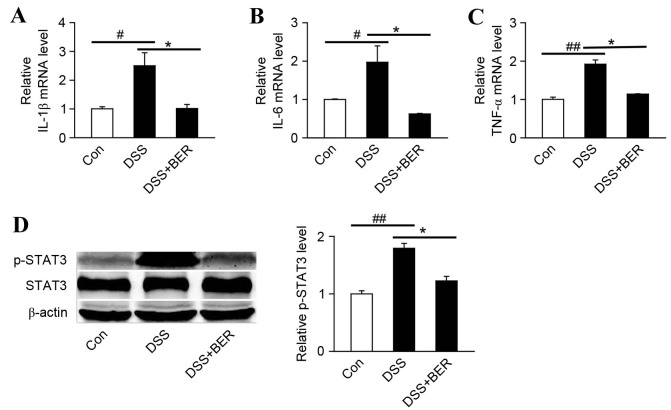
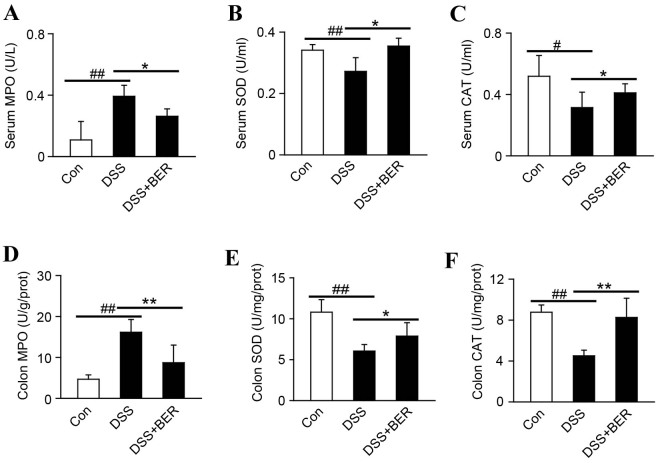
Berberine has demonstrated efficacy in alleviating experimental colitis and . However, the anti-colitis mechanisms of berberine that enable it to promote intestinal barrier function remain unclear. The present study aimed to evaluate the effect of berberine on intestinal epithelial barrier function, expression of tight junction proteins and the levels of inflammatory and oxidative stress factors in the intestinal mucosa of dextran sulfate sodium (DSS)-induced colitis mice. Berberine (100 mg/kg) was administered for five days to mice with established colitis, induced by administration of DSS (3% w/v) for six days. Intestinal barrier function and the presence of proinflammatory factors, oxidative stress and active signaling pathways in the colon were determined principally by western blotting and reverse transcription-quantitative polymerase chain reaction. It was observed that berberine reduced weight loss, shortening of the colon and colon damage in DSS-colitis mice. In addition, berberine significantly inhibited the increase of fluorescein isothiocyanate-dextran in serum and the decrease of zonula occluden-1 (also known as tight junction protein-1), occludin and epithelial cadherin expression in colonic tissue, relative to a DSS-treated control group. Berberine also significantly inhibited the expression of interleukin (IL)-1β, IL-6 and tumor necrosis factor-α mRNA and phosphorylation of signal transducer and activator of transcription 3. Furthermore, berberine reduced the levels of myeloperoxidase and increased the levels of superoxide dismutase and catalase in colon and serum samples relative to the control group. The expression of cluster of differentiation 68 in the colon of colitis mice was also reduced by berberine. Collectively, these data suggest that berberine alleviates colitis principally by improving intestinal barrier function and promoting anti-inflammatory and antioxidative stress responses. In turn these effects inhibit macrophage infiltration into the colon and thus may be central to the anti-colitis activity of berberine.
黄连素已显示出在减轻实验性结肠炎方面的疗效。然而,黄连素促进肠道屏障功能的抗结肠炎机制仍不清楚。本研究旨在评估黄连素对葡聚糖硫酸钠(DSS)诱导的结肠炎小鼠肠黏膜上皮屏障功能、紧密连接蛋白表达以及炎症和氧化应激因子水平的影响。对通过给予DSS(3% w/v)六天诱导建立结肠炎的小鼠,给予黄连素(100 mg/kg)五天。主要通过蛋白质印迹法和逆转录-定量聚合酶链反应来测定结肠中的肠道屏障功能、促炎因子的存在、氧化应激和活性信号通路。观察到黄连素减轻了DSS诱导的结肠炎小鼠的体重减轻、结肠缩短和结肠损伤。此外,相对于DSS处理的对照组,黄连素显著抑制了血清中异硫氰酸荧光素-葡聚糖的增加以及结肠组织中小带闭合蛋白-1(也称为紧密连接蛋白-1)、闭合蛋白和上皮钙黏蛋白表达的降低。黄连素还显著抑制白细胞介素(IL)-1β、IL-6和肿瘤坏死因子-α mRNA的表达以及信号转导和转录激活因子3的磷酸化。此外,相对于对照组,黄连素降低了结肠和血清样本中髓过氧化物酶的水平,并提高了超氧化物歧化酶和过氧化氢酶的水平。黄连素还降低了结肠炎小鼠结肠中分化簇68的表达。总体而言,这些数据表明黄连素主要通过改善肠道屏障功能以及促进抗炎和抗氧化应激反应来减轻结肠炎。这些作用进而抑制巨噬细胞浸润到结肠中,因此可能是黄连素抗结肠炎活性的核心。