Chen Xin, Chughtai Abrar Ahmad, Dyda Amalie, MacIntyre Chandini Raina
School of Public Health and Community Medicine, University of New South Wales, Sydney, NSW 2052, Australia.
College of Public Service and Community Solutions, Arizona State University, Tempe, AZ 85287, USA.
Emerg Microbes Infect. 2017 Jun 7;6(6):e51. doi: 10.1038/emi.2017.40.
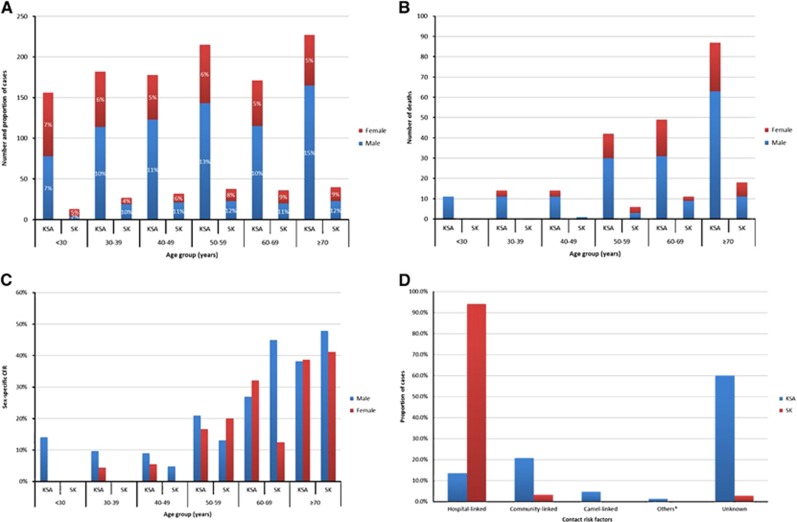
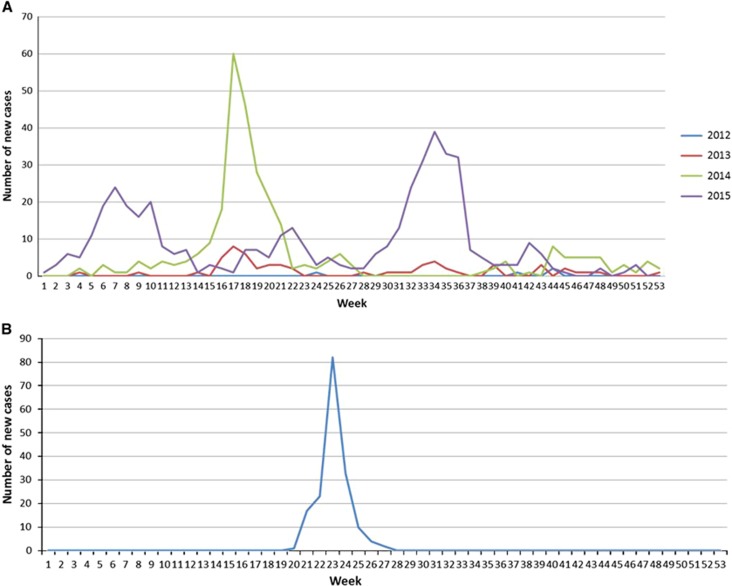
MERS-CoV infection emerged in the Kingdom of Saudi Arabia (KSA) in 2012 and has spread to 26 countries. However, 80% of all cases have occurred in KSA. The largest outbreak outside KSA occurred in South Korea (SK) in 2015. In this report, we describe an epidemiological comparison of the two outbreaks. Data from 1299 cases in KSA (2012-2015) and 186 cases in SK (2015) were collected from publicly available resources, including FluTrackers, the World Health Organization (WHO) outbreak news and the Saudi MOH (MOH). Descriptive analysis, t-tests, Chi-square tests and binary logistic regression were conducted to compare demographic and other characteristics (comorbidity, contact history) of cases by nationality. Epidemic curves of the outbreaks were generated. The mean age of cases was 51 years in KSA and 54 years in SK. Older males (⩾70 years) were more likely to be infected or to die from MERS-CoV infection, and males exhibited increased rates of comorbidity in both countries. The epidemic pattern in KSA was more complex, with animal-to-human, human-to-human, nosocomial and unknown exposure, whereas the outbreak in SK was more clearly nosocomial. Of the 1186 MERS cases in KSA with reported risk factors, 158 (13.3%) cases were hospital associated compared with 175 (94.1%) in SK, and an increased proportion of cases with unknown exposure risk was found in KSA (710, 59.9%). In a globally connected world, travel is a risk factor for emerging infections, and health systems in all countries should implement better triage systems for potential imported cases of MERS-CoV to prevent large epidemics.
中东呼吸综合征冠状病毒(MERS-CoV)感染于2012年在沙特阿拉伯王国(沙特)出现,并已传播至26个国家。然而,所有病例的80%发生在沙特。沙特境外最大规模的疫情爆发于2015年在韩国(韩国)发生。在本报告中,我们描述了这两次疫情的流行病学比较。从包括FluTrackers、世界卫生组织(WHO)疫情新闻和沙特卫生部(MOH)在内的公开可用资源中收集了沙特1299例病例(2012 - 2015年)和韩国186例病例(2015年)的数据。进行了描述性分析、t检验、卡方检验和二元逻辑回归,以按国籍比较病例的人口统计学和其他特征(合并症、接触史)。绘制了疫情的流行曲线。沙特病例的平均年龄为51岁,韩国为54岁。年龄较大的男性(≥70岁)更易感染MERS-CoV或死于该病毒感染,且在两国男性的合并症发生率均较高。沙特的疫情模式更为复杂,存在动物传人、人传人、医院感染和暴露途径不明的情况,而韩国的疫情更明显是医院感染。在沙特报告了危险因素的1186例中东呼吸综合征病例中,158例(13.3%)与医院相关,而在韩国这一比例为175例(94.1%),并且沙特发现暴露风险不明的病例比例更高(710例,59.9%)。在一个全球互联的世界中,旅行是新发感染的一个危险因素,所有国家的卫生系统都应实施更好的分诊系统,以应对中东呼吸综合征冠状病毒潜在输入病例,防止大规模疫情爆发。