Rivas-Arancibia Selva, Rodríguez-Martínez Erika, Badillo-Ramírez Isidro, López-González Ulises, Saniger José M
Departamento de Fisiología, Facultad de Medicina, Universidad Nacional Autónoma de MéxicoCiudad de México, Mexico.
Centro de Ciencias Aplicadas y Desarrollo Tecnológico, Universidad Nacional Autónoma de MéxicoCiudad de México, Mexico.
Front Mol Neurosci. 2017 May 22;10:137. doi: 10.3389/fnmol.2017.00137. eCollection 2017.
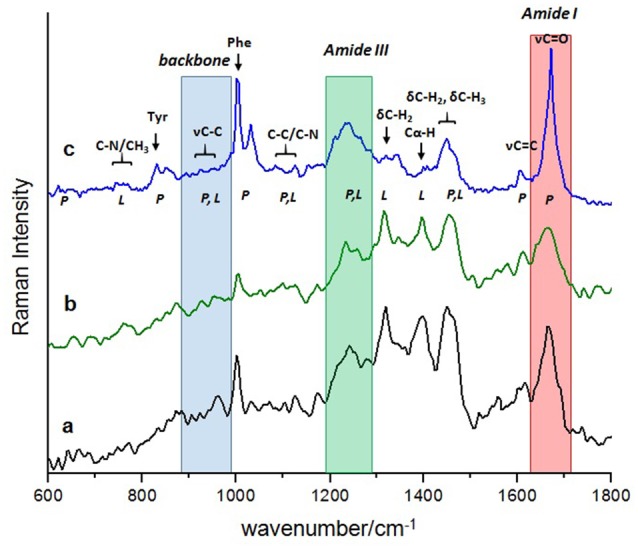
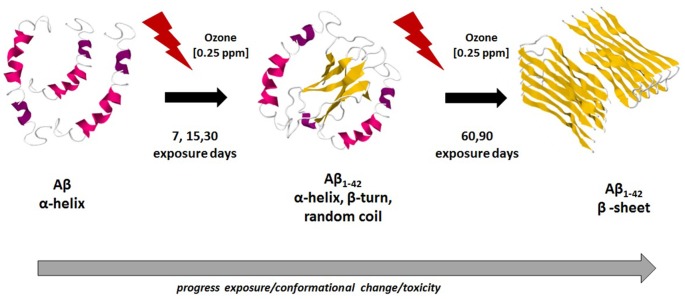
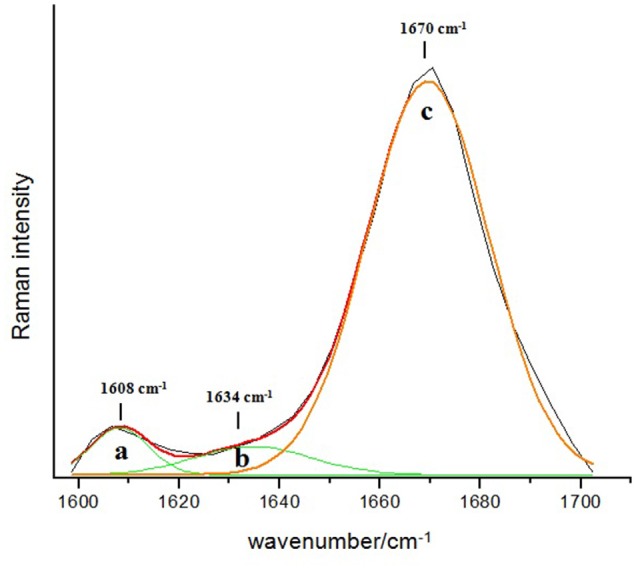
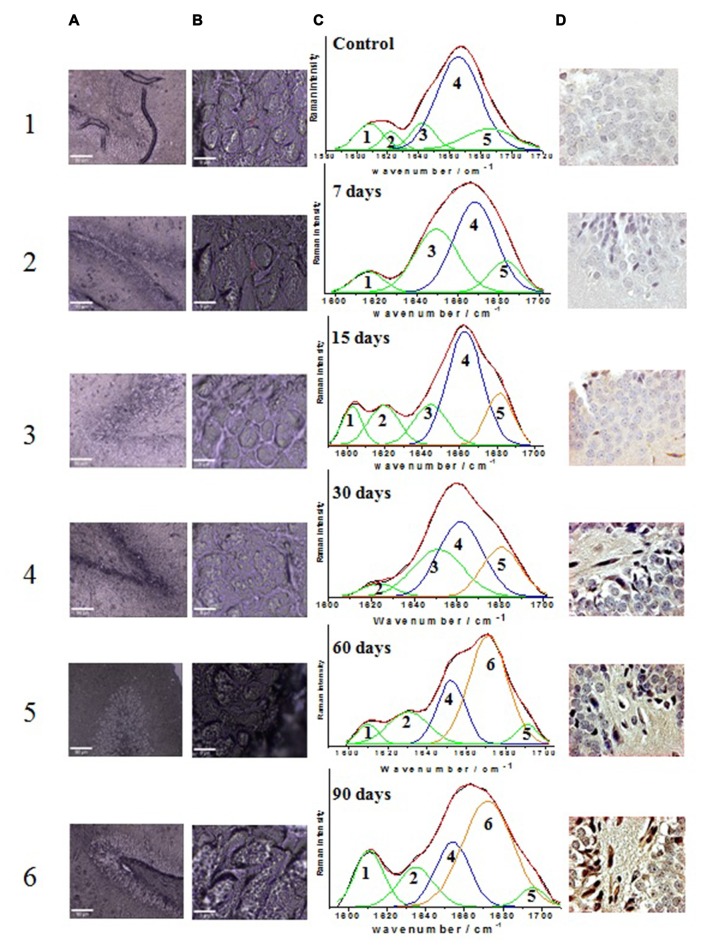
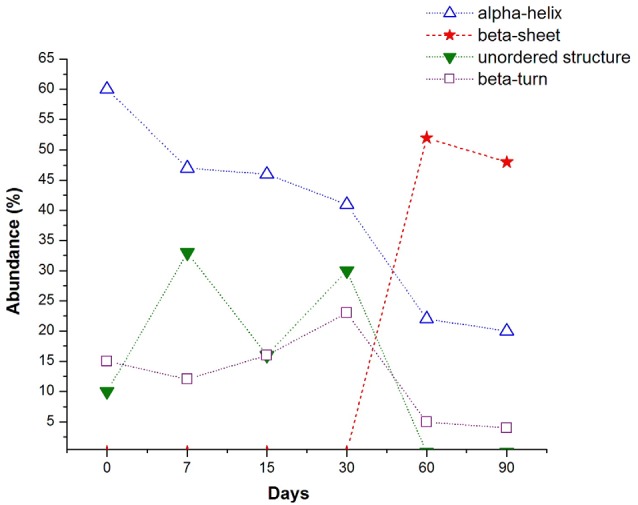
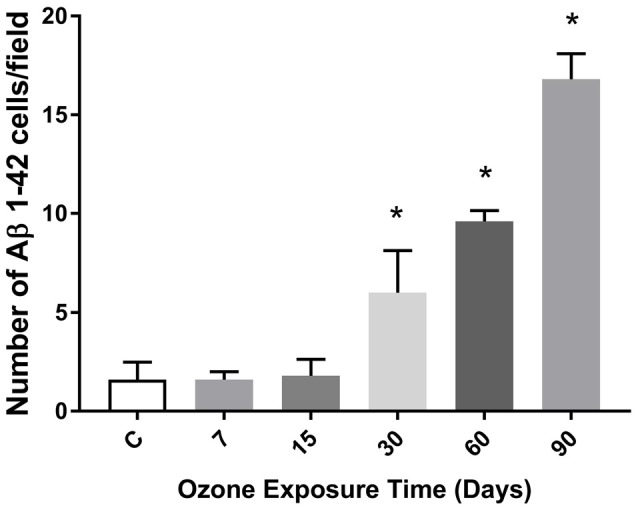
The aim of this work was to study the effect of oxidative stress on the structural changes of the secondary peptide structure of amyloid beta 1-42 (Aβ 1-42), in the dentate gyrus of hippocampus of rats exposed to low doses of ozone. The animals were exposed to ozone-free air (control group) and 0.25 ppm ozone during 7, 15, 30, 60, and 90 days, respectively. The samples were studied by: (1) Raman spectroscopy to detect the global conformational changes in peptides with α-helix and β-sheet secondary structure, following the deconvolution profile of the amide I band; and (2) immunohistochemistry against Aβ 1-42. The results of the deconvolutions of the amide I band indicate that, ozone exposure causes a progressively decrease in the abundance percentage of α-helix secondary structure. Furthermore, the β-sheet secondary structure increases its abundance percentage. After 60 days of ozone exposure, the β-sheet band is identified in a similar wavenumber of the Aβ 1-42 peptide standard. Immunohistochemistry assays show an increase of Aβ 1-42 immunoreactivity, coinciding with the conformational changes observed in the Raman spectroscopy of Aβ 1-42 at 60 and 90 days. In conclusion, oxidative stress produces changes in the folding process of amyloid beta peptide structure in the dentate gyrus, leading to its conformational change in a final β-sheet structure. This is associated to an increase in Aβ 1-42 expression, similar to the one that happens in the brain of Alzheimer's Disease (AD) patients.
这项工作的目的是研究氧化应激对暴露于低剂量臭氧的大鼠海马齿状回中淀粉样β蛋白1-42(Aβ 1-42)二级肽结构变化的影响。将动物分别暴露于无臭氧的空气(对照组)和0.25 ppm的臭氧中,持续7天、15天、30天、60天和90天。通过以下方法对样本进行研究:(1)拉曼光谱法,通过酰胺I带的反卷积谱检测具有α-螺旋和β-折叠二级结构的肽的整体构象变化;(2)针对Aβ 1-42的免疫组织化学法。酰胺I带的反卷积结果表明,臭氧暴露导致α-螺旋二级结构的丰度百分比逐渐降低。此外,β-折叠二级结构的丰度百分比增加。臭氧暴露60天后,在与Aβ 1-42肽标准品相似的波数处鉴定出β-折叠带。免疫组织化学分析显示Aβ 1-42免疫反应性增加,这与在60天和90天时Aβ 1-42拉曼光谱中观察到的构象变化一致。总之,氧化应激会导致海马齿状回中淀粉样β肽结构的折叠过程发生变化,使其构象最终转变为β-折叠结构。这与Aβ 1-42表达的增加有关,类似于阿尔茨海默病(AD)患者大脑中发生的情况。