Ramírez-Mendoza Abraham Alberto, Mendoza-Magaña María Luisa, Ramírez-Herrera Mario Alberto, Hernández-Nazara Zamira Helena, Domínguez-Rosales José Alfredo
Laboratorio de Biología de la Neurotransmisión, Departamento de Biología Celular y Molecular, Centro Universitario de Ciencias Biológicas y Agropecuarias, Universidad de Guadalajara, Zapopán ZC 45200, Jalisco, Mexico.
Laboratorio de Neurofisiología, Departamento de Fisiología, Centro Universitario de Ciencias de la Salud, Universidad de Guadalajara, Guadalajara ZC 44340, Jalisco, Mexico.
Antioxidants (Basel). 2024 Mar 7;13(3):326. doi: 10.3390/antiox13030326.
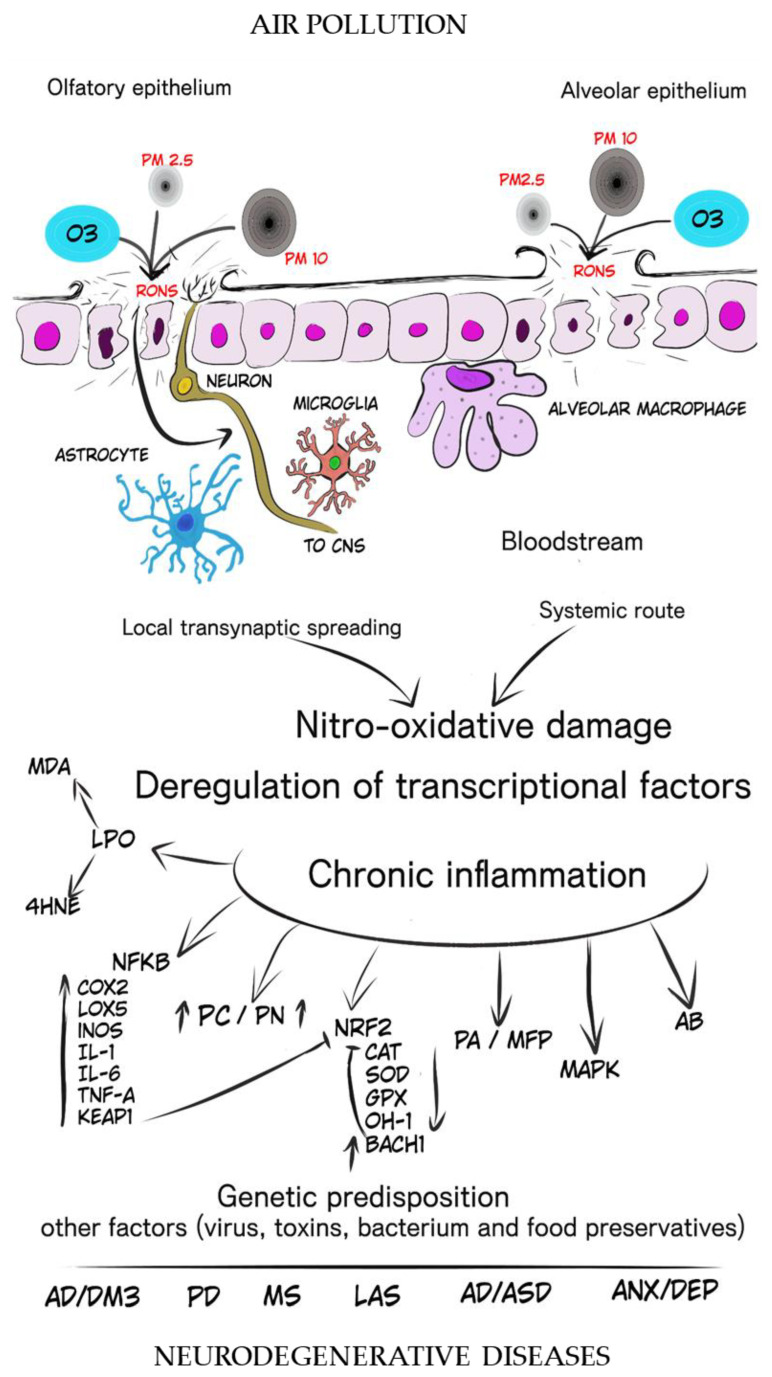
Millions of people around the world are exposed to air pollutants, such as particulate matter 2.5 (PM) and ozone (O). Such exposure usually does not exclude these two types of pollutants and their harmful effects could be additive or synergistic. O is a highly oxidizing gas that reacts with the cellular environment just as PM, triggering nitrooxidative damage. Once nitrooxidative stress overcomes the endogenous antioxidant system, an acute neuroinflammatory process is generated, and once it becomes chronic, it favors the formation of neurodegenerative disease markers. The presence of these markers becomes potentially dangerous in people who have a genetic predisposition and are at a higher risk of developing neurodegenerative diseases such as Alzheimer's and Parkinson's. Our experimental approach for nitrooxidative damage and neuroinflammation caused by air pollutants has focused on the exposure of rats to O in an isolated chamber. The hippocampus is the most studied brain structure because of its neuronal connectivity network with the olfactory epithelium, its weak antioxidant defense, and its fundamental roll in cognitive processes. However, other brain structures may exhibit a different degree of damage upon exposure to O and PM, making their involvement an important factor in developing other CNS diseases. The age spectrum for augmented sensibility to air pollutants seems to mostly affect the pre-postnatal (autism spectrum) period and the elderly (neurodegenerative). Thus, a new approach could be the estimation of the damage caused by PM and O through a controlled exposure paradigm to determine the extent of damage caused by both pollutants.
全世界数以百万计的人暴露于空气污染物中,如细颗粒物2.5(PM)和臭氧(O)。这种暴露通常并不排除这两种污染物,它们的有害影响可能是相加的或协同的。臭氧是一种强氧化性气体,与细颗粒物一样会与细胞环境发生反应,引发氮氧化损伤。一旦氮氧化应激超过内源性抗氧化系统,就会产生急性神经炎症过程,而一旦其变为慢性,就会促进神经退行性疾病标志物的形成。对于有遗传易感性且患阿尔茨海默病和帕金森病等神经退行性疾病风险较高的人来说,这些标志物的存在可能会变得很危险。我们针对空气污染物引起的氮氧化损伤和神经炎症的实验方法,重点是将大鼠置于隔离舱中暴露于臭氧。海马体是研究最多的脑结构,因为它与嗅觉上皮有神经元连接网络、抗氧化防御能力较弱且在认知过程中起重要作用。然而,其他脑结构在暴露于臭氧和细颗粒物时可能会表现出不同程度的损伤,这使得它们的参与成为发展其他中枢神经系统疾病的一个重要因素。对空气污染物敏感性增强的年龄谱似乎主要影响出生前后(自闭症谱系)时期和老年人(神经退行性疾病)。因此,一种新的方法可能是通过控制暴露范式来估计细颗粒物和臭氧造成的损伤,以确定这两种污染物造成的损伤程度。