Hou Qihang, Ye Lulu, Huang Lulu, Yu Qinghua
College of veterinary medicine, Nanjing Agricultural University, Nanjing, China.
Front Immunol. 2017 May 23;8:599. doi: 10.3389/fimmu.2017.00599. eCollection 2017.
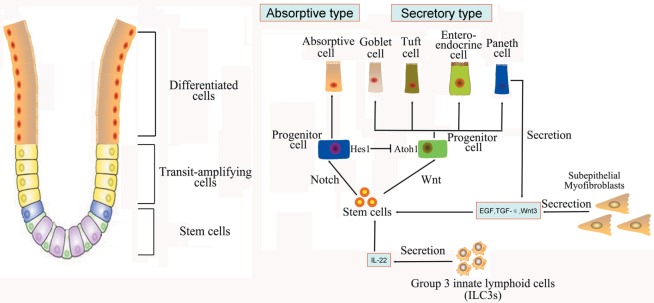
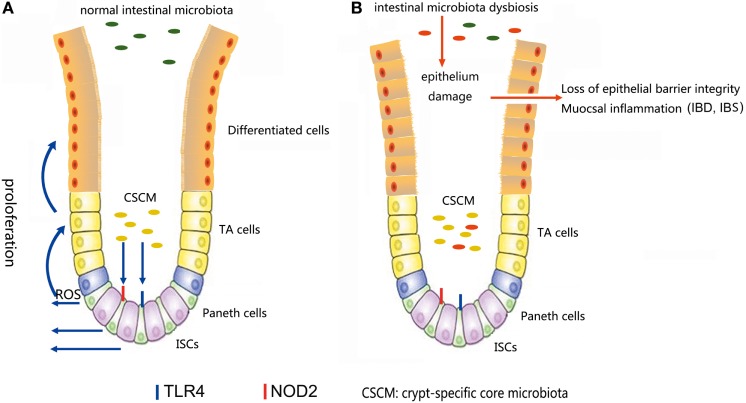
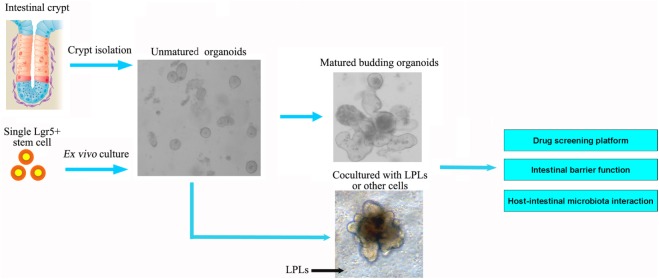
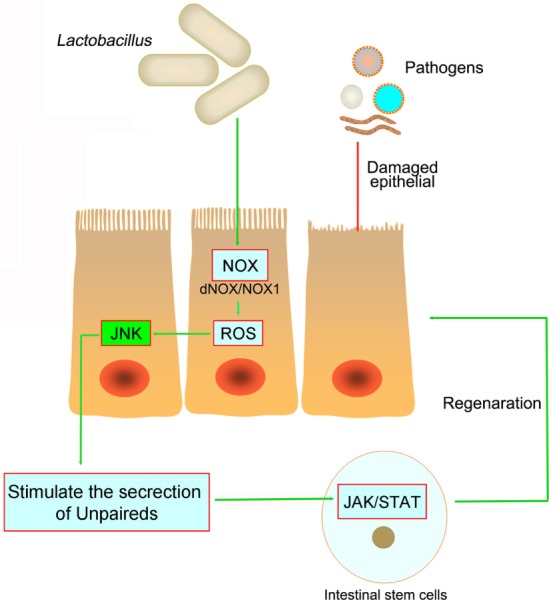
The intestine is home to trillions of microorganisms, and the vast diversity within this gut microbiota exists in a balanced state to protect the intestinal mucosal barrier. Research into the association of the intestinal microbiota with health and disease (including diet, nutrition, obesity, inflammatory bowel disease, and cancer) continues to expand, with the field advancing at a rapid rate. Intestinal stem cells (ISCs) are the fundamental component of the mucosal barrier; they undergo continuous proliferation to replace the epithelium, which is also intimately involved in intestinal diseases. The intestinal microbiota, such as , communicates with ISCs both directly and indirectly to regulate the proliferation and differentiation of ISCs. Moreover, infection significantly decreased the expression of intestinal stem cell markers Lgr5 and Bmi1. However, the detailed interaction of intestinal microbiota and ISCs are still unclear. This review considers the progress of research on the model and niches of ISCs, as well as the complex interplay between the gut microbiota and ISCs, which will be crucial for explaining the mechanisms of intestinal diseases related to imbalances in the intestinal microbiota and ISCs.
肠道是数万亿微生物的家园,肠道微生物群的巨大多样性以平衡状态存在,以保护肠道黏膜屏障。肠道微生物群与健康和疾病(包括饮食、营养、肥胖、炎症性肠病和癌症)之间关联的研究不断扩展,该领域正在迅速发展。肠道干细胞(ISC)是黏膜屏障的基本组成部分;它们持续增殖以替换上皮细胞,而上皮细胞也与肠道疾病密切相关。肠道微生物群,例如 ,直接和间接地与ISC相互作用,以调节ISC的增殖和分化。此外, 感染显著降低了肠道干细胞标志物Lgr5和Bmi1的表达。然而,肠道微生物群与ISC之间的详细相互作用仍不清楚。本综述考虑了ISC的模型和生态位的研究进展,以及肠道微生物群与ISC之间的复杂相互作用,这对于解释与肠道微生物群和ISC失衡相关的肠道疾病机制至关重要。