
用于基于频域光学相干断层扫描(SD-OCT)图像的糖尿病性黄斑水肿(DME)分类的机器学习技术。
Machine learning techniques for diabetic macular edema (DME) classification on SD-OCT images.
作者信息
Alsaih Khaled, Lemaitre Guillaume, Rastgoo Mojdeh, Massich Joan, Sidibé Désiré, Meriaudeau Fabrice
机构信息
LE2I, CNRS, Arts et Métiers, Université Bourgogne Franche-Comté, 12 rue de la Fonderie, Le Creusot, France.
Centre for Intelligent Signal and Imaging Research (CISIR), Electrical & Electronic Engineering Department, Universiti Teknologi PETRONAS, 32610, Seri Iskandar, Malaysia.
出版信息
Biomed Eng Online. 2017 Jun 7;16(1):68. doi: 10.1186/s12938-017-0352-9.
BACKGROUND
Spectral domain optical coherence tomography (OCT) (SD-OCT) is most widely imaging equipment used in ophthalmology to detect diabetic macular edema (DME). Indeed, it offers an accurate visualization of the morphology of the retina as well as the retina layers.
METHODS
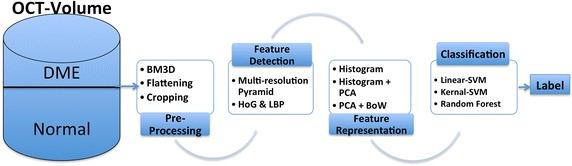
The dataset used in this study has been acquired by the Singapore Eye Research Institute (SERI), using CIRRUS TM (Carl Zeiss Meditec, Inc., Dublin, CA, USA) SD-OCT device. The dataset consists of 32 OCT volumes (16 DME and 16 normal cases). Each volume contains 128 B-scans with resolution of 1024 px × 512 px, resulting in more than 3800 images being processed. All SD-OCT volumes are read and assessed by trained graders and identified as normal or DME cases based on evaluation of retinal thickening, hard exudates, intraretinal cystoid space formation, and subretinal fluid. Within the DME sub-set, a large number of lesions has been selected to create a rather complete and diverse DME dataset. This paper presents an automatic classification framework for SD-OCT volumes in order to identify DME versus normal volumes. In this regard, a generic pipeline including pre-processing, feature detection, feature representation, and classification was investigated. More precisely, extraction of histogram of oriented gradients and local binary pattern (LBP) features within a multiresolution approach is used as well as principal component analysis (PCA) and bag of words (BoW) representations.
RESULTS AND CONCLUSION
Besides comparing individual and combined features, different representation approaches and different classifiers are evaluated. The best results are obtained for LBP[Formula: see text] vectors while represented and classified using PCA and a linear-support vector machine (SVM), leading to a sensitivity(SE) and specificity (SP) of 87.5 and 87.5%, respectively.
背景
频域光学相干断层扫描(OCT)(SD - OCT)是眼科用于检测糖尿病性黄斑水肿(DME)的应用最为广泛的成像设备。实际上,它能准确呈现视网膜及其各层的形态。
方法
本研究使用的数据集由新加坡眼科研究所(SERI)采集,采用的是CIRRUS TM(卡尔蔡司医疗技术公司,美国加利福尼亚州都柏林)SD - OCT设备。该数据集包含32个OCT容积数据(16例DME和16例正常病例)。每个容积包含128幅B扫描图像,分辨率为1024像素×512像素,共处理了3800余幅图像。所有SD - OCT容积数据均由经过培训的分级人员读取和评估,并根据视网膜增厚、硬性渗出、视网膜内囊样腔隙形成和视网膜下液等情况确定为正常或DME病例。在DME子集中,选取了大量病变以创建一个较为完整和多样的DME数据集。本文提出了一种用于SD - OCT容积数据的自动分类框架,以识别DME与正常容积数据。为此,研究了一个通用流程,包括预处理、特征检测、特征表示和分类。更确切地说,采用了多分辨率方法下的定向梯度直方图和局部二值模式(LBP)特征提取,以及主成分分析(PCA)和词袋(BoW)表示法。
结果与结论
除了比较单个特征和组合特征外,还评估了不同的表示方法和不同的分类器。当使用PCA和线性支持向量机(SVM)对LBP[公式:见正文]向量进行表示和分类时,获得了最佳结果,灵敏度(SE)和特异性(SP)分别为87.5%和87.5%。

 Zotero 插件