Ophthalmology Clinic, Department of Medicine and Ageing Science, University "G. D'Annunzio" of Chieti-Pescara, Via Dei Vestini Snc, 66100, Chieti, Italy.
Datamantix S.R.L. Artificial Intelligence Company, Via Paolo Sarpi, 14/15, 33100, Udine, Italy.
Sci Rep. 2024 Jul 19;14(1):16652. doi: 10.1038/s41598-024-63844-9.
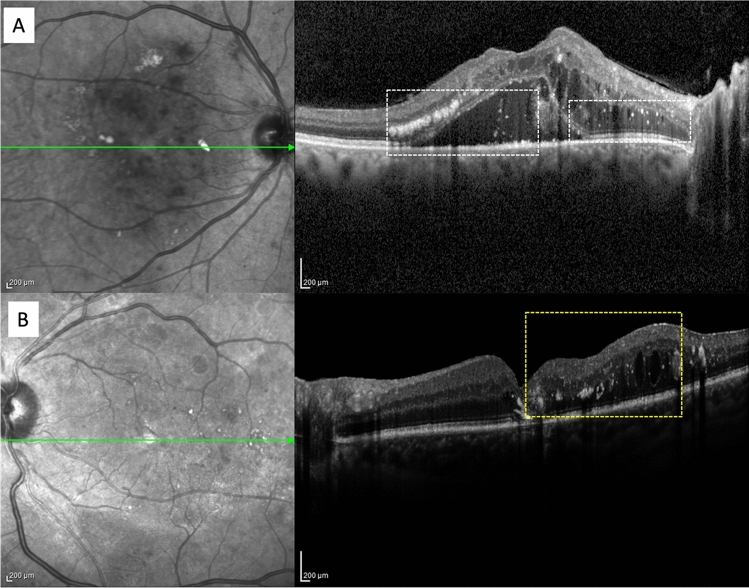
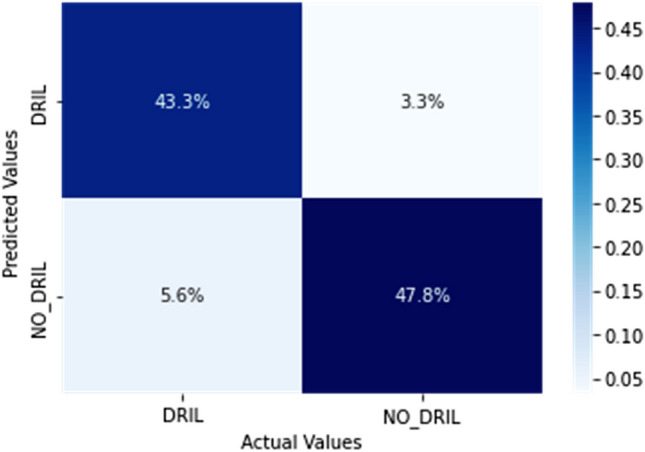
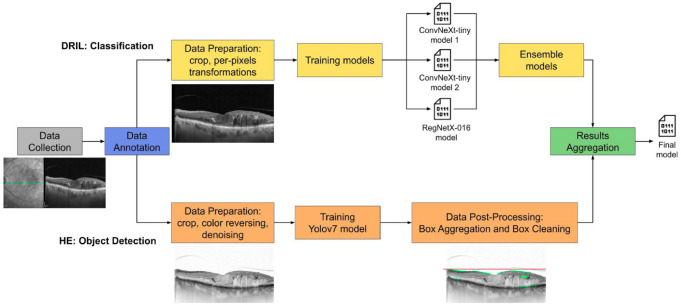
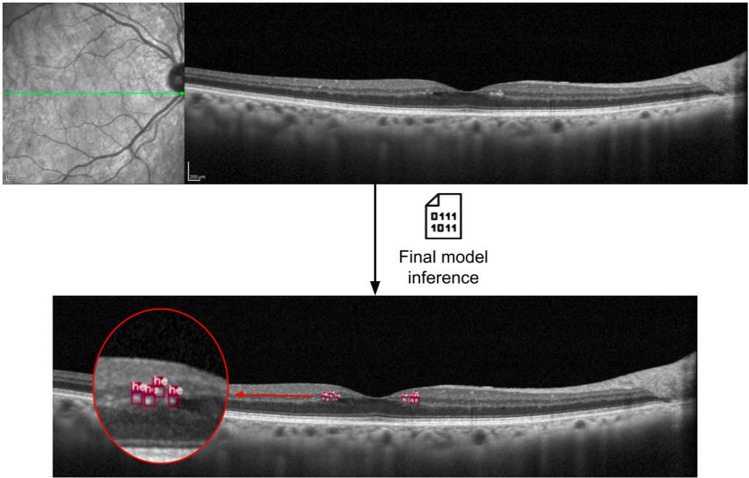
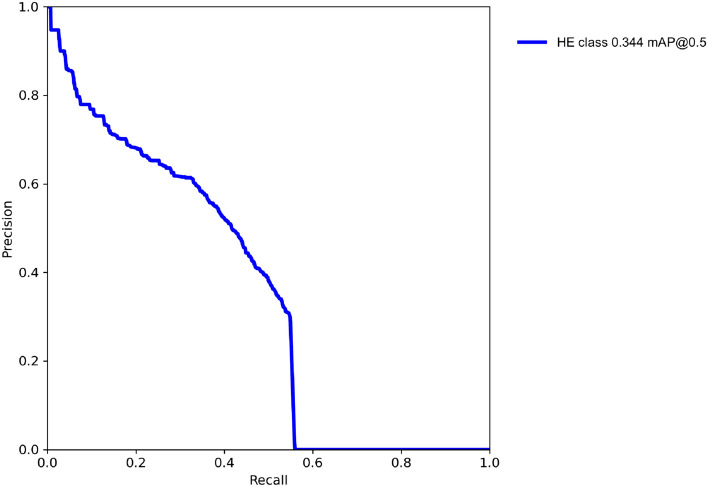
The purpose of the study was to detect Hard Exudates (HE) and classify Disorganization of Retinal Inner Layers (DRIL) implementing a Deep Learning (DL) system on optical coherence tomography (OCT) images of eyes with diabetic macular edema (DME). We collected a dataset composed of 442 OCT images on which we annotated 6847 HE and the presence of DRIL. A complex operational pipeline was defined to implement data cleaning and image transformations, and train two DL models. The state-of-the-art neural network architectures (Yolov7, ConvNeXt, RegNetX) and advanced techniques were exploited to aggregate the results (Ensemble learning, Edge detection) and obtain a final model. The DL approach reached good performance in detecting HE and classifying DRIL. Regarding HE detection the model got an AP@0.5 score equal to 34.4% with Precision of 48.7% and Recall of 43.1%; while for DRIL classification an Accuracy of 91.1% with Sensitivity and Specificity both of 91.1% and AUC and AUPR values equal to 91% were obtained. The P-value was lower than 0.05 and the Kappa coefficient was 0.82. The DL models proved to be able to identify HE and DRIL in eyes with DME with a very good accuracy and all the metrics calculated confirmed the system performance. Our DL approach demonstrated to be a good candidate as a supporting tool for ophthalmologists in OCT images analysis.
本研究旨在利用深度学习(DL)系统在糖尿病性黄斑水肿(DME)患者的光学相干断层扫描(OCT)图像上检测硬性渗出物(HE)并对视网膜内层紊乱(DRIL)进行分类。我们收集了一个由 442 张 OCT 图像组成的数据集,在这些图像上我们标注了 6847 个 HE 和 DRIL 的存在。定义了一个复杂的操作流程来实现数据清理和图像转换,并训练两个 DL 模型。利用最先进的神经网络架构(Yolov7、ConvNeXt、RegNetX)和先进技术来聚合结果(集成学习、边缘检测)并获得最终模型。DL 方法在检测 HE 和分类 DRIL 方面表现出良好的性能。在 HE 检测方面,该模型在 AP@0.5 上的得分达到 34.4%,精度为 48.7%,召回率为 43.1%;而在 DRIL 分类方面,准确率为 91.1%,灵敏度和特异性均为 91.1%,AUC 和 AUPR 值均为 91%。P 值小于 0.05,Kappa 系数为 0.82。DL 模型证明能够非常准确地识别 DME 患者的 HE 和 DRIL,所有计算的指标都证实了系统的性能。我们的 DL 方法被证明是 OCT 图像分析中眼科医生的一个很好的辅助工具。