Berman Marvin H, Halper James P, Nichols Trent W, Jarrett H, Lundy Alan, Huang Jason H
P.I. Quietmind Foundation, 1016 Greenwood Ave, Wyncote PA 19095, USA.
Board, Quietmind Foundation, CNDD Hanover PA 17331, USA.
J Neurol Neurosci. 2017;8(1). doi: 10.21767/2171-6625.1000176. Epub 2017 Feb 28.
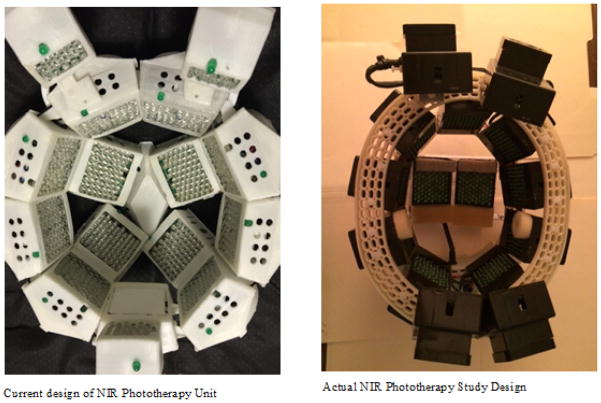
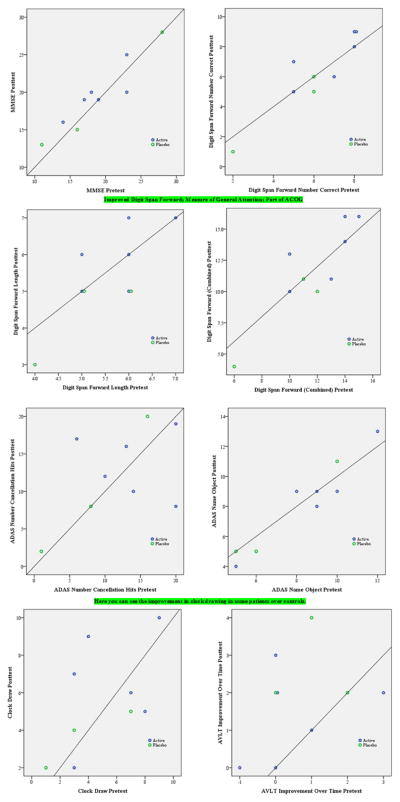
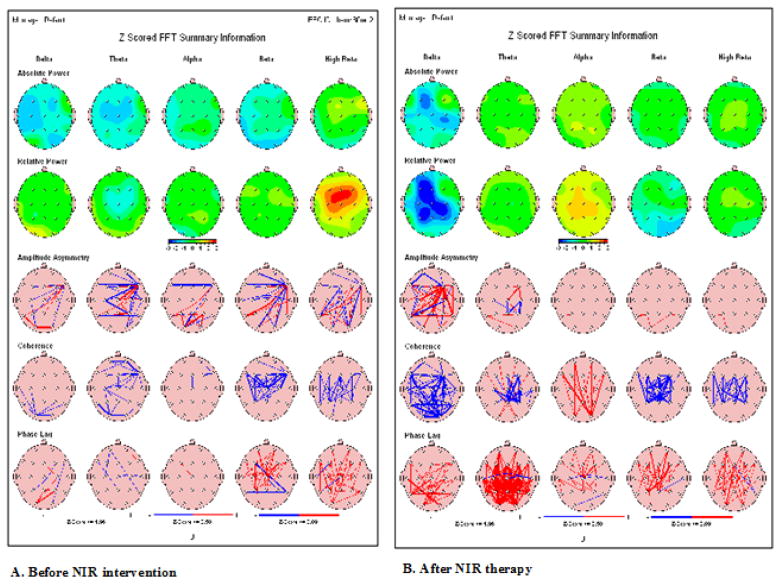
Alzheimer's disease (AD) is a common, chronic expensive debilitating neurodegenerative disease with no current treatments to prevent the physical deterioration of the brain and the consequent cognitive deficits. The current pathophysiology of Alzheimer's disease is the accumulation of neurofibrillary tangles (NFTs) of hyperphosphorylated tau protein and amyloid-beta (Aβ) plaques. Antibody therapy of Tau and Amyloid beta, vaccines and other methods to decrease Tau and or Amyloid have not been successful after considerable pharmaceutical and biotech efforts. For example, Eli Lilly announced a major change to its closely watched clinical trial for the Alzheimer's drug solanezumab which failed to reach statistical significance. Recently, a report on animal models using photomodulation with near infrared light to treat AD pathology in K369I tau transgenic model (K3) l engineered to develop neurofibrillary tangles, and the APPs/PSEN1dE9 transgenic model (APP/PS1) to develop amyloid plaques. Mice were treated with NIR 20 times over a four-week period and NIR treatment (600-1000 nm) was associated with a reduction in the size and number of amyloid-β plaques in the neocortex and hippocampus. We now report a small pilot double blind, placebo-controlled trial (n=11) 6 active, 3 controls and 2 dropouts assessing the effect of 28 consecutive, sixminute transcranial sessions of near infrared (NIR) stimulation using 1060-1080 nm light emitting diodes. Subjects were independently diagnosed with dementia conducted in an outpatient behavioral healthcare clinic. IRB approval was obtained through the Quietmind Foundation's institutional review Board (IRB). Results showed changes in executive functioning; clock drawing, immediate recall, praxis memory, visual attention and task switching (Trails A&B) as well as a trend of improved EEG amplitude and connectivity measures. Neuroplasticity has also been reported with NIR light stimulation and mitochondrial enhancement.
阿尔茨海默病(AD)是一种常见、慢性、昂贵且使人衰弱的神经退行性疾病,目前尚无预防大脑物理退化及随之而来的认知缺陷的治疗方法。阿尔茨海默病当前的病理生理学是过度磷酸化的tau蛋白神经原纤维缠结(NFTs)和β淀粉样蛋白(Aβ)斑块的积累。在制药和生物技术领域付出巨大努力后,针对Tau和β淀粉样蛋白的抗体疗法、疫苗及其他降低Tau和/或淀粉样蛋白的方法均未成功。例如,礼来公司宣布对其备受关注的阿尔茨海默病药物索拉苏单抗的临床试验进行重大调整,该试验未达到统计学显著性。最近,有一份关于动物模型的报告,该模型使用近红外光进行光调制,以治疗K369I tau转基因模型(K3)中的AD病理,K3模型被设计用于产生神经原纤维缠结,以及APPs/PSEN1dE9转基因模型(APP/PS1)用于产生淀粉样蛋白斑块。小鼠在四周内接受了20次近红外光治疗,近红外光治疗(600 - 1000 nm)与新皮层和海马体中β淀粉样蛋白斑块的大小和数量减少有关。我们现在报告一项小型先导双盲、安慰剂对照试验(n = 11),其中6名受试者为实验组、3名受试者为对照组、2名受试者退出试验,该试验评估了使用1060 - 1080 nm发光二极管进行连续28次、每次6分钟的经颅近红外(NIR)刺激的效果。受试者在门诊行为医疗诊所被独立诊断为痴呆。通过静思基金会的机构审查委员会(IRB)获得了IRB批准。结果显示执行功能有变化;画钟试验、即刻回忆、动作记忆、视觉注意力和任务切换(连线测验A和B),以及脑电图振幅和连通性测量有改善的趋势。也有报道称近红外光刺激可促进神经可塑性并增强线粒体功能。