Silva Carlos Alberto, Hudak Andrew Thomas, Klauberg Carine, Vierling Lee Alexandre, Gonzalez-Benecke Carlos, de Padua Chaves Carvalho Samuel, Rodriguez Luiz Carlos Estraviz, Cardil Adrián
Department of Natural Resources and Society, College of Natural Resources, University of Idaho, (UI), 875 Perimeter Drive, Moscow, ID, 83843, USA.
US Forest Service (USDA), Rocky Mountain Research Station, RMRS, 1221 South Main Street, Moscow, ID, 83843, USA.
Carbon Balance Manag. 2017 Dec;12(1):13. doi: 10.1186/s13021-017-0081-1. Epub 2017 Jun 7.
LiDAR remote sensing is a rapidly evolving technology for quantifying a variety of forest attributes, including aboveground carbon (AGC). Pulse density influences the acquisition cost of LiDAR, and grid cell size influences AGC prediction using plot-based methods; however, little work has evaluated the effects of LiDAR pulse density and cell size for predicting and mapping AGC in fast-growing Eucalyptus forest plantations. The aim of this study was to evaluate the effect of LiDAR pulse density and grid cell size on AGC prediction accuracy at plot and stand-levels using airborne LiDAR and field data. We used the Random Forest (RF) machine learning algorithm to model AGC using LiDAR-derived metrics from LiDAR collections of 5 and 10 pulses m (RF5 and RF10) and grid cell sizes of 5, 10, 15 and 20 m.
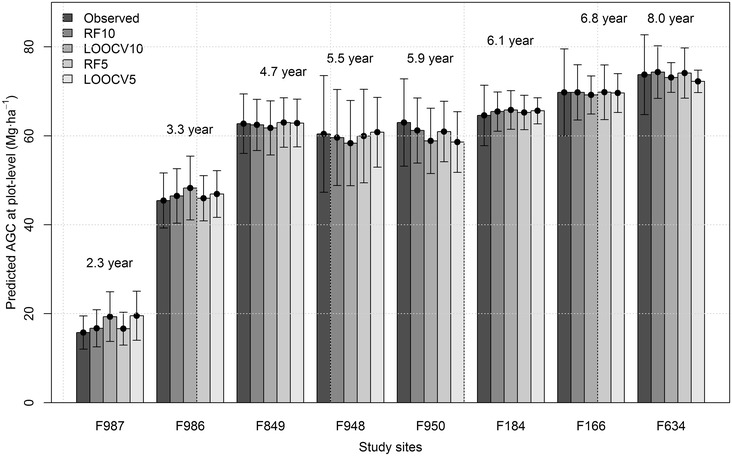
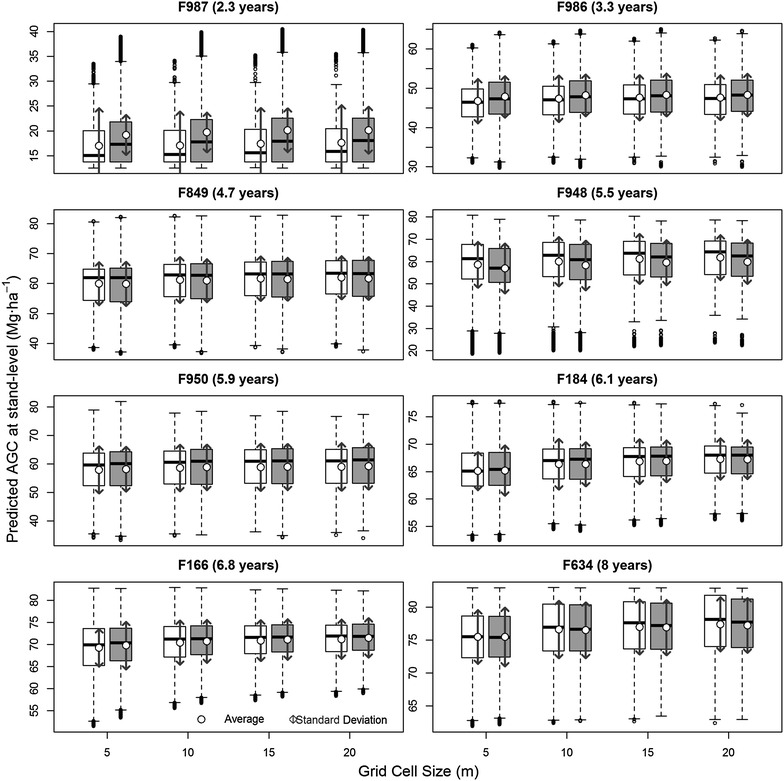
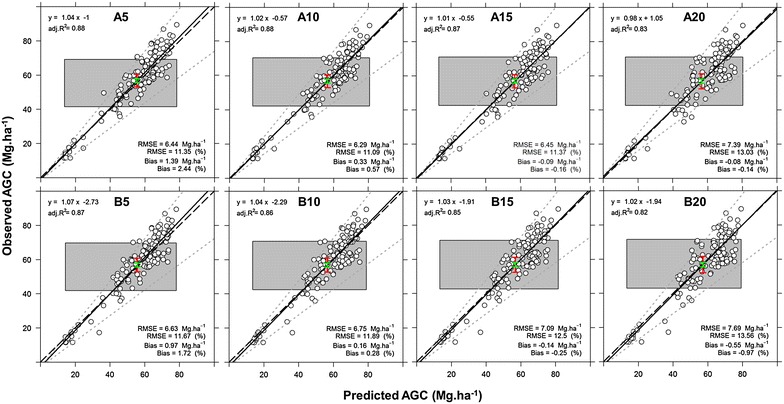
The results show that LiDAR pulse density of 5 pulses m provides metrics with similar prediction accuracy for AGC as when using a dataset with 10 pulses m in these fast-growing plantations. Relative root mean square errors (RMSEs) for the RF5 and RF10 were 6.14 and 6.01%, respectively. Equivalence tests showed that the predicted AGC from the training and validation models were equivalent to the observed AGC measurements. The grid cell sizes for mapping ranging from 5 to 20 also did not significantly affect the prediction accuracy of AGC at stand level in this system.
LiDAR measurements can be used to predict and map AGC across variable-age Eucalyptus plantations with adequate levels of precision and accuracy using 5 pulses m and a grid cell size of 5 m. The promising results for AGC modeling in this study will allow for greater confidence in comparing AGC estimates with varying LiDAR sampling densities for Eucalyptus plantations and assist in decision making towards more cost effective and efficient forest inventory.
激光雷达遥感是一种快速发展的技术,可用于量化包括地上碳(AGC)在内的各种森林属性。脉冲密度会影响激光雷达的采集成本,而网格单元大小会影响基于样地方法的AGC预测;然而,很少有研究评估激光雷达脉冲密度和单元大小对快速生长的桉树林人工林中AGC预测和制图的影响。本研究的目的是利用机载激光雷达和实地数据,评估激光雷达脉冲密度和网格单元大小对样地和林分水平上AGC预测精度的影响。我们使用随机森林(RF)机器学习算法,利用来自5脉冲/m和10脉冲/m的激光雷达数据(RF5和RF10)以及5、10、15和20米的网格单元大小,对AGC进行建模。
结果表明,在这些快速生长的人工林中,5脉冲/m的激光雷达脉冲密度提供的AGC预测精度指标与使用10脉冲/m数据集时相似。RF5和RF10的相对均方根误差(RMSE)分别为6.14%和6.01%。等效性检验表明,训练模型和验证模型预测的AGC与观测到的AGC测量值等效。在该系统中,5至20米的制图网格单元大小也未显著影响林分水平上AGC的预测精度。
使用5脉冲/m和5米的网格单元大小,激光雷达测量可用于以足够的精度预测和绘制不同年龄的桉树林人工林中的AGC。本研究中AGC建模的良好结果将使人们更有信心比较不同激光雷达采样密度下桉树林人工林的AGC估计值,并有助于做出更具成本效益和效率的森林清查决策。