Huang Miaoyun, Huang David, Zhang Jianping, Chen Yuangui, Xu Benhua, Chen Lixin
Department of Radiation Oncology, Fujian Medical University Union Hospital, Fuzhou, China.
Medical Physics Graduate Program, Duke Kunshan University, Kunshan, China.
J Appl Clin Med Phys. 2017 Jul;18(4):97-105. doi: 10.1002/acm2.12098. Epub 2017 Jun 8.
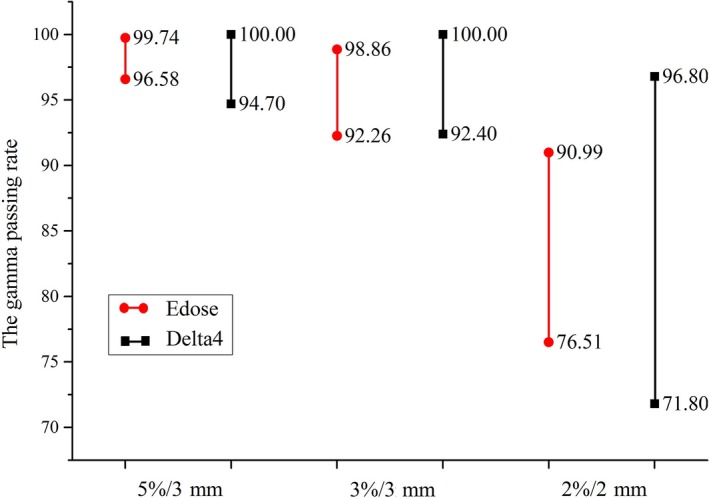
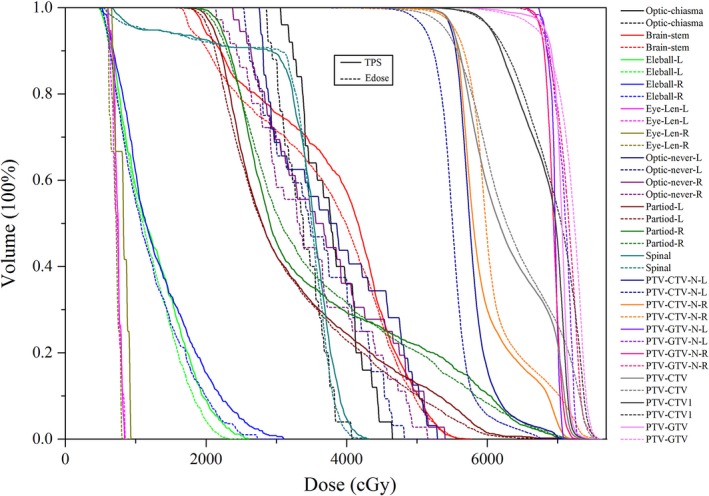
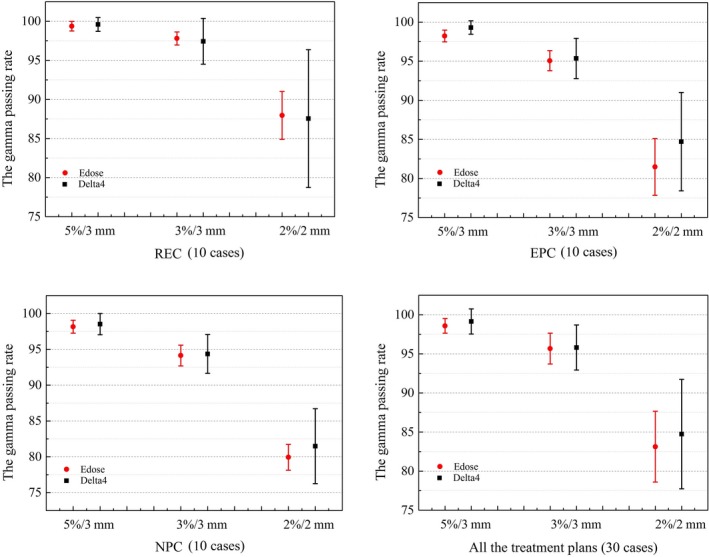
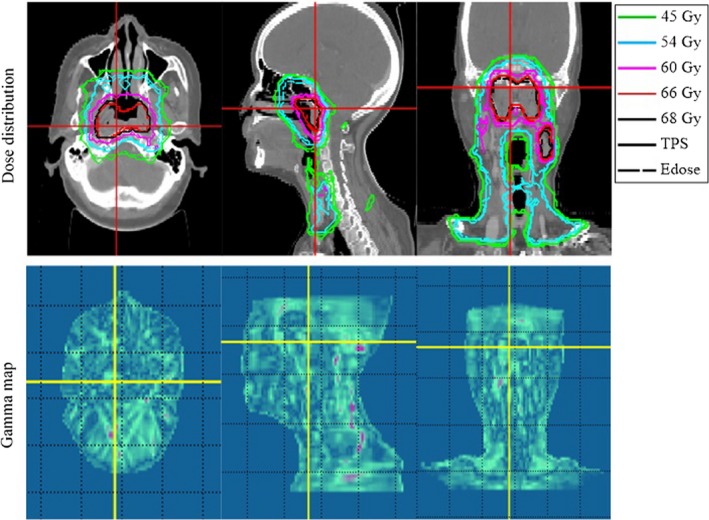
The three-dimensional dose (3D) distribution of intensity-modulated radiation therapy (IMRT) was verified based on electronic portal imaging devices (EPIDs), and the results were analyzed. Thirty IMRT plans of different lesions were selected for 3D EPID-based dose verification. The gamma passing rates of the 3D dose verification-based EPID system (Edose, Version 3.01, Raydose, Guangdong, China) and Delta4 measurements were then compared with treatment planning system (TPS) calculations using global gamma criteria of 5%/3 mm, 3%/3 mm, and 2%/2 mm. Furthermore, the dose-volume histograms (DVHs) for planning target volumes (PTVs) as well as organs at risk (OARs) were analyzed using Edose. For dose verification of the 30 treatment plans, the average gamma passing rates of Edose reconstructions under the gamma criteria of 5%/3 mm, 3%/3 mm, and 2%/2 mm were (98.58 ± 0.93)%, (95.67 ± 1.97)%, and (83.13 ± 4.53)%, respectively, whereas the Delta4 measurement results were (99.14% ± 1.16)%, (95.81% ± 2.88)%, and (84.74% ± 7.00)%, respectively. The dose differences between Edose reconstructions and TPS calculations were within 3% for D , D , and D in each PTV, with the exception that the D of the PTV-clinical target volume (CTV) in esophageal carcinoma cases was (3.21 ± 2.33)%. However, the larger dose deviations in OARs (such as lens, parotid gland, optic nerve, and spinal cord) can be determined based on DVHs. The difference was particularly obvious for OARs with small volumes; for example, the maximum dose deviation for the lens reached (-6.12 ± 5.28)%. A comparison of the results obtained with Edose and Delta4 indicated that the Edose system could be applied for 3D pretreatment dose verification of IMRT. This system could also be utilized to evaluate the gamma passing rate of each treatment plan. Furthermore, the detailed dose distributions of PTVs and OARs could be indicated based on DVHs, providing additional reliable data for quality assurance in a clinic setting.
基于电子射野影像装置(EPID)对调强放射治疗(IMRT)的三维剂量(3D)分布进行验证,并对结果进行分析。选择30个不同病变的IMRT计划进行基于3D EPID的剂量验证。然后使用5%/3 mm、3%/3 mm和2%/2 mm的全局γ标准,将基于3D剂量验证的EPID系统(Edose,版本3.01,Raydose,中国广东)和Delta4测量的γ通过率与治疗计划系统(TPS)计算结果进行比较。此外,使用Edose分析计划靶区(PTV)以及危及器官(OAR)的剂量体积直方图(DVH)。对于30个治疗计划的剂量验证,在5%/3 mm、3%/3 mm和2%/2 mm的γ标准下,Edose重建的平均γ通过率分别为(98.58±0.93)%、(95.67±1.97)%和(83.13±4.53)%,而Delta4测量结果分别为(99.14%±1.16)%、(95.81%±2.88)%和(84.74%±7.00)%。每个PTV中Edose重建与TPS计算之间的剂量差异在D 、D 和D 时均在3%以内,但食管癌病例中PTV-临床靶区(CTV)的D 为(3.21±2.33)%。然而,根据DVH可以确定OAR(如晶状体、腮腺、视神经和脊髓)中较大剂量偏差。对于小体积的OAR,差异尤为明显;例如,晶状体的最大剂量偏差达到(-6.12±5.28)%。Edose和Delta4所得结果的比较表明,Edose系统可用于IMRT的3D预处理剂量验证。该系统还可用于评估每个治疗计划的γ通过率。此外,基于DVH可以显示PTV和OAR的详细剂量分布,为临床环境中的质量保证提供额外可靠的数据。