Schwartzbaum Judith, Wang Min, Root Elisabeth, Pietrzak Maciej, Rempala Grzegorz A, Huang Ruo-Pan, Johannesen Tom Borge, Grimsrud Tom K
Division of Epidemiology, College of Public Health, Ohio State University, Columbus, Ohio, United States of America.
Comprehensive Cancer Center, Ohio State University, Columbus, Ohio, United States of America.
PLoS One. 2017 Jun 8;12(6):e0178705. doi: 10.1371/journal.pone.0178705. eCollection 2017.
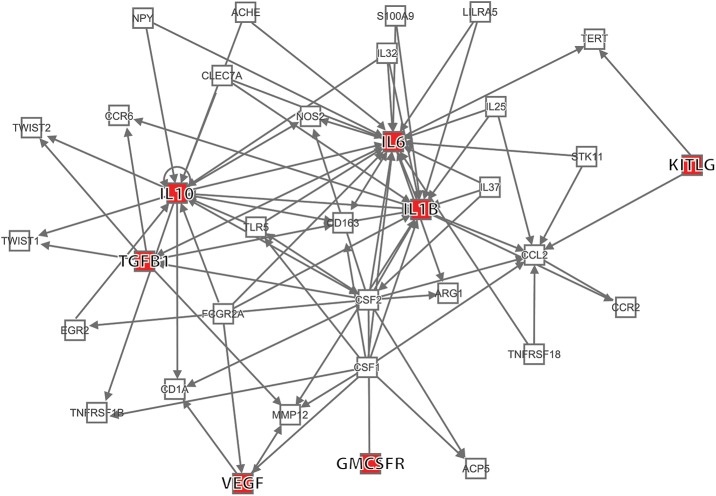
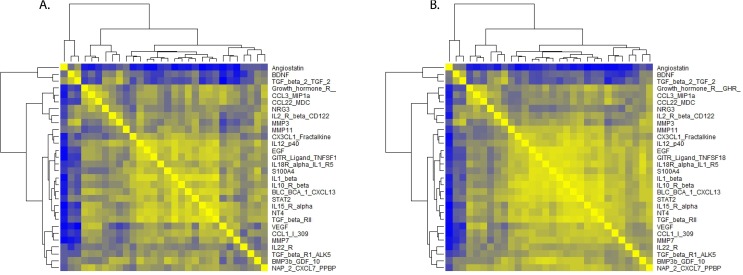
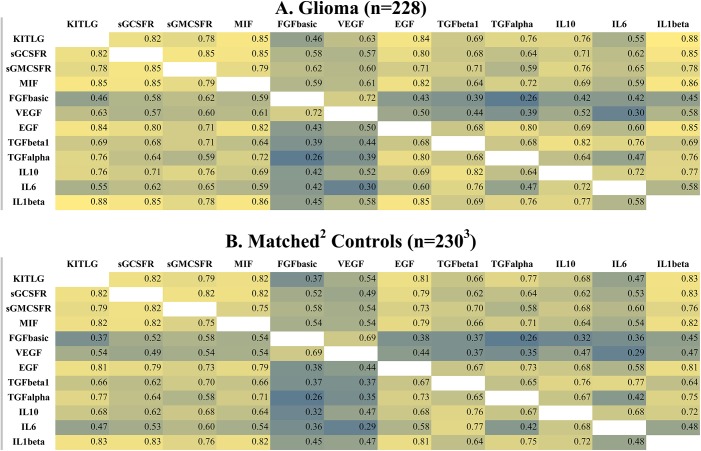
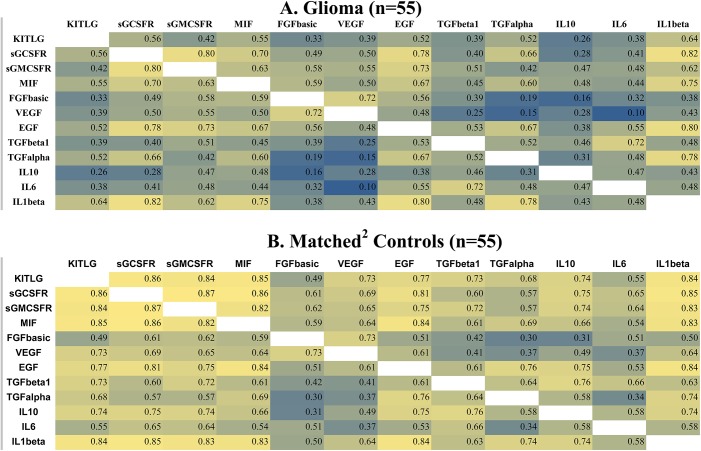
Recent research shows bidirectional communication between the normal brain and the peripheral immune system. Glioma is a primary brain tumor characterized by systemic immunosuppression. To better understand gliomagenesis, we evaluated associations between 277 prediagnostic serum cytokines and glioma. We used glioma (n = 487) and matched control (n = 487) specimens from the Janus Serum Bank Cohort in Oslo, Norway. Conditional logistic regression allowed us to identify those cytokines that were individually associated with glioma. Next, we used heat maps to compare case to control Pearson correlation matrices of 12 cytokines modeled in an in silico study of the interaction between the microenvironment and the tumor. We did the same for case-control correlation matrices of lasso-selected cytokines and all 277 cytokines in the data set. Cytokines related to glioma risk (P ≤ .05) more than 10 years before diagnosis are sIL10RB, VEGF, beta-Catenin and CCL22. LIF was associated with decreased glioma risk within five years before glioma diagnosis (odds ratio (OR) = 0.47, 95% confidence interval (CI) = 0.23, 0.94). After adjustment for cytokines above, the previously observed interaction between IL4 and sIL4RA persisted (> 20 years before diagnosis, OR = 1.72, 95% CI = 1.20, 2.47). In addition, during this period, case correlations among 12 cytokines were weaker than were those among controls. This pattern was also observed among 30 lasso- selected cytokines and all 277 cytokines. We identified four cytokines and one interaction term that were independently related to glioma risk. We have documented prediagnostic changes in serum cytokine levels that may reflect the presence of a preclinical tumor.
近期研究表明,正常大脑与外周免疫系统之间存在双向交流。胶质瘤是一种以全身免疫抑制为特征的原发性脑肿瘤。为了更好地理解胶质瘤的发生机制,我们评估了277种诊断前血清细胞因子与胶质瘤之间的关联。我们使用了来自挪威奥斯陆贾纳斯血清库队列的胶质瘤样本(n = 487)和匹配的对照样本(n = 487)。条件逻辑回归使我们能够识别那些与胶质瘤单独相关的细胞因子。接下来,我们使用热图比较病例组与对照组中12种细胞因子的皮尔逊相关矩阵,这些细胞因子是在微环境与肿瘤相互作用的计算机模拟研究中建模的。我们对套索选择的细胞因子以及数据集中所有277种细胞因子的病例 - 对照相关矩阵也进行了同样的操作。在诊断前10年以上与胶质瘤风险相关(P≤0.05)的细胞因子有可溶性白细胞介素10受体β(sIL10RB)、血管内皮生长因子(VEGF)、β - 连环蛋白和CC趋化因子配体22(CCL22)。白血病抑制因子(LIF)与胶质瘤诊断前五年内胶质瘤风险降低相关(优势比(OR)= 0.47,95%置信区间(CI)= 0.23,0.94)。在对上述细胞因子进行调整后,之前观察到的白细胞介素4(IL4)与可溶性白细胞介素4受体α(sIL4RA)之间的相互作用仍然存在(诊断前> 20年,OR = 1.72,95% CI = 1.20,2.47)。此外,在此期间,12种细胞因子之间的病例相关性比对照组之间的相关性弱。在30种套索选择的细胞因子和所有277种细胞因子中也观察到了这种模式。我们确定了四种细胞因子和一个相互作用项与胶质瘤风险独立相关。我们记录了诊断前血清细胞因子水平的变化,这些变化可能反映了临床前肿瘤的存在。