Izawa Kazuhiro P, Shibata Ai, Ishii Kaori, Miyawaki Rina, Oka Koichiro
Graduate School of Health Sciences, Kobe University, Suma, Kobe, Japan.
Faculty of Health and Sport Sciences, University of Tsukuba, Tsukuba, Ibaraki, Japan.
PLoS One. 2017 Jun 9;12(6):e0178654. doi: 10.1371/journal.pone.0178654. eCollection 2017.
Physical activity and physical performance relate to quality of life, mortality, and morbidity in elderly people. However, little is known about differences in physical performance related to low-intensity light physical activity (LLPA), high-intensity light physical activity (HLPA), and moderate-intensity physical activity (MPA) and how they are separated by sex in elderly populations.
This study aimed to determine differences in LLPA, HLPA, MPA, and physical performance, and associations between these measures in community-dwelling elderly men and women.
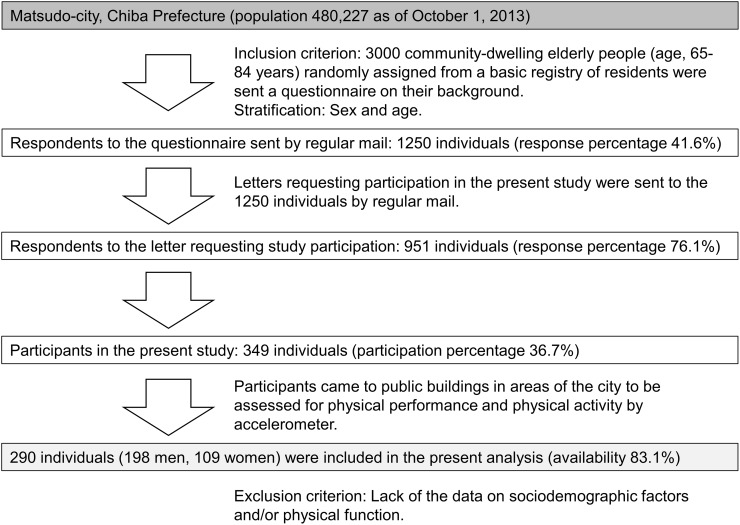
Physical activity and physical performance such as timed-up-and-go test, one-leg standing time, and maximum gait speed were measured in 181 community-dwelling elderly men (mean age, 75.1 ± 5.3 years) and 109 women (mean age, 73.4 ± 4.8 years) in 2013. Physical activity was classified as LLPA (1.61.9 METs of physical activity), HLPA (2.02.9 METs of physical activity), and MPA (over 3 METs of physical activity). The association between the values of these three intensities of physical activity in the participants was assessed by Pearson's correlation coefficients. Multiple linear regression analyses were used to assess the association of physical performance values with the three groups defined by accelerometer-measured physical activity intensity adjusted for sociographic, behavioral, and multiple diseases in the participants.
MPA was beneficially associated with all physical performance indicators in the men (all P<0.05) and women (all P<0.05). Only HLPA showed significant associations with the timed-up-and-go test (P = 0.001) and maximum gait speed (P = 0.006) in women.
These results may support the notion that not only HLPA in women but MPA in both sexes appears to improve physical performance in elderly populations.
The present study findings provide novel epidemiological evidence for the potential benefits of HLPA in women and also reinforce the potential benefits of MPA in both sexes, which is the mainstay of public health recommendations.
身体活动和身体机能与老年人的生活质量、死亡率和发病率相关。然而,关于低强度轻度身体活动(LLPA)、高强度轻度身体活动(HLPA)和中等强度身体活动(MPA)相关的身体机能差异以及老年人群中这些差异如何按性别区分,我们知之甚少。
本研究旨在确定社区居住的老年男性和女性在LLPA、HLPA、MPA和身体机能方面的差异,以及这些指标之间的关联。
2013年,对181名社区居住的老年男性(平均年龄75.1±5.3岁)和109名女性(平均年龄73.4±4.8岁)测量了身体活动和身体机能,如计时起立行走测试、单腿站立时间和最大步速。身体活动被分类为LLPA(身体活动代谢当量为1.61.9)、HLPA(身体活动代谢当量为2.02.9)和MPA(身体活动代谢当量超过3)。通过Pearson相关系数评估参与者中这三种身体活动强度值之间的关联。使用多元线性回归分析评估身体机能值与根据参与者的社会统计学、行为和多种疾病调整后的加速度计测量的身体活动强度定义的三组之间的关联。
MPA与男性(所有P<0.05)和女性(所有P<0.05)的所有身体机能指标均呈有益关联。仅HLPA与女性的计时起立行走测试(P = 0.001)和最大步速(P = 0.006)显示出显著关联。
这些结果可能支持这样一种观点,即不仅女性的HLPA,而且男女两性的MPA似乎都能改善老年人群的身体机能。
本研究结果为HLPA对女性的潜在益处提供了新的流行病学证据,也强化了MPA对男女两性的潜在益处,而MPA是公共卫生建议的主要内容。