Liu Haiyang, Fu Beide, Pang Meixia, Feng Xiu, Yu Xiaomu, Tong Jingou
State Key Laboratory of Freshwater Ecology and Biotechnology, Institute of Hydrobiology, Chinese Academy of Sciences, Wuhan 430072, China.
Graduate School, University of Chinese Academy of Sciences, Beijing 100039, China.
G3 (Bethesda). 2017 Aug 7;7(8):2473-2487. doi: 10.1534/g3.117.041376.
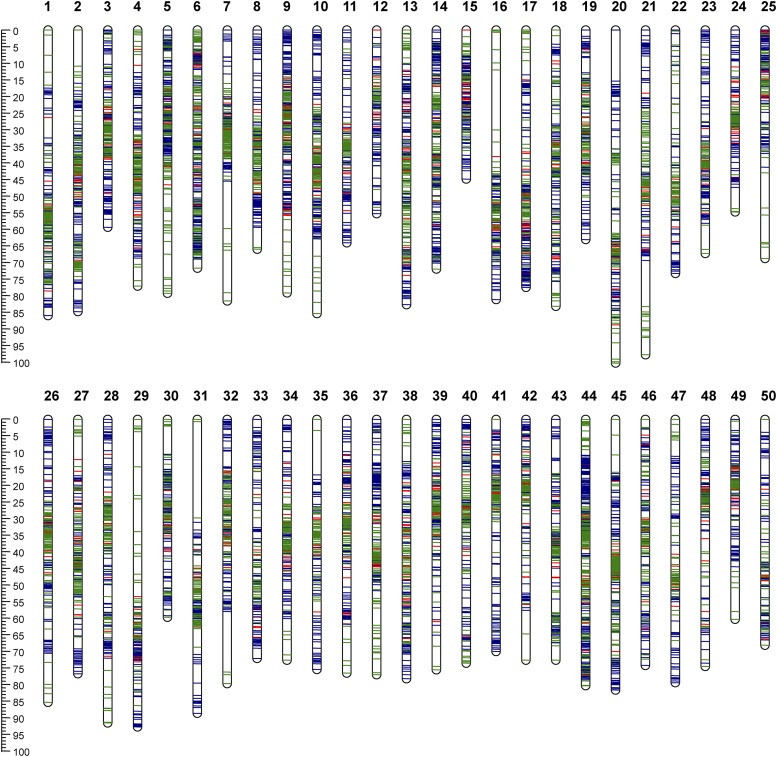
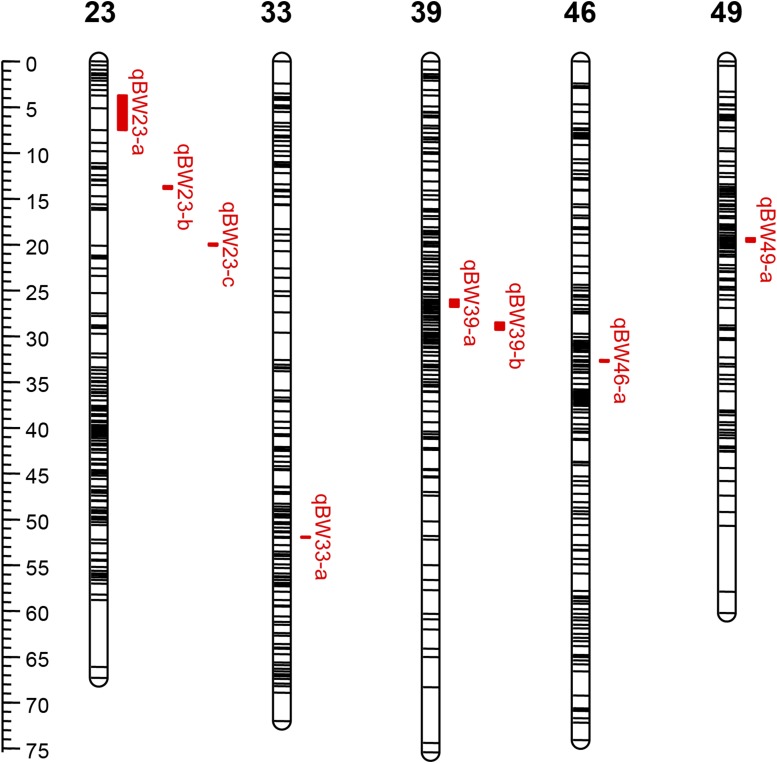
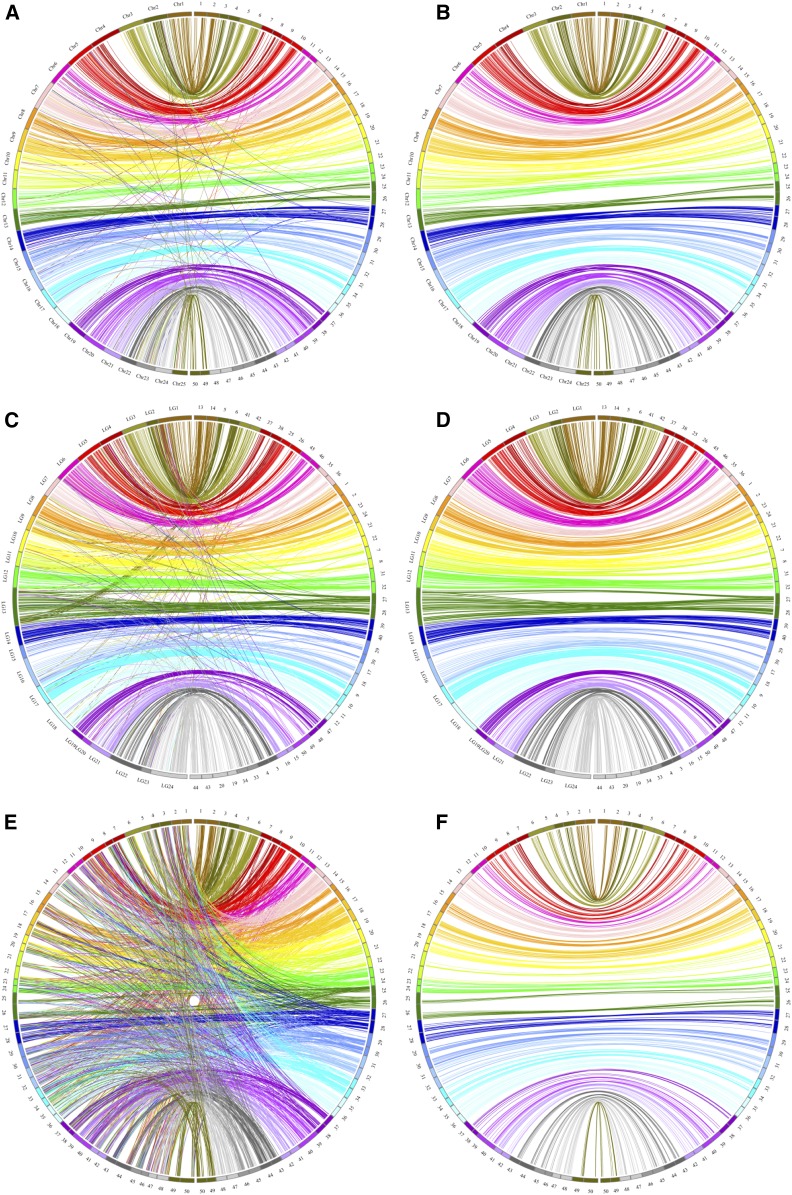
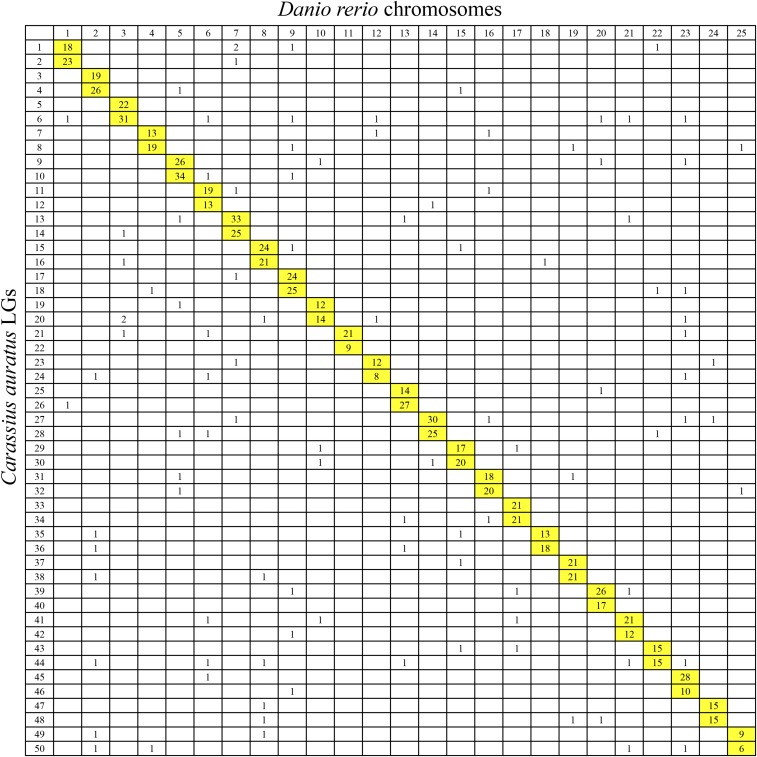
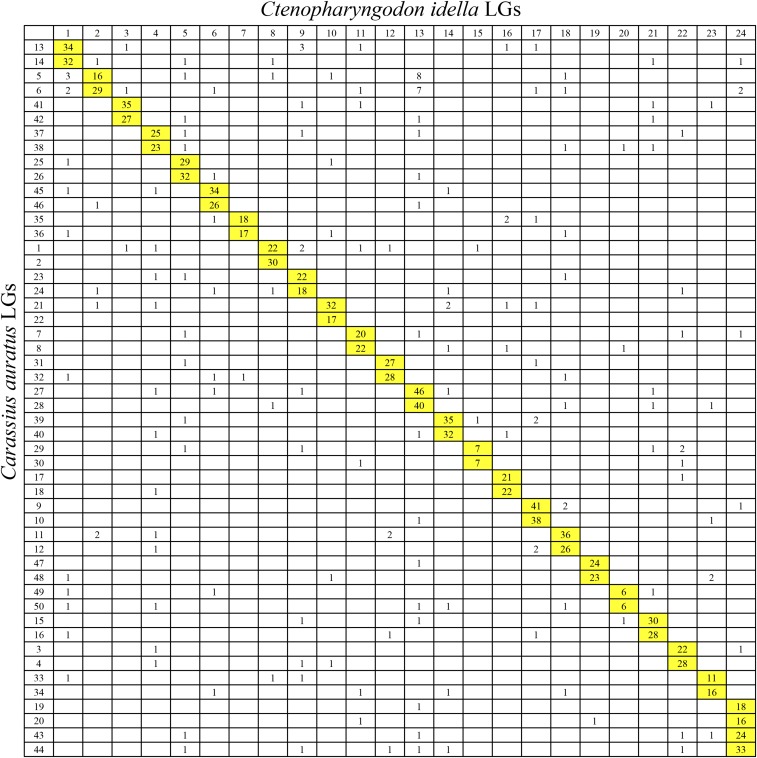
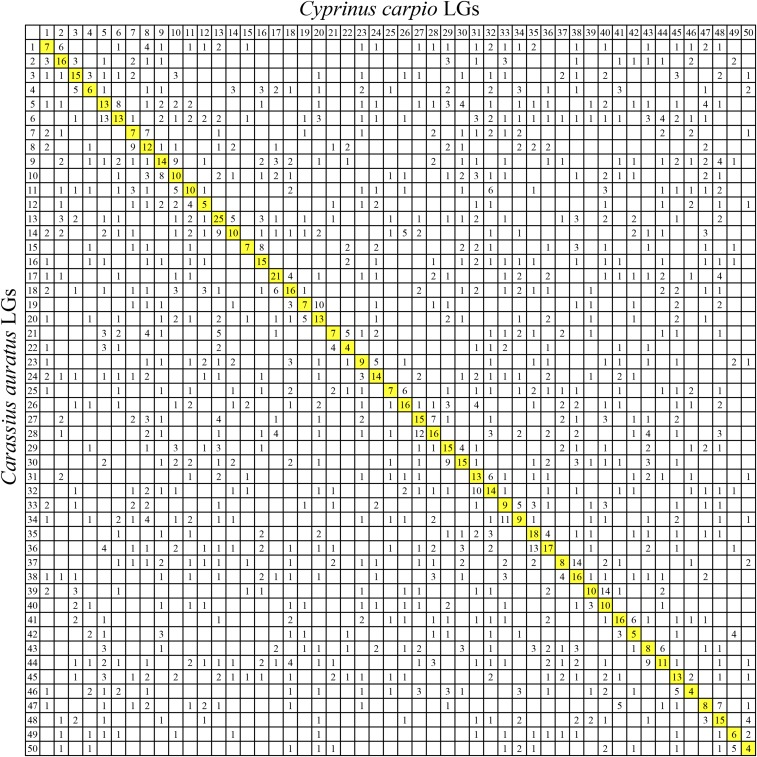
A high-resolution genetic linkage map is essential for a wide range of genetics and genomics studies such as comparative genomics analysis and QTL fine mapping. Crucian carp () is widely distributed in Eurasia, and is an important aquaculture fish worldwide. In this study, a high-density genetic linkage map was constructed for crucian carp using 2b-RAD technology. The consensus map contains 8487 SNP markers, assigning to 50 linkage groups (LGs) and spanning 3762.88 cM, with an average marker interval of 0.44 cM and genome coverage of 98.8%. The female map had 4410 SNPs, and spanned 3500.42 cM (0.79 cM/marker), while the male map had 4625 SNPs and spanned 3346.33 cM (0.72 cM/marker). The average recombination ratio of female to male was 2.13:1, and significant male-biased recombination suppressions were observed in LG47 and LG49. Comparative genomics analysis revealed a clear 2:1 syntenic relationship between crucian carp LGs and chromosomes of zebrafish and grass carp, and a 1:1 correspondence, but extensive chromosomal rearrangement, between crucian carp and common carp, providing evidence that crucian carp has experienced a fourth round of whole genome duplication (4R-WGD). Eight chromosome-wide QTL for body weight at 2 months after hatch were detected on five LGs, explaining 10.1-13.2% of the phenotypic variations. Potential candidate growth-related genes, such as an EGF-like domain and TGF-β, were identified within the QTL intervals. This high-density genetic map and QTL analysis supplies a basis for genome evolutionary studies in cyprinid fishes, genome assembly, and QTL fine mapping for complex traits in crucian carp.
高分辨率遗传连锁图谱对于广泛的遗传学和基因组学研究至关重要,如比较基因组学分析和QTL精细定位。鲫鱼()广泛分布于欧亚大陆,是全球重要的水产养殖鱼类。在本研究中,利用2b-RAD技术构建了鲫鱼的高密度遗传连锁图谱。该共识图谱包含8487个SNP标记,分配到50个连锁群(LGs),跨度为3762.88 cM,平均标记间隔为0.44 cM,基因组覆盖率为98.8%。雌性图谱有4410个SNP,跨度为3500.42 cM(0.79 cM/标记),而雄性图谱有4625个SNP,跨度为3346.33 cM(0.72 cM/标记)。雌性与雄性的平均重组率为2.13:1,在LG47和LG49中观察到显著的雄性偏向重组抑制。比较基因组学分析揭示了鲫鱼LGs与斑马鱼和草鱼染色体之间明显的2:1同线性关系,以及鲫鱼与鲤鱼之间的1:1对应关系,但存在广泛的染色体重排,这为鲫鱼经历了第四轮全基因组复制(4R-WGD)提供了证据。在孵化后2个月的体重方面,在5个LGs上检测到8个全染色体范围的QTL,解释了10.1-13.2%的表型变异。在QTL区间内鉴定出了潜在的候选生长相关基因,如一个EGF样结构域和TGF-β。这种高密度遗传图谱和QTL分析为鲤科鱼类的基因组进化研究、基因组组装以及鲫鱼复杂性状的QTL精细定位提供了基础。