Linke Monika, Fritsch Stephanie Deborah, Sukhbaatar Nyamdelger, Hengstschläger Markus, Weichhart Thomas
Center of Pathobiochemistry and Genetics, Institute of Medical Genetics, Medical University of Vienna, Austria.
FEBS Lett. 2017 Oct;591(19):3089-3103. doi: 10.1002/1873-3468.12711. Epub 2017 Jun 23.
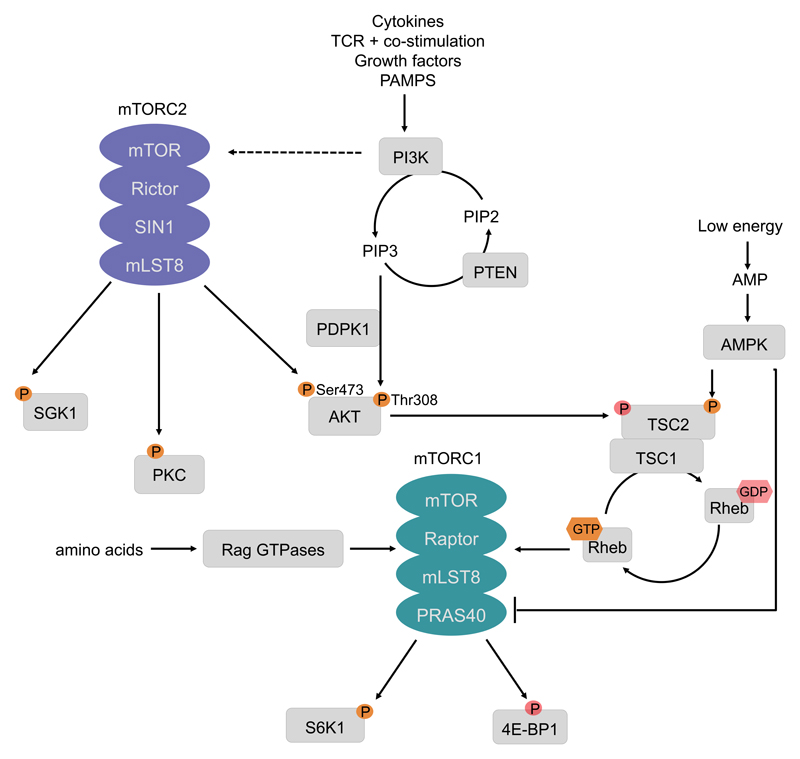
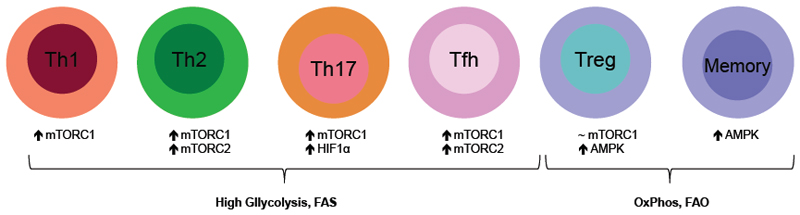
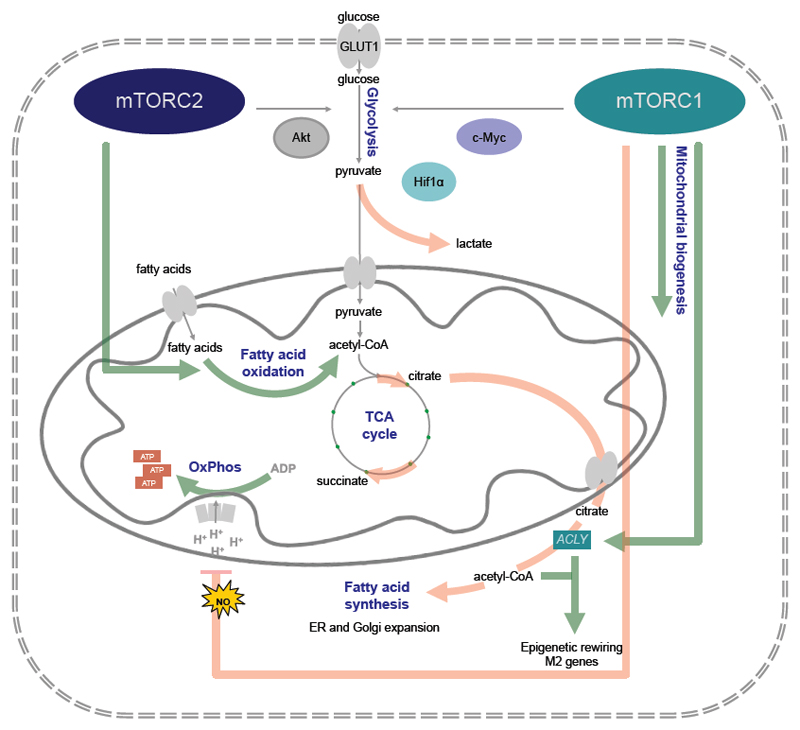
The mechanistic target of rapamycin (mTOR) pathway is an evolutionarily conserved signaling pathway that senses intra- and extracellular nutrients, growth factors, and pathogen-associated molecular patterns to regulate the function of innate and adaptive immune cell populations. In this review, we focus on the role of the mTOR complex 1 (mTORC1) and mTORC2 in the regulation of the cellular energy metabolism of these immune cells to regulate and support immune responses. In this regard, mTORC1 and mTORC2 generally promote an anabolic response by stimulating protein synthesis, glycolysis, mitochondrial functions, and lipid synthesis to influence proliferation and survival, effector and memory responses, innate training and tolerance as well as hematopoietic stem cell maintenance and differentiation. Deactivation of mTOR restores cell homeostasis after immune activation and optimizes antigen presentation and memory T-cell generation. These findings show that the mTOR pathway integrates spatiotemporal information of the environmental and cellular energy status by regulating cellular metabolic responses to guide immune cell activation. Elucidation of the metabolic control mechanisms of immune responses will help to generate a systemic understanding of the immune system.
雷帕霉素的作用机制靶点(mTOR)通路是一条在进化上保守的信号通路,它能感知细胞内和细胞外的营养物质、生长因子以及病原体相关分子模式,以调节固有免疫细胞群体和适应性免疫细胞群体的功能。在本综述中,我们重点关注mTOR复合体1(mTORC1)和mTORC2在调节这些免疫细胞的细胞能量代谢以调控和支持免疫反应方面的作用。在这方面,mTORC1和mTORC2通常通过刺激蛋白质合成、糖酵解、线粒体功能和脂质合成来促进合成代谢反应,从而影响细胞增殖和存活、效应和记忆反应、固有免疫训练和耐受以及造血干细胞的维持和分化。mTOR失活可在免疫激活后恢复细胞稳态,并优化抗原呈递和记忆性T细胞生成。这些发现表明,mTOR通路通过调节细胞代谢反应来整合环境和细胞能量状态的时空信息,从而指导免疫细胞激活。阐明免疫反应的代谢控制机制将有助于对免疫系统形成系统性理解。