Mackenzie Grant A, Hill Philip C, Sahito Shah M, Jeffries David J, Hossain Ilias, Bottomley Christian, Uchendu Uchendu, Ameh David, Ndiaye Malick, Osuorah Chidebereh D, Adeyemi Oyedeji, Pathirana Jayani, Olatunji Yekini, Abatan Bade, Ahameefula Ebirim, Muhammad Bilquees S, Fombah Augustin E, Saha Debasish, Mackenzie Roslyn, Plumb Ian, Akano Aliu, Ebruke Bernard, Ideh Readon C, Kuti Bankole, Githua Peter, Olutunde Emmanuel, Ofordile Ogochukwu, Green Edward, Usuf Effua, Badji Henry, Ikumapayi Usman N A, Manjang Ahmad, Salaudeen Rasheed, Nsekpong E David, Jarju Sheikh, Antonio Martin, Sambou Sana, Ceesay Lamin, Lowe-Jallow Yamundow, Sowe Dawda, Jasseh Momodou, Mulholland Kim, Knoll Maria, Levine Orin S, Howie Stephen R, Adegbola Richard A, Greenwood Brian M, Corrah Tumani
Medical Research Council Unit, The Gambia, Fajara, The Gambia; Murdoch Childrens Research Institute, Melbourne, VIC, Australia; London School of Hygiene & Tropical Medicine, London, UK.
Centre for International Health, University of Otago, Dunedin, New Zealand.
Lancet Infect Dis. 2017 Sep;17(9):965-973. doi: 10.1016/S1473-3099(17)30321-3. Epub 2017 Jun 7.
Pneumococcal conjugate vaccines (PCVs) are used in many low-income countries but their impact on the incidence of pneumonia is unclear. The Gambia introduced PCV7 in August, 2009, and PCV13 in May, 2011. We aimed to measure the impact of the introduction of these vaccines on pneumonia incidence.
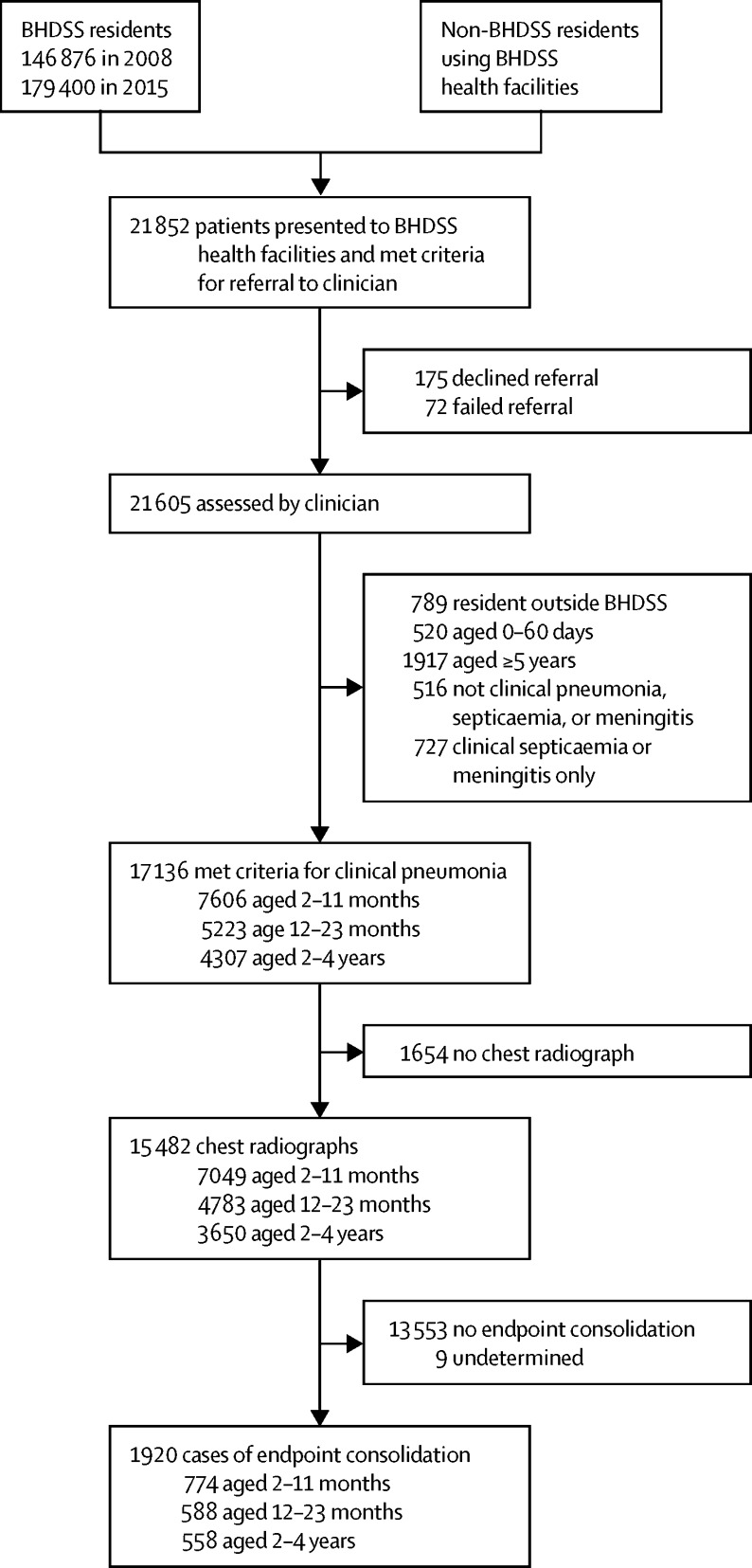
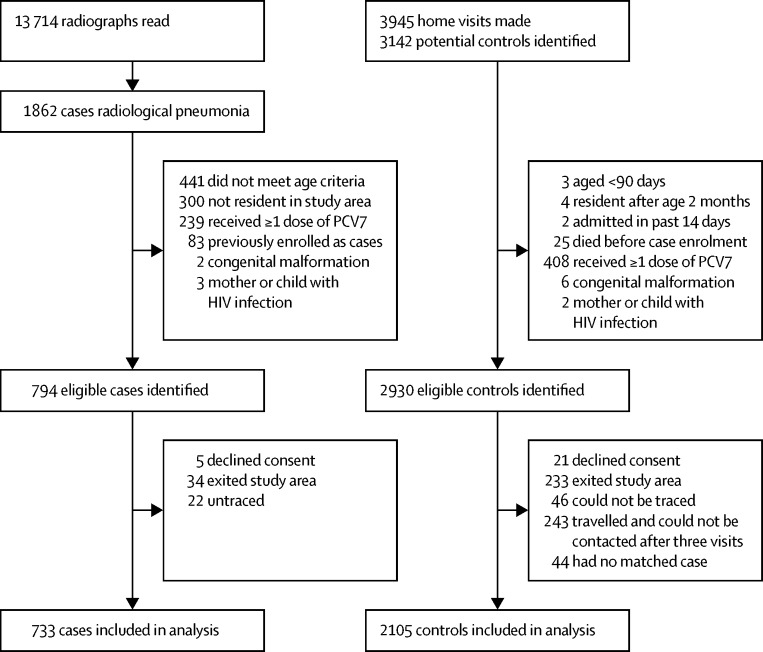
We did population-based surveillance and case-control studies. The primary endpoint was WHO-defined radiological pneumonia with pulmonary consolidation. Population-based surveillance was for suspected pneumonia in children aged 2-59 months (minimum age 3 months in the case-control study) between May 12, 2008, and Dec 31, 2015. Surveillance for the impact study was limited to the Basse Health and Demographic Surveillance System (BHDSS), whereas surveillance for the case-control study included both the BHDSS and Fuladu West Health and Demographic Surveillance System. Nurses screened all outpatients and inpatients at all health facilities in the surveillance area using standardised criteria for referral to clinicians in Basse and Bansang. These clinicians recorded clinical findings and applied standardised criteria to identify patients with suspected pneumonia. We compared the incidence of pneumonia during the baseline period (May 12, 2008, to May 11, 2010) and the PCV13 period (Jan 1, 2014, to Dec 31, 2015). We also investigated the effectiveness of PCV13 using case-control methods between Sept 12, 2011, and Sept 31, 2014. Controls were aged 90 days or older, and were eligible to have received at least one dose of PCV13; cases had the same eligibility criteria with the addition of having WHO-defined radiological pneumonia.
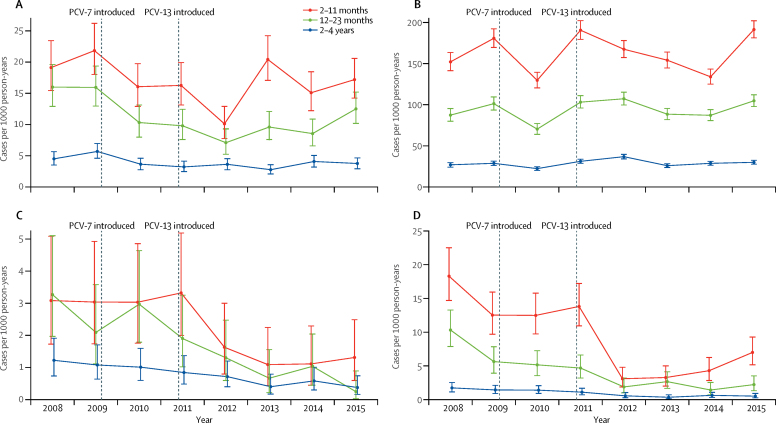
We investigated 18 833 children with clinical pneumonia and identified 2156 cases of radiological pneumonia. Among children aged 2-11 months, the incidence of radiological pneumonia fell from 21·0 cases per 1000 person-years in the baseline period to 16·2 cases per 1000 person-years (23% decline, 95% CI 7-36) in 2014-15. In the 12-23 month age group, radiological pneumonia decreased from 15·3 to 10·9 cases per 1000 person-years (29% decline, 12-42). In children aged 2-4 years, incidence fell from 5·2 to 4·1 cases per 1000 person-years (22% decline, 1-39). Incidence of all clinical pneumonia increased by 4% (-1 to 8), but hospitalised cases declined by 8% (3-13). Pneumococcal pneumonia declined from 2·9 to 1·2 cases per 1000 person-years (58% decline, 22-77) in children aged 2-11 months and from 2·6 to 0·7 cases per 1000 person-years (75% decline, 47-88) in children aged 12-23 months. Hypoxic pneumonia fell from 13·1 to 5·7 cases per 1000 person-years (57% decline, 42-67) in children aged 2-11 months and from 6·8 to 1·9 cases per 1000 person-years (72% decline, 58-82) in children aged 12-23 months. In the case-control study, the best estimate of the effectiveness of three doses of PCV13 against radiological pneumonia was an adjusted odds ratio of 0·57 (0·30-1·08) in children aged 3-11 months and vaccine effectiveness increased with greater numbers of doses (p=0·026). The analysis in children aged 12 months and older was underpowered because there were few unvaccinated cases and controls.
The introduction of PCV in The Gambia was associated with a moderate impact on the incidence of radiological pneumonia, a small reduction in cases of hospitalised pneumonia, and substantial reductions of pneumococcal and hypoxic pneumonia in young children. Low-income countries that introduce PCV13 with reasonable coverage can expect modest reductions in hospitalised cases of pneumonia and a marked impact on the incidence of severe childhood pneumonia.
GAVI's Pneumococcal vaccines Accelerated Development and Introduction Plan, Bill & Melinda Gates Foundation, and UK Medical Research Council.
肺炎球菌结合疫苗(PCV)在许多低收入国家得到应用,但其对肺炎发病率的影响尚不清楚。冈比亚于2009年8月引入PCV7,并于2011年5月引入PCV13。我们旨在评估引入这些疫苗对肺炎发病率的影响。
我们开展了基于人群的监测和病例对照研究。主要终点是世界卫生组织(WHO)定义的伴有肺部实变的放射性肺炎。基于人群的监测针对2008年5月12日至2015年12月31日期间2至59个月大的儿童(病例对照研究中的最小年龄为3个月)中的疑似肺炎。影响研究的监测仅限于巴塞卫生和人口监测系统(BHDSS),而病例对照研究的监测包括BHDSS和富拉杜西部卫生和人口监测系统。护士使用标准化标准对监测区域内所有卫生设施的门诊和住院患者进行筛查,以便转诊至巴塞和班桑的临床医生处。这些临床医生记录临床发现并应用标准化标准来识别疑似肺炎患者。我们比较了基线期(2008年5月12日至2010年5月11日)和PCV13期(2014年1月1日至2015年12月31日)的肺炎发病率。我们还在2011年9月12日至2014年9月31日期间使用病例对照方法调查了PCV13的有效性。对照年龄在90天及以上,并且有资格接受至少一剂PCV13;病例具有相同的资格标准,另外还患有WHO定义的放射性肺炎。
我们调查了18833例临床肺炎儿童,确定了2156例放射性肺炎病例。在2至11个月大的儿童中,放射性肺炎的发病率从基线期的每1000人年21.0例降至2014 - 2015年的每1000人年16.2例(下降23%,95%CI 7 - 36)。在12至23个月年龄组中,放射性肺炎从每1000人年15.3例降至10.9例(下降29%,12 - 42)。在2至4岁的儿童中,发病率从每1000人年5.2例降至4.1例(下降22%,1 - 39)。所有临床肺炎的发病率增加了4%(-1至8),但住院病例下降了8%(3 - 13)。2至11个月大的儿童中,肺炎球菌肺炎从每1000人年2.9例降至1.2例(下降58%,22 - 77),12至23个月大的儿童中从每1000人年2.6例降至0.7例(下降75%,47 - 88)。2至11个月大的儿童中,缺氧性肺炎从每1000人年13.1例降至5.7例(下降57%,42 - 67),12至23个月大的儿童中从每1000人年6.8例降至1.9例(下降72%,58 - 82)。在病例对照研究中,三剂PCV13对放射性肺炎有效性的最佳估计是3至11个月大儿童的调整优势比为0.57(0.30 - 1.08),并且疫苗有效性随着接种剂量的增加而提高(p = 0.026)。对12个月及以上儿童的分析效能不足,因为未接种疫苗的病例和对照很少。
在冈比亚引入PCV与放射性肺炎发病率的适度降低、住院肺炎病例的小幅减少以及幼儿肺炎球菌性和缺氧性肺炎的大幅减少相关。以合理覆盖率引入PCV13的低收入国家有望使住院肺炎病例适度减少,并对严重儿童肺炎的发病率产生显著影响。
全球疫苗免疫联盟(GAVI)的肺炎球菌疫苗加速开发和引入计划、比尔及梅琳达·盖茨基金会和英国医学研究理事会。