Lourdudoss Cecilia, Wolk Alicja, Nise Lena, Alfredsson Lars, Vollenhoven Ronald van
Department of Medicine Solna, Karolinska Institutet, Stockholm, Sweden.
Department of Environmental Medicine, Karolinska Institutet, Stockholm, Sweden.
BMJ Open. 2017 Jun 10;7(6):e016154. doi: 10.1136/bmjopen-2017-016154.
Dietary intake of vitamin D and omega-3 fatty acids (FA) may be associated with superior response to antirheumatic treatments. In addition, dietary folate intake may be associated with worse response to methotrexate (MTX). The aim of this study was to investigate the association between dietary vitamin D, omega-3 FA, folate and treatment results of disease-modifying antirheumatic drugs (DMARDs) in patients with rheumatoid arthritis (RA).
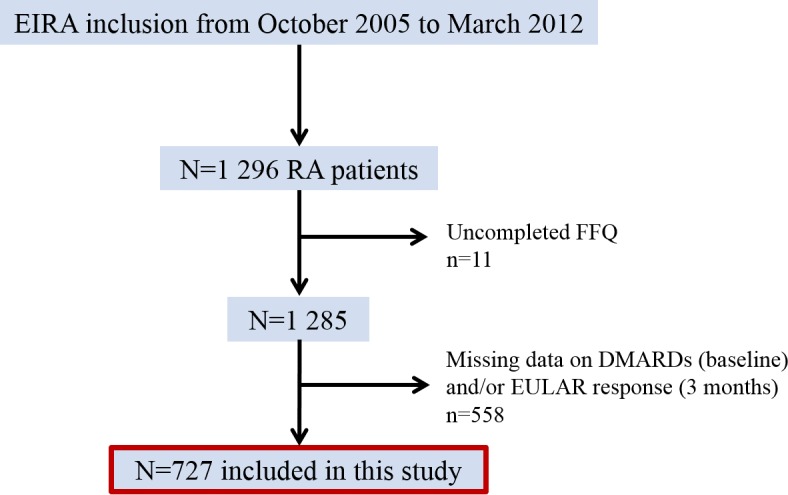
This prospective study was based on data from the Epidemiological Investigation of Rheumatoid Arthritis (EIRA) study, and included 727 patients with early RA from 10 hospitals in Sweden. Data on dietary vitamin D, omega-3 FA and folate intake based on food frequency questionnaires were linked with data on European League Against Rheumatism (EULAR) response after 3 months of DMARD treatment. Associations between vitamin D, omega-3 FA, folate and EULAR response were analysed with logistic regression adjusted for potential confounders.
The majority of patients (89.9%) were initially treated with MTX monotherapy and more than half (56.9%) with glucocorticoids. Vitamin D and omega-3 FA were associated with good EULAR response (OR 1.80 (95% CI 1.14 to 2.83) and OR 1.60 (95% CI 1.02 to 2.53), respectively). Folate was not significantly associated with EULAR response (OR 1.20 (95% CI 0.75 to 1.91)). Similar results were seen in a subgroup of patients who were initially treated with MTX monotherapy at baseline.
Higher intake of dietary vitamin D and omega-3 FA during the year preceding DMARD initiation may be associated with better treatment results in patients with early RA. Dietary folate intake was not associated with worse or better response to treatment, especially to MTX. Our results suggest that some nutrients may be associated with enhanced treatment results of DMARDs.
饮食中维生素D和ω-3脂肪酸(FA)的摄入可能与抗风湿治疗的更佳反应相关。此外,饮食中叶酸的摄入可能与甲氨蝶呤(MTX)治疗反应较差有关。本研究的目的是调查类风湿关节炎(RA)患者饮食中维生素D、ω-3 FA、叶酸与改善病情抗风湿药(DMARDs)治疗效果之间的关联。
这项前瞻性研究基于类风湿关节炎流行病学调查(EIRA)研究的数据,纳入了瑞典10家医院的727例早期RA患者。基于食物频率问卷的饮食中维生素D、ω-3 FA和叶酸摄入量数据与DMARD治疗3个月后的欧洲抗风湿病联盟(EULAR)反应数据相关联。采用多因素logistic回归分析维生素D、ω-3 FA、叶酸与EULAR反应之间的关联,并对潜在混杂因素进行校正。
大多数患者(89.9%)最初接受MTX单药治疗,超过一半(56.9%)接受糖皮质激素治疗。维生素D和ω-3 FA与良好的EULAR反应相关(OR分别为1.80(95%CI 1.14至2.83)和1.60(95%CI 1.02至2.53))。叶酸与EULAR反应无显著关联(OR 1.20(95%CI 0.75至1.91))。在基线时最初接受MTX单药治疗的患者亚组中也观察到了类似结果。
在开始使用DMARDs前一年中,饮食中较高的维生素D和ω-3 FA摄入量可能与早期RA患者更好的治疗效果相关。饮食中叶酸摄入量与治疗反应的好坏无关,尤其是与MTX治疗反应无关。我们的结果表明,某些营养素可能与DMARDs治疗效果的增强有关。