Veronese Nicola, Sigeirsdottir Kristin, Eiriksdottir Gudny, Marques Elisa A, Chalhoub Didier, Phillips Caroline L, Launer Lenore J, Maggi Stefania, Gudnason Vilmundur, Harris Tamara B
1 National Research Council, Neuroscience Institute-Aging Branch, Padova, Italy .
2 Icelandic Heart Association , Kopavogur, Iceland .
Rejuvenation Res. 2017 Dec;20(6):517-524. doi: 10.1089/rej.2016.1905. Epub 2017 Aug 7.
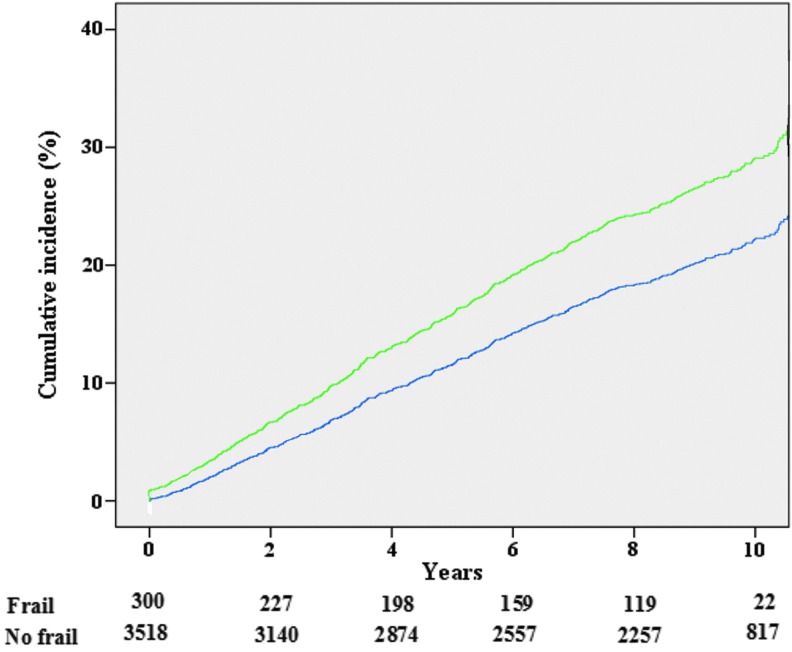
Frailty is a risk factor for cardiovascular diseases (CVD), but the studies available have not considered the presence of subclinical atherosclerotic disease as potential confounders. We investigated the association between frailty and the onset of CVD independently of subclinical atherosclerotic disease. For this reason, a sample of 3818 older participants participating in the Age, Gene/Environment Susceptibility-Reykjavik Study without CVD at baseline was followed for a median of 8.7 years. Frailty was defined as the presence of ≥3 among five Fried's criteria (unintentional weight loss, low physical activity level, weakness, exhaustion, and slow gait speed). Incident CVD was defined as onset of coronary artery disease, heart failure, stroke, and CVD-related mortality identified using hospital, medical, and death records. Subclinical atherosclerotic disease was evaluated as the maximum value of carotid intima media thickness, presence of carotid plaque (moderate or high), and total coronary calcifications (CACs). At baseline, frail participants (n = 300) were more frequently obese, diabetic, and had a greater presence of metabolic syndrome than the nonfrail (n = 3518). Frail participants also showed a higher presence of carotid plaques and CACs. Using a Cox's regression analysis, adjusted for clinical, biochemical, and subclinical atherosclerosis estimates, frailty increased the risk of CVD (hazard ratio [HR] = 1.35; 95% confidence interval [CI]: 1.05-1.74), with results stronger for women than men (HR = 1.51, p = 0.006 and 1.19, p = 0.44, respectively). Among Fried's criteria, exhaustion was the only criterion significantly associated with the onset of new CVD events (HR = 1.30; 95% CI: 1.00-1.73). In conclusion, frailty was associated with the onset of CVD in older people even after adjusting for subclinical atherosclerotic disease.
衰弱是心血管疾病(CVD)的一个风险因素,但现有研究尚未将亚临床动脉粥样硬化疾病的存在视为潜在的混杂因素。我们研究了衰弱与CVD发病之间的关联,且独立于亚临床动脉粥样硬化疾病进行分析。因此,对3818名参与年龄、基因/环境易感性-雷克雅未克研究的老年参与者进行了研究,这些参与者在基线时无CVD,随访时间中位数为8.7年。衰弱被定义为在弗里德五项标准(非故意体重减轻、低身体活动水平、虚弱、疲惫和缓慢的步态速度)中存在≥3项。新发CVD被定义为使用医院、医疗和死亡记录确定的冠状动脉疾病、心力衰竭、中风以及CVD相关死亡率的发病情况。亚临床动脉粥样硬化疾病通过颈动脉内膜中层厚度的最大值、颈动脉斑块(中度或高度)的存在以及总冠状动脉钙化(CAC)进行评估。在基线时,衰弱参与者(n = 300)比非衰弱参与者(n = 3518)更频繁地出现肥胖、糖尿病,且代谢综合征的发生率更高。衰弱参与者还表现出更高的颈动脉斑块和CAC发生率。使用Cox回归分析,在对临床、生化和亚临床动脉粥样硬化评估进行调整后,衰弱增加了CVD风险(风险比[HR] = 1.35;95%置信区间[CI]:1.05 - 1.74),女性的结果比男性更强(HR分别为1.51,p = 0.006和1.19,p = 0.44)。在弗里德标准中,疲惫是与新发CVD事件发病唯一显著相关的标准(HR = 1.30;95% CI:1.00 - 1.73)。总之,即使在对亚临床动脉粥样硬化疾病进行调整后,衰弱仍与老年人CVD的发病相关。