Hergens Maria-Pia, Nederby Öhd Joanna, Alm Erik, Askling Helena H, Helgesson Sofia, Insulander Mona, Lagerqvist Nina, Svenungsson Bo, Tihane Malin, Tolfvenstam Thomas, Follin Per
Department of Communicable Disease Control and Prevention, Stockholm County Council, Sweden.
Department of Medicine Solna, Infectious Disease Unit, Karolinska Institutet, Stockholm, Sweden.
Euro Surveill. 2017 Jun 1;22(22). doi: 10.2807/1560-7917.ES.2017.22.22.30543.
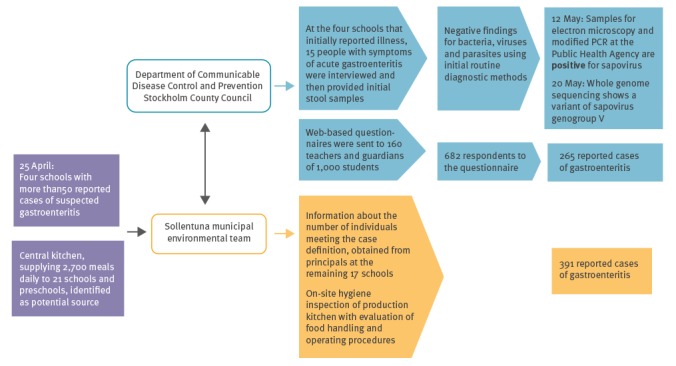
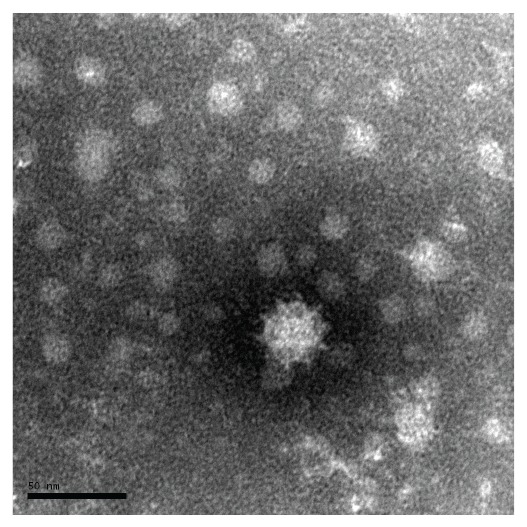
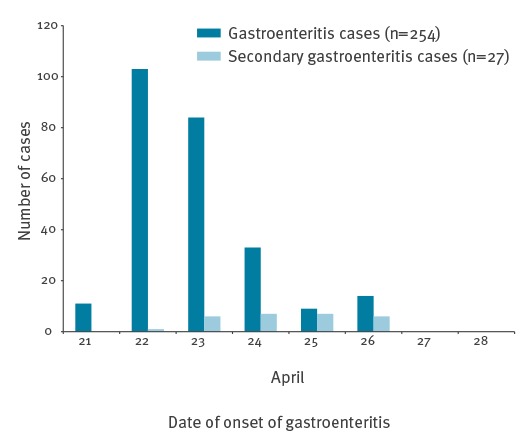
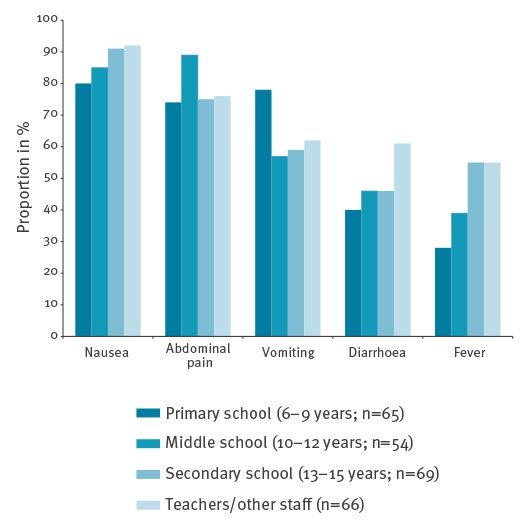
A food-borne outbreak of gastroenteritis with more than 650 suspected cases occurred in April 2016 in Sollentuna, Sweden. It originated in a school kitchen serving a total of 2,700 meals daily. Initial microbiological testing (for Campylobacter, Salmonella, Shigella, Yersinia, Giardia, Cryptosporidium, Entamoeba histolytica, adeno-, astro-, noro-, rota- and sapovirus) of stool samples from 15 symptomatic cases was negative, despite a clinical presentation suggestive of calicivirus. Analyses of the findings from both the Sollentuna municipality environmental team and a web-based questionnaire suggested that the source of the outbreak was the salad buffet served on 20 April, although no specific food item could be identified. Subsequent electron microscopic examination of stool samples followed by whole genome sequencing revealed a variant of sapovirus genogroup V. The virus was not detected using standard PCR screening. This paper describes the epidemiological outbreak investigation and findings leading to the discovery.
2016年4月,瑞典索伦特纳发生了一起食源性肠胃炎疫情,疑似病例超过650例。疫情起源于一所学校厨房,该厨房每天供应总计2700份餐食。对15例有症状病例的粪便样本进行的初步微生物检测(检测弯曲杆菌、沙门氏菌、志贺氏菌、耶尔森氏菌、贾第虫、隐孢子虫、溶组织内阿米巴、腺病毒、星状病毒、诺如病毒、轮状病毒和札幌病毒)结果均为阴性,尽管临床表现提示为杯状病毒感染。索伦特纳市环境团队的调查结果以及一份网络调查问卷分析表明,此次疫情的源头是4月20日供应的沙拉自助餐,不过无法确定具体的致病食物。随后对粪便样本进行电子显微镜检查,接着进行全基因组测序,发现了一株V型札幌病毒变异株。使用标准PCR筛查未检测到该病毒。本文描述了此次疫情的流行病学调查以及导致这一发现的结果。