Oyaneder Terrazas Javiera, Contreras Héctor R, García Carlos
Physiology and Biophysics Program, Faculty of Medicine, University of Chile, Santiago 8380000, Chile.
Department of Basic and Clinical Oncology, Faculty of Medicine, University of Chile, Santiago 8380000, Chile.
Toxins (Basel). 2017 Jun 12;9(6):190. doi: 10.3390/toxins9060190.
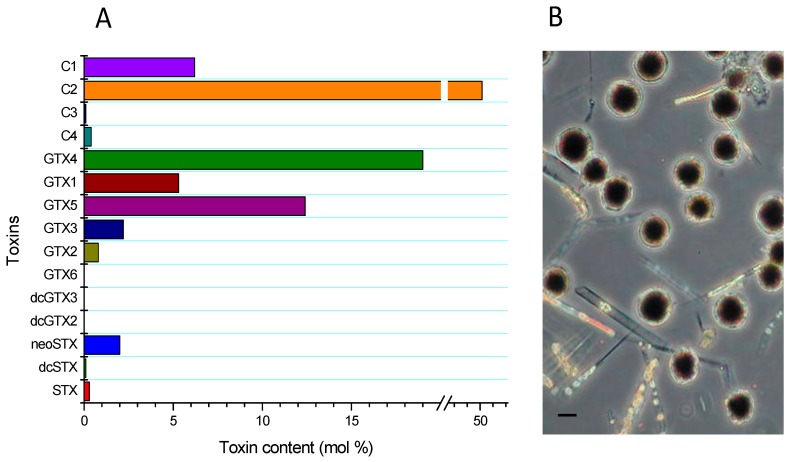
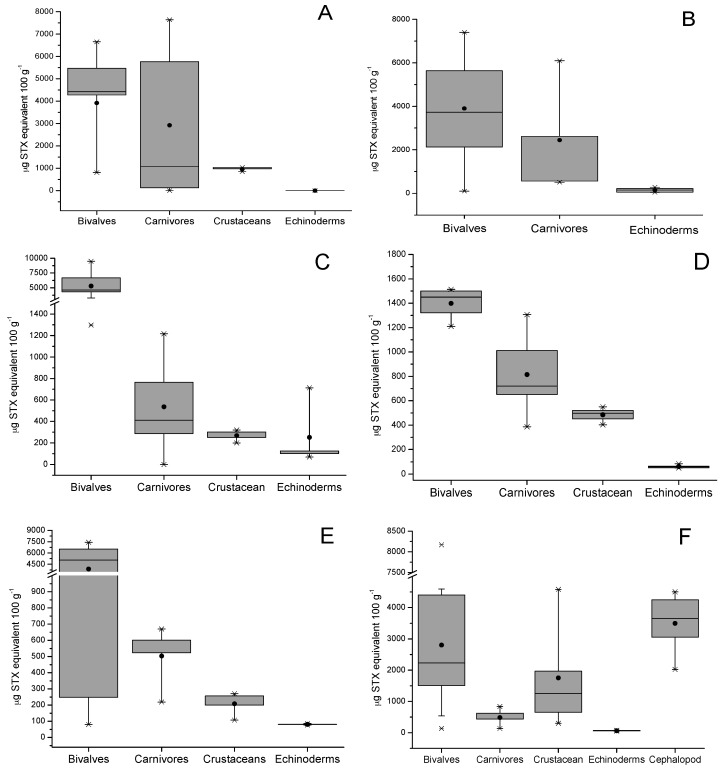
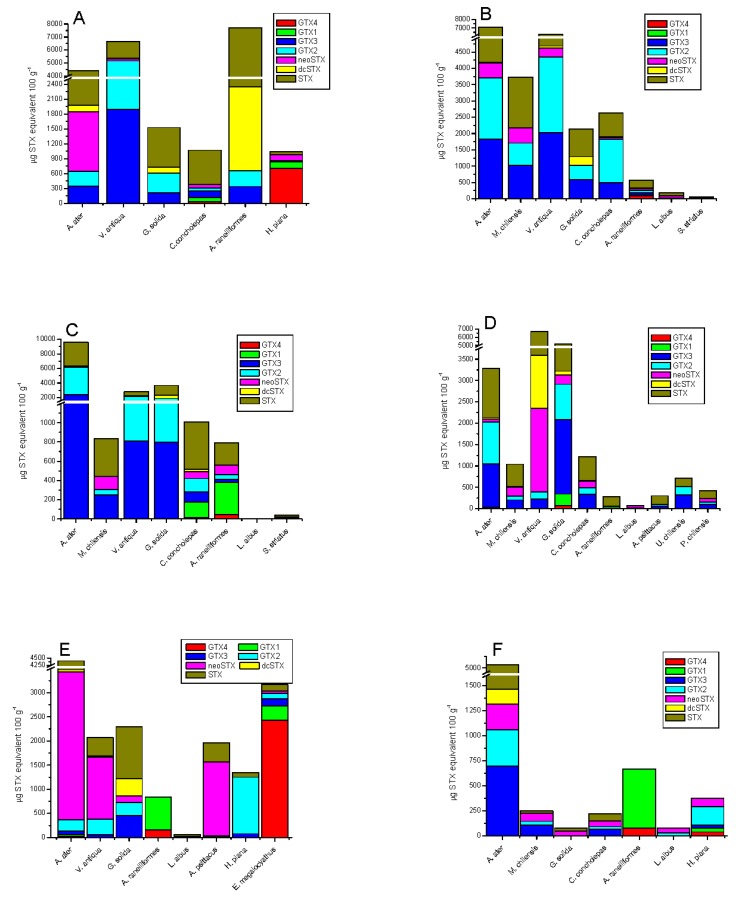
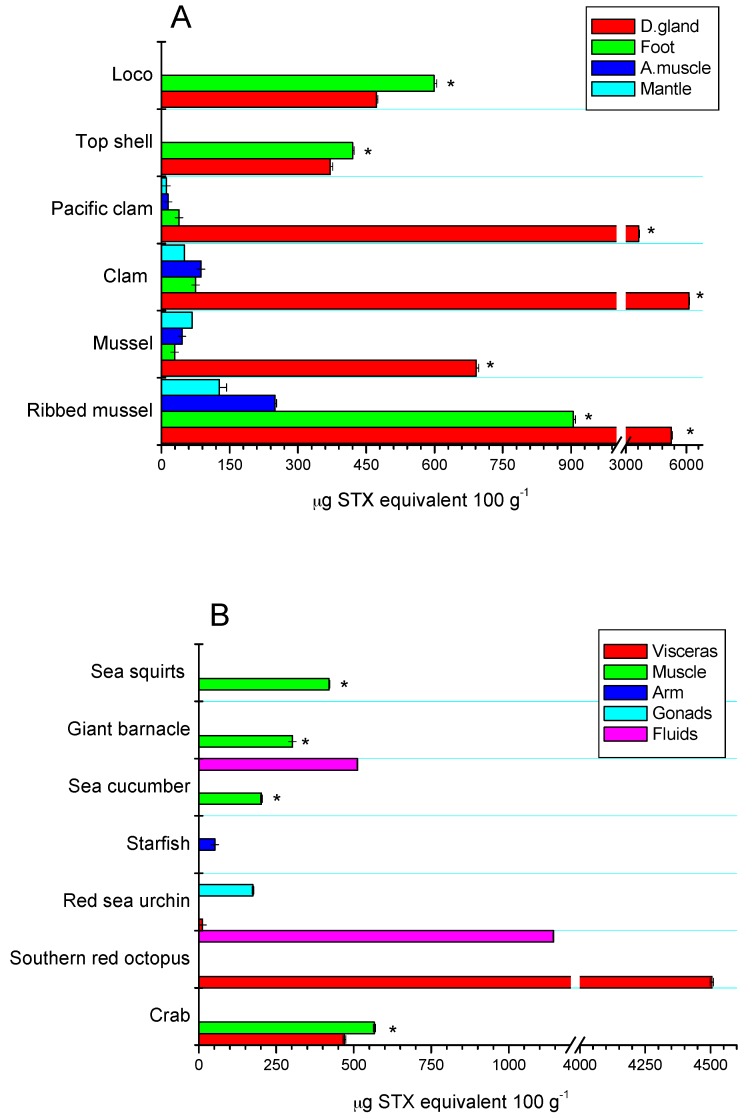
The saxitoxin-group (STX-group) corresponds to toxic metabolites produced by cyanobacteria and dinoflagellates of the genera , and . Over the last decade, it has been possible to extrapolate the areas contaminated with the STX-group worldwide, including Chile, a phenomenon that has affected ≈35% of the Southern Pacific coast territory, generating a high economic impact. The objective of this research was to study the toxicity of the STX-group in all aquatic organisms (bivalves, algae, echinoderms, crustaceans, tunicates, cephalopods, gastropods, and fish) present in areas with a variable presence of harmful algal blooms (HABs). Then, the toxic profiles of each species and dose of STX equivalents ingested by a 60 kg person from 400 g of shellfish were determined to establish the health risk assessment. The toxins with the highest prevalence detected were gonyautoxin-4/1 (GTX4/GTX1), gonyautoxin-3/2 (GTX3/GTX2), neosaxitoxin (neoSTX), decarbamoylsaxitoxin (dcSTX), and saxitoxin (STX), with average concentrations of 400, 2800, 280, 200, and 2000 µg kg respectively, a species-specific variability, dependent on the evaluated tissue, which demonstrates the biotransformation of the analogues in the trophic transfer with a predominance of α-epimers in all toxic profiles. The identification in multiple vectors, as well as in unregulated species, suggests that a risk assessment and risk management update are required; also, chemical and specific analyses for the detection of all analogues associated with the STX-group need to be established.
石房蛤毒素组(STX组)对应于蓝藻和某些属的甲藻产生的有毒代谢产物。在过去十年中,已经能够推断出全球受STX组污染的区域,包括智利,这一现象影响了南太平洋海岸约35%的领土,造成了巨大的经济影响。本研究的目的是研究STX组对有害藻华(HABs)存在情况各异的区域中所有水生生物(双壳类、藻类、棘皮动物、甲壳类、被囊动物、头足类、腹足类和鱼类)的毒性。然后,确定每种物种的毒性特征以及60公斤体重的人从400克贝类中摄入的STX当量剂量,以进行健康风险评估。检测到的最普遍的毒素是膝沟藻毒素-4/1(GTX4/GTX1)、膝沟藻毒素-3/2(GTX3/GTX2)、新石房蛤毒素(neoSTX)、脱氨甲酰基石房蛤毒素(dcSTX)和石房蛤毒素(STX),平均浓度分别为400、2800、280、200和2000微克/千克,存在物种特异性差异,取决于所评估的组织,这表明在营养转移过程中类似物的生物转化,在所有毒性特征中α-差向异构体占主导。在多种载体以及未受管制的物种中的鉴定表明,需要更新风险评估和风险管理;此外,需要建立用于检测与STX组相关的所有类似物的化学和特异性分析方法。