Spolverini A, Fuchs G, Bublik D R, Oren M
Department of Molecular Cell Biology, Weizmann Institute of Science, Rehovot, Israel.
Oncogene. 2017 Oct 19;36(42):5819-5828. doi: 10.1038/onc.2017.187. Epub 2017 Jun 12.
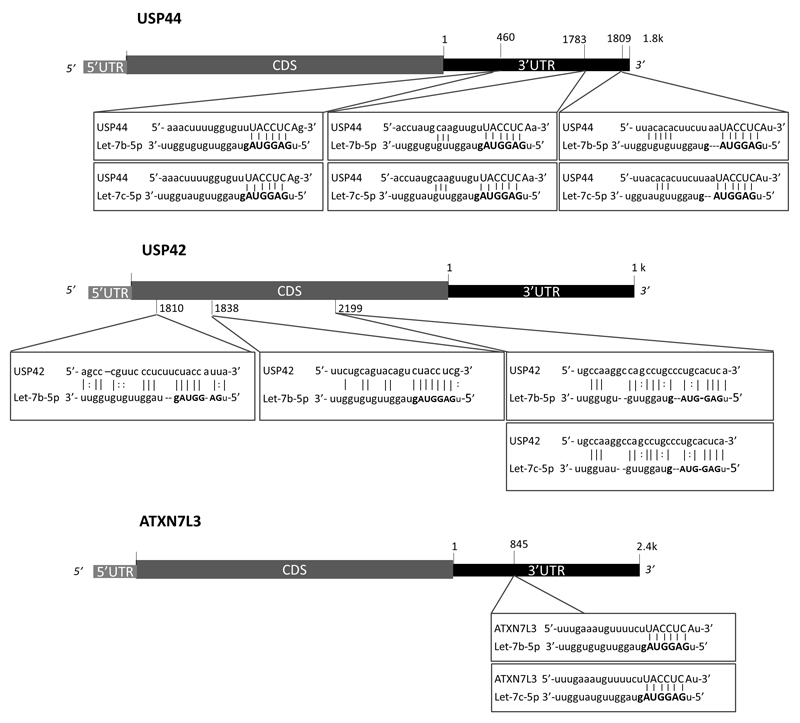
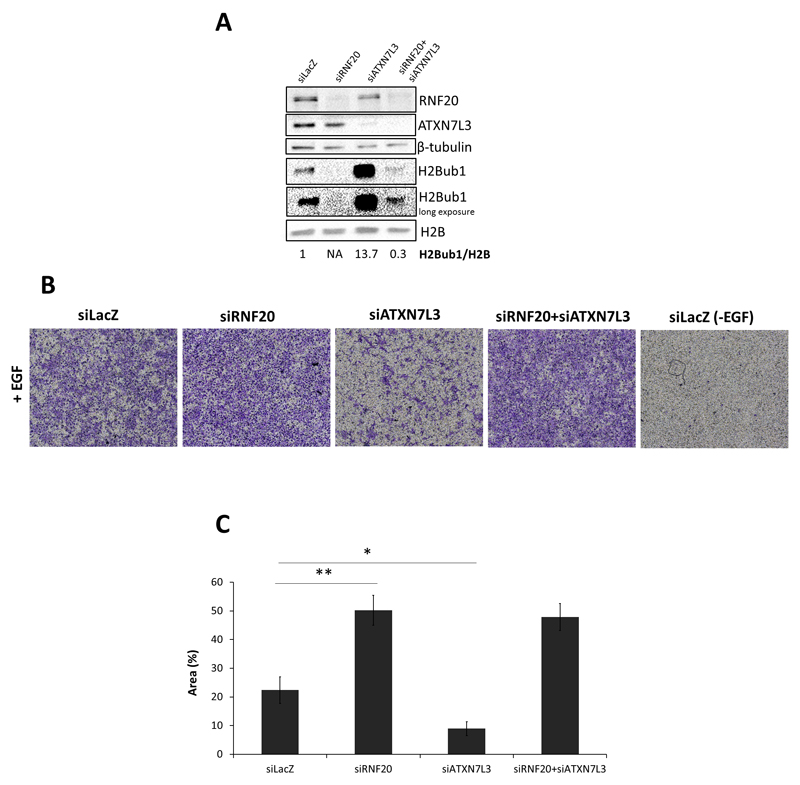
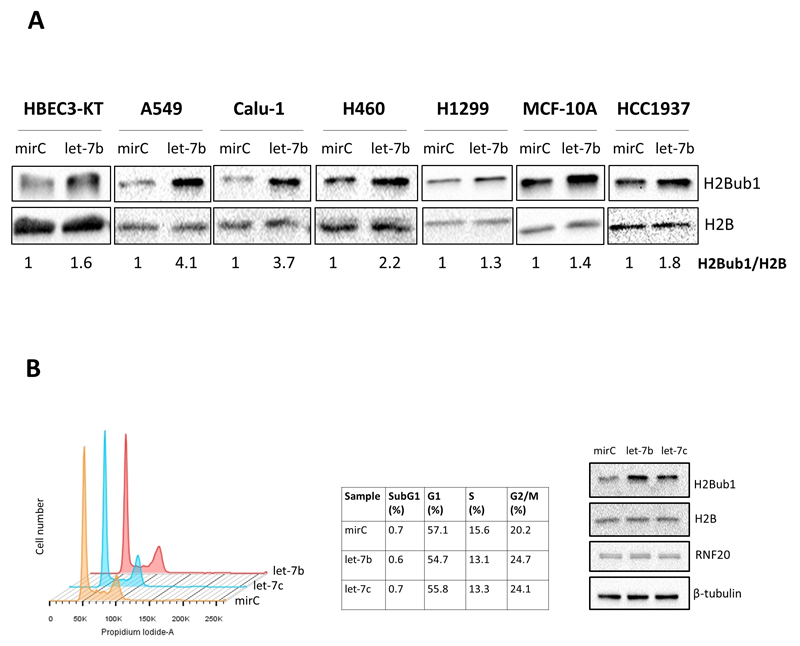
Monoubiquitylation of histone H2B (H2Bub1) is catalyzed mainly by the RNF20/RNF40 complex and erased by multiple deubiquitylating enzymes (DUBs). H2Bub1 influences many aspects of chromatin function, including transcription regulation and DNA repair. Cancer cells often display reduced levels of H2Bub1, and this reduction may contribute to cancer progression. The let-7 family of microRNAs (miRNAs) comprises multiple members with reported tumor-suppressive features, whose expression is frequently downregulated in cancer. We now report that let-7b and let-7c can positively regulate cellular H2Bub1 levels. Overexpression of let-7b and let-7c in a variety of non-transformed and cancer-derived cell lines results in H2Bub1 elevation. The positive effect of let-7b and let-7c on H2Bub1 levels is achieved through targeting of multiple mRNAs, coding for distinct components of the H2B deubiquitylation machinery. Specifically, let-7b and let-7c bind directly and inhibit the mRNAs encoding the DUBs USP42 and USP44, and also the mRNA encoding the adapter protein ATXN7L3, which is part of the DUB module of the SAGA complex. RNF20 knockdown (KD) strongly reduces H2Bub1 levels and increases the migration of non-transformed mammary epithelial cells and breast cancer-derived cells. Remarkably, overexpression of let-7b, which partly counteracts the effect of RNF20 KD on H2Bub1 levels, also reverses the pro-migratory effect of RNF20 KD. Likewise, ATXN7L3 KD also increases H2Bub1 levels and reduces cell migration, and this anti-migratory effect is abolished by simultaneous KD of RNF20. Together, our findings uncover a novel function of let-7 miRNAs as regulators of H2B ubiquitylation, suggesting an additional mechanism whereby these miRNAs can exert their tumor-suppressive effects.
组蛋白H2B的单泛素化修饰(H2Bub1)主要由RNF20/RNF40复合物催化,并被多种去泛素化酶(DUBs)去除。H2Bub1影响染色质功能的多个方面,包括转录调控和DNA修复。癌细胞中H2Bub1水平通常降低,这种降低可能促进癌症进展。let-7家族微小RNA(miRNAs)包含多个具有肿瘤抑制特性的成员,其表达在癌症中常常下调。我们现在报告,let-7b和let-7c可以正向调节细胞H2Bub1水平。在多种未转化和癌症来源的细胞系中过表达let-7b和let-7c会导致H2Bub1升高。let-7b和let-7c对H2Bub1水平的正向作用是通过靶向多个mRNA实现的,这些mRNA编码H2B去泛素化机制的不同组分。具体而言,let-7b和let-7c直接结合并抑制编码DUBs USP42和USP44的mRNA,以及编码衔接蛋白ATXN7L3的mRNA,ATXN7L3是SAGA复合物DUB模块的一部分。敲低(KD)RNF20会强烈降低H2Bub1水平,并增加未转化乳腺上皮细胞和乳腺癌来源细胞的迁移。值得注意的是,过表达let-7b部分抵消了RNF20 KD对H2Bub1水平的影响,同时也逆转了RNF20 KD的促迁移作用。同样,敲低ATXN7L3也会增加H2Bub1水平并减少细胞迁移,而RNF20的同时敲低会消除这种抗迁移作用。总之,我们的研究结果揭示了let-7 miRNAs作为H2B泛素化调节剂的新功能,提示了这些miRNAs发挥其肿瘤抑制作用的另一种机制。