Department of Microbiology, Cornell University, Ithaca, NY 14853-8101, USA.
Metallomics. 2017 Jul 19;9(7):840-851. doi: 10.1039/c7mt00112f.
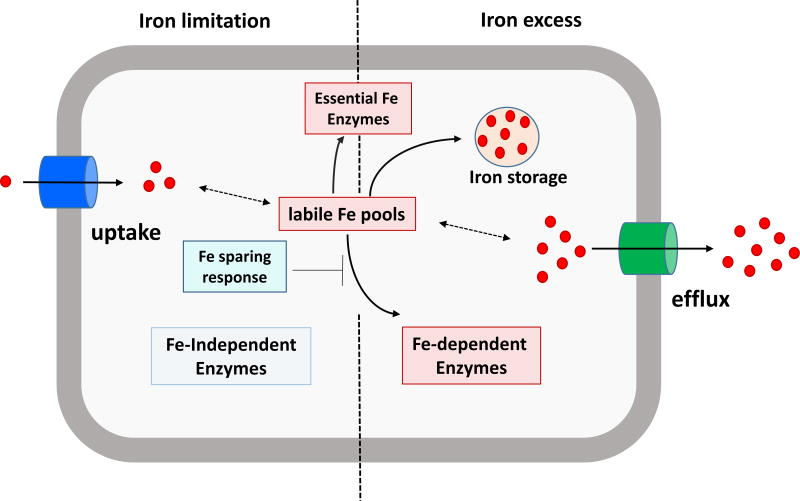
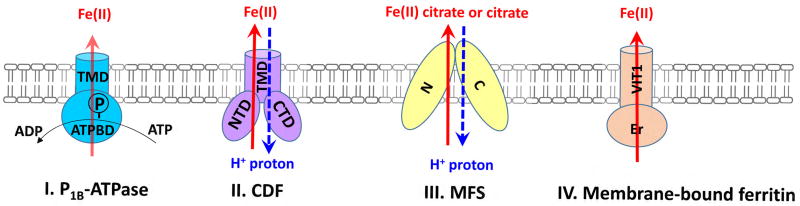
Bacteria require iron for growth, with only a few reported exceptions. In many environments, iron is a limiting nutrient for growth and high affinity uptake systems play a central role in iron homeostasis. However, iron can also be detrimental to cells when it is present in excess, particularly under aerobic conditions where its participation in Fenton chemistry generates highly reactive hydroxyl radicals. Recent results have revealed a critical role for iron efflux transporters in protecting bacteria from iron intoxication. Systems that efflux iron are widely distributed amongst bacteria and fall into several categories: P-type ATPases, cation diffusion facilitator (CDF) proteins, major facilitator superfamily (MFS) proteins, and membrane bound ferritin-like proteins. Here, we review the emerging role of iron export in both iron homeostasis and as part of the adaptive response to oxidative stress.
细菌的生长需要铁,只有少数报道的例外。在许多环境中,铁是生长的限制营养物质,而高亲和力摄取系统在铁稳态中起着核心作用。然而,当铁过量存在时,它也会对细胞造成损害,特别是在有氧条件下,铁参与芬顿化学产生高反应性的羟基自由基。最近的结果表明,铁外排转运蛋白在保护细菌免受铁中毒方面起着关键作用。铁外排系统在细菌中广泛分布,并分为几类:P 型 ATP 酶、阳离子扩散促进剂 (CDF) 蛋白、主要易化因子超家族 (MFS) 蛋白和膜结合的类铁蛋白。在这里,我们综述了铁外排在铁稳态和作为适应氧化应激反应的一部分的新兴作用。