Almasian Kia Abdollah, Rezapour Aziz, Khosravi Ardeshir, Afzali Abarghouei Vajiheh
Department of Health Economics, School of Health Management and Information Sciences, Iran University of Medical Sciences, Tehran, Iran.
J Prev Med Public Health. 2017;50(3):201-209. doi: 10.3961/jpmph.17.028.
The aim of this study was to assess the socioeconomic inequality in malnutrition in under-5 children in Iran in order to help policymakers reduce such inequality.
Data on 8443 under-5 children were extracted from the Iran Multiple Indicator Demographic and Health Survey. The wealth index was used as proxy for socioeconomic status. Socioeconomic inequality in stunting, underweight, and wasting was calculated using the concentration index. The concentration index was calculated for the whole sample, as well as for subcategories defined in terms of categories such as area of residence (urban and rural) and the sex of children.
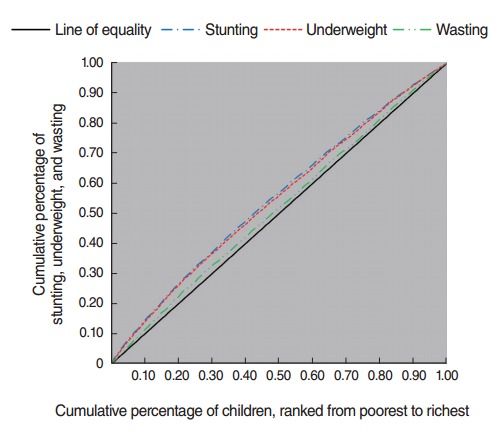
Stunting was observed to be more prevalent than underweight or wasting. The results of the concentration index at the national level, as well as in rural and urban areas and in terms of children's sex, showed that inequality in stunting and underweight was statistically significant and that children in the lower quintiles were more malnourished. The wasting index was not sensitive to socioeconomic status, and its concentration index value was not statistically significant.
This study showed that it can be misleading to assess the mean levels of malnutrition at the national level without knowledge of the distribution of malnutrition among socioeconomic groups. Significant socioeconomic inequalities in stunting and underweight were observed at the national level and in both urban and rural areas. Regarding the influence of nutrition on the health and economic well-being of preschool-aged children, it is necessary for the government to focus on taking targeted measures to reduce malnutrition and to focus on poorer groups within society who bear a greater burden of malnutrition.
本研究旨在评估伊朗5岁以下儿童营养不良方面的社会经济不平等状况,以帮助政策制定者减少此类不平等。
从伊朗多指标人口与健康调查中提取了8443名5岁以下儿童的数据。财富指数被用作社会经济地位的代理指标。使用集中指数计算发育迟缓、体重不足和消瘦方面的社会经济不平等。计算了整个样本以及按居住地区(城市和农村)和儿童性别等类别定义的子类别中的集中指数。
观察到发育迟缓比体重不足或消瘦更为普遍。国家层面以及农村和城市地区以及按儿童性别的集中指数结果表明,发育迟缓和体重不足方面的不平等具有统计学意义,且处于较低五分位数的儿童营养不良情况更严重。消瘦指数对社会经济地位不敏感,其集中指数值无统计学意义。
本研究表明,在不了解社会经济群体中营养不良分布情况的前提下评估国家层面的营养不良平均水平可能会产生误导。在国家层面以及城市和农村地区均观察到发育迟缓和体重不足方面存在显著的社会经济不平等。鉴于营养对学龄前儿童健康和经济福祉的影响,政府有必要集中精力采取针对性措施减少营养不良,并关注社会中承担更大营养不良负担的较贫困群体。