International Institute for Population Sciences, Deonar, Mumbai, India.
PLoS One. 2013 May 29;8(5):e64972. doi: 10.1371/journal.pone.0064972. Print 2013.
Despite the growing evidence from other developing countries, intra-urban inequality in childhood undernutrition is poorly researched in India. Additionally, the factors contributing to the poor/non-poor gap in childhood undernutrition have not been explored. This study aims to quantify the contribution of factors that explain the poor/non-poor gap in underweight, stunting, and wasting among children aged less than five years in urban India.
We used cross-sectional data from the third round of the National Family Health Survey conducted during 2005-06. Descriptive statistics were used to understand the gap in childhood undernutrition between the urban poor and non-poor, and across the selected covariates. Blinder-Oaxaca decomposition technique was used to explain the factors contributing to the average gap in undernutrition between poor and non-poor children in urban India.
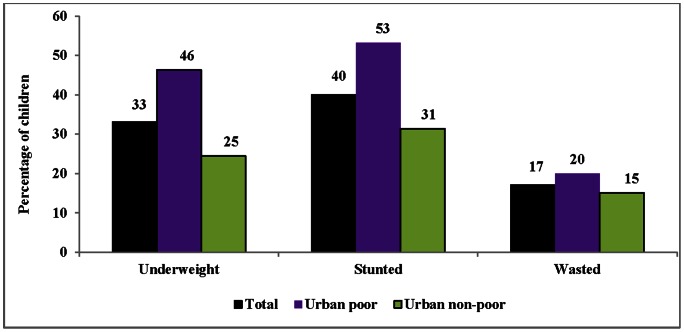
Considerable proportions of urban children were found to be underweight (33%), stunted (40%), and wasted (17%) in 2005-06. The undernutrition gap between the poor and non-poor was stark in urban India. For all the three indicators, the main contributing factors were underutilization of health care services, poor body mass index of the mothers, and lower level of parental education among those living in poverty.
The findings indicate that children belonging to poor households are undernourished due to limited use of health care services, poor health of mothers, and poor educational status of their parents. Based on the findings the study suggests that improving the public services such as basic health care and the education level of the mothers among urban poor can ameliorate the negative impact of poverty on childhood undernutrition.
尽管其他发展中国家的证据不断增加,但印度对城市内儿童营养不足的不平等问题研究甚少。此外,导致贫困/非贫困儿童营养不足差距的因素尚未得到探讨。本研究旨在定量分析解释印度城市地区五岁以下儿童消瘦、发育迟缓、消瘦的贫困/非贫困差距的因素。
我们使用了 2005-06 年进行的第三次国家家庭健康调查的横断面数据。描述性统计数据用于了解印度城市地区贫困和非贫困儿童在儿童营养不足方面的差距,并了解选定协变量的差距。使用 Blinder-Oaxaca 分解技术来解释导致印度城市地区贫困和非贫困儿童营养不足平均差距的因素。
2005-06 年,相当比例的城市儿童体重不足(33%)、发育迟缓(40%)和消瘦(17%)。印度城市地区贫困和非贫困之间的营养不足差距很大。对于所有三个指标,主要的贡献因素是卫生保健服务利用率低、母亲的身体质量指数低以及贫困家庭中父母的教育水平低。
研究结果表明,贫困家庭的儿童由于卫生保健服务利用有限、母亲健康状况不佳以及父母教育程度低而营养不良。根据研究结果,建议改善公共服务,如基本医疗保健和贫困家庭母亲的教育水平,可以减轻贫困对儿童营养不足的负面影响。